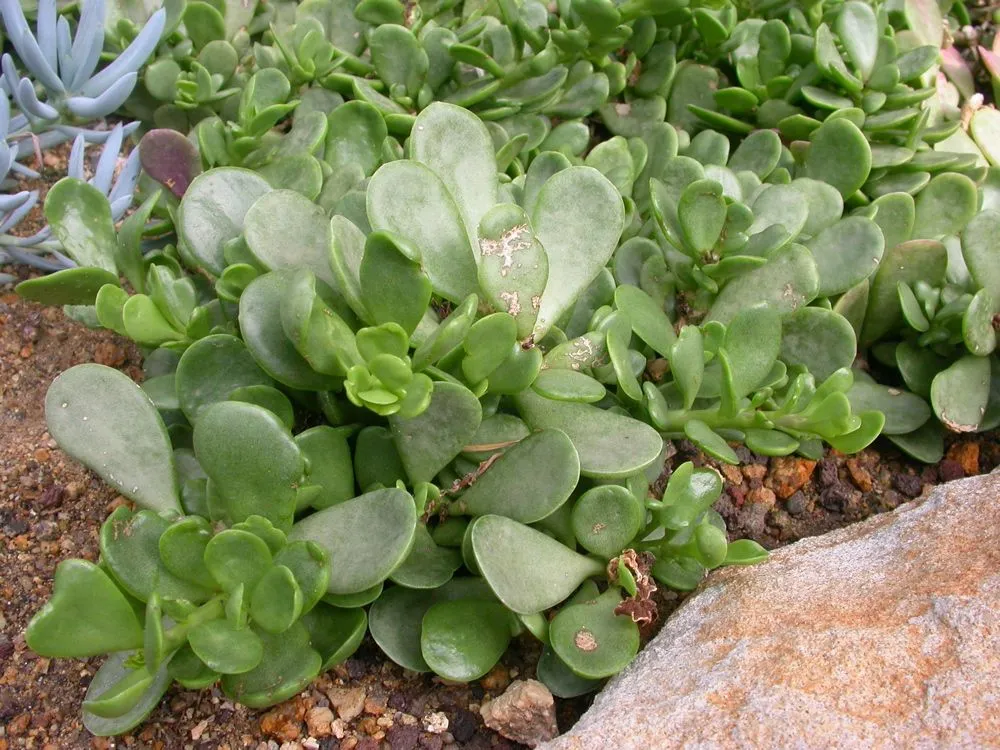
Mealybugs are the most common insect pest on cultivated Senecio and Curio succulents, and they are well-adapted to the specific architecture of these plants. The tangled strands of Curio rowleyanus (string of pearls), the dense white felt of Senecio haworthii (cocoon plant), and the sheltered leaf axils of upright Curio species all provide the dark, humid hiding places that mealybugs exploit. The pest can be present at low levels for several weeks before visible damage appears. By the time pearls are yellowing or falling without an obvious watering explanation, the population may already be several generations old.
Early detection and immediate isolation are the two most important factors in a successful outcome. Part of the Complete Senecio Guide.
How mealybugs damage Senecio and Curio
Mealybugs are small, soft-bodied insects in the family Pseudococcidae. The female, which does the feeding damage, is 3–5 mm long, oval, and covered in white waxy secretions that give her a cottony appearance. The short-lived, winged males are rarely seen. Females congregate in protected sites — leaf axils, strand tangles, root junctions — and feed by inserting stylet mouthparts into plant tissue and extracting phloem sap.
The damage in Senecio and Curio is twofold. Direct sap extraction weakens the plant — in heavily infested string of pearls, the phloem of the trailing strands is tapped at multiple points, reducing turgor and nutrient supply to the pearls. Pearls shrivel or yellow despite normal watering conditions. Second, the honeydew excreted by feeding mealybugs coats lower leaves and the surface beneath the pot, promoting sooty mould and attracting ants that actively protect mealybug colonies from predators.
A third problem specific to this genus is the difficulty of fully inspecting strand tangles. A mature string of pearls in a hanging basket creates hundreds of sheltered intersections where strands cross — each a potential refuge. A visible cottony tuft is diagnostic, but the absence of visible tufts does not rule out an infestation. The most reliable inspection technique is to direct a torch from below the basket to backlight the tangles, making white cottony masses visible even deep inside the plant.
Above-ground mealybug — identification
Above-ground Pseudococcus and Planococcus species are the most common form. Signs of above-ground mealybug on Senecio and Curio:
- White cottony tufts at leaf axils, at points where strands cross or overlap, or at the stem-to-soil junction.
- White waxy powder or flocculent residue on stem surfaces, particularly in sheltered angles and joints.
- Yellowing, shrivelling, or premature pearl or leaf drop without an obvious watering cause — this symptom is also caused by senecio root rot, so confirm pest presence before treating for water issues.
- Sticky honeydew residue on the pot surface, lower leaves, or the surface below the hanging basket.
- Ants actively patrolling the stem or soil surface — a reliable indicator of honeydew-producing insect activity.
A low-level infestation may show only one of these signs. An established infestation typically shows three or more. Treatment is easier and more effective the earlier it begins — a plant with 10 visible mealybugs is manageable; one with hundreds in every axil is significantly more difficult.
Root mealybug — the hidden infestation
Root mealybug (Rhizoecus species) is the most damaging form because it is entirely invisible without unpotting. These insects colonise the root zone, feeding at root tips and root junctions, and covering themselves and the root surface with white waxy residue. Affected roots may appear nearly normal except for the wax — they are not necessarily black as in root rot.
Signs that suggest root mealybug rather than above-ground infestation:
- Slow overall decline over weeks or months with no obvious watering error.
- Yellowing or shrivelling pearls that does not respond to correct watering adjustments.
- No visible cottony tufts on thorough above-ground inspection.
- The plant looks progressively less healthy despite standard care.
Confirm by unpotting. Remove all substrate from the root ball and examine roots and the substrate itself. Root mealybug wax appears as small white cottony or crystalline deposits on the roots and in the soil particles. The insects themselves — white, elongated, 1–2 mm — are visible when the root ball is gently separated. For the full root inspection and identification process see root mealybug identification.
Identifying the infestation type
| Sign | Location | Type |
|---|---|---|
| White cottony tufts | Leaf axils, strand crossings | Above-ground mealybug |
| White waxy powder | Stem surfaces, sheltered joints | Above-ground mealybug |
| Sticky residue, ants present | Below plant, on lower leaves | Above-ground mealybug (honeydew) |
| White crystalline deposits | Root surface, substrate particles | Root mealybug |
| Decline without above-ground signs | No visible tufts or residue | Root mealybug (confirm by unpotting) |
Risk and severity
Above-ground mealybug at early stages is relatively low risk and responds well to manual alcohol treatment. At later stages, with population spread through the full strand tangle and into the stem base, treatment is more labour-intensive and the plant may not recover its original density. Root mealybug at any stage is medium-to-high risk because it impairs water and nutrient uptake in ways that mimic both overwatering and drought, leading to misdiagnosis and ineffective responses.
Any plant confirmed or suspected to have mealybug must be isolated from other plants immediately. First-instar nymphs — the crawlers — are mobile and can walk to neighbouring plants or drop and travel across a windowsill surface. A mealybug infestation discovered on a plant that has been touching others should prompt inspection of all nearby plants.
Treatment — step by step
Above-ground mealybug
- Isolate the plant immediately from all other plants. Place on a separate surface or in a separate room.
- Inspect the full plant under good lighting with a magnifying glass. Examine every leaf axil, strand crossing, and the soil surface junction.
- Dip a cotton swab in 70% isopropyl alcohol and press it directly onto each visible mealybug and cottony mass. The alcohol dissolves the waxy coating and kills the insect on contact. Do not spray alcohol broadly — targeted application avoids stressing plant tissue.
- For accessible strands, wipe the full length of each strand with a separate alcohol-dampened swab to remove eggs and crawlers too small to see individually.
- Repeat the full inspection and treatment every 7 days for four consecutive weeks. Eggs are resistant to alcohol — the repeat treatments target crawlers that hatch in the intervals between sessions.
- After four treatments with no new mealybugs visible, continue bi-monthly inspection for a further three months.
For the full cross-genus treatment protocol and identification of specific mealybug species, see mealybug identification.
Root mealybug
- Unpot the plant and remove all substrate from the root ball under running water.
- Examine roots carefully. Trim away any dead or heavily infested root sections.
- Prepare a neem oil solution: 5 ml neem oil per litre of water with 1 ml of mild dish soap to emulsify. Submerge the root ball in this solution for 10 minutes.
- Allow the root ball to air-dry in shade for 24 hours.
- Repot in fresh mineral mix in a clean pot that has been sterilised with a dilute bleach solution (1 part bleach to 9 parts water) and rinsed thoroughly. Do not reuse the old substrate.
- Water lightly after 7 days. Monitor carefully for a full growing season.
Prevention
Quarantine all new plants for at least two weeks before placing them near your collection — this is the single most effective prevention. Inspect any purchased plant under bright light before bringing it indoors. Maintain adequate air circulation around plants: still, warm, humid air is the environment mealybugs prefer. Avoid placing multiple plants so close together that their strands and stems touch, as this provides a direct bridge for crawlers. A monthly inspection routine — 5 minutes per plant with a torch and magnifying glass — catches infestations before they become serious. This discipline matters especially for string of pearls dying diagnoses, where mealybug is frequently overlooked in favour of more obvious watering explanations.
See also
- Mealybug identification — identification and treatment across all succulent genera.
- Root mealybug identification — identifying and treating root-zone infestations that show no above-ground signs.
- String of pearls dying — the full diagnostic guide to Curio rowleyanus decline, including mealybug as a cause.
Frequently Asked Questions
Why do my string of pearls keep getting mealybugs?
String of pearls strand tangles create sheltered, lightly humid microclimates that mealybugs prefer. Warm indoor temperatures, proximity to infested plants, and skipping monthly inspection all increase infestation frequency. A strict 2-week quarantine for all new plants before placing near your collection is the most effective long-term control.
What does mealybug damage look like on Senecio?
Yellowing or shrivelling pearls on an otherwise normally watered plant, white cottony residue in strand tangles or leaf axils, sticky honeydew on lower leaves or the surface below the pot, and ants on or near the plant. Slow overall decline without an obvious watering cause is the classic early sign of an established infestation.
Does neem oil work on mealybugs?
Neem oil (azadirachtin) disrupts mealybug feeding and reproduction but does not kill on contact as effectively as isopropyl alcohol. Use neem as a follow-up preventive spray after manual removal, or as a root drench for root mealybug. Do not rely on neem oil alone as the primary treatment for an established above-ground infestation.
How do I treat root mealybug on string of pearls?
Unpot the plant and wash all substrate from the root ball under running water. Inspect roots for white waxy residue or small white crawlers. Soak the root ball in a dilute neem oil solution — 5 ml per litre of water with 1 ml of mild soap to emulsify — for 10 minutes. Allow to air-dry in shade for 24 hours. Repot in fresh mineral mix in a clean, sterilised pot.