| Question | Short Answer |
|---|---|
| Is Senecio mikanioides a succulent? | No. |
| What is the current name for Senecio mikanioides? | The post gives Delairea odorata as the current name, in a monotypic genus outside Senecio. |
| Is German ivy invasive? | Yes. |
| How is German ivy different from wax ivy? | German ivy has thinner, less waxy leaves and a more aggressive climbing rate. |
Delairea odorata Lem., formerly Senecio mikanioides Otto ex Walp., is German ivy or Cape ivy. It is a climbing evergreen vine, not a true succulent, and it has been moved out of Senecio entirely into its own monotypic genus Delairea under current taxonomy. Nursery and online listings still use the old name widely.
This page exists to disambiguate: shoppers sometimes arrive looking for care information on a "succulent senecio mikanioides", but the plant is not succulent in any useful horticultural sense. Part of the Complete Senecio Guide.
What the plant actually is
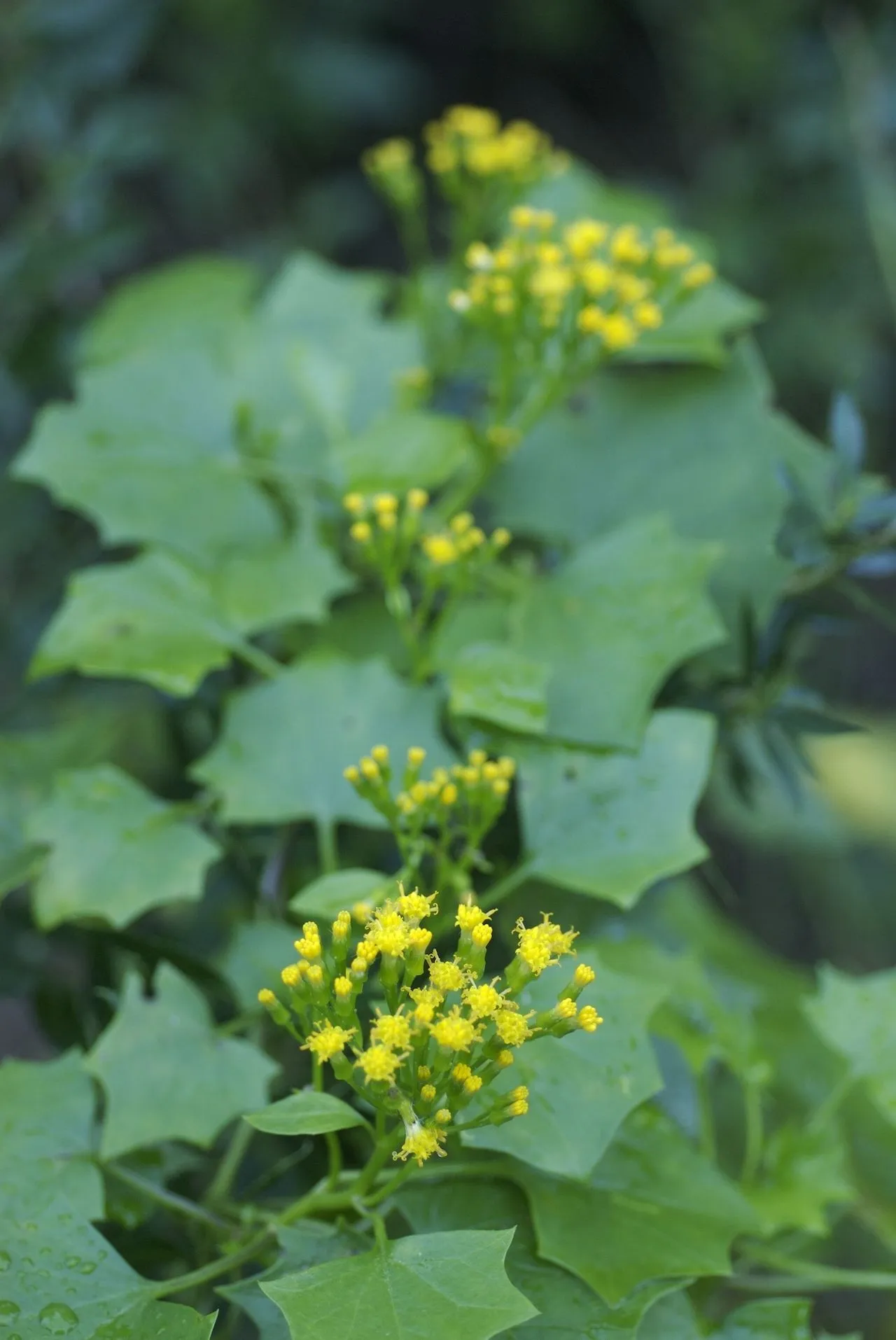
- Twining climber with slender green stems, growing to 4 m or more.
- Leaves ivy-shaped, thin and mildly fleshy, 4–8 cm across, with 5–7 shallow pointed lobes.
- Flower heads small, yellow, in dense panicles at the shoot tips; strongly fragrant in late winter, which gives the Latin epithet odorata.
- Latex-exuding from broken stems.
Native to the Western Cape of South Africa, in forest margins and stream sides. Widely naturalised outside its native range and listed as a serious invasive weed along the west coast of the United States, in parts of Australia, and in Mediterranean Europe.
Distinguished from Senecio macroglossus (wax ivy) by thinner, less waxy, and less fleshy leaves, and by a far more aggressive climbing rate. Distinguished from Senecio angulatus (Cape ivy) by leaf shape: D. odorata has the full 5–7 lobes of an ivy leaf, S. angulatus has a simpler hastate (arrow) leaf.
Why this is not really a succulent
The leaves contain only incidental water-storage tissue. The plant tolerates brief drought because of its climbing habit and taproot, not because of leaf or stem succulence. A care regime drawn from the Complete Senecio Guide, with its gritty mineral substrate and sparing watering, will starve this plant within a season.
Brief care
- Full sun to bright partial shade.
- Ordinary loam-based compost; no special drainage requirements beyond avoiding waterlogging.
- Weekly watering in active growth; let the top 2 cm dry between waterings.
- Prune hard to control spread. Cut to any node; regrowth is rapid.
- Frost-sensitive; protect below 0 °C.
Invasive status
In California, Oregon, Hawaii, south-eastern Australia, New Zealand, and parts of Spain and Portugal, Delairea odorata is a listed invasive weed. Escaped garden specimens smother native vegetation, particularly in riparian corridors and coastal scrub. If you grow it in or near one of these regions, keep it contained, do not dispose of prunings outdoors, and consider alternatives such as non-invasive Senecio macroglossus 'Variegatus' for decorative climbing use.
Notes
Toxic to livestock and mildly toxic to pets. The pyrrolizidine alkaloid content is higher than in most cultivated succulent Senecio.
If you were expecting a succulent Senecio, see the main Complete Senecio Guide for the true succulents in the genus and its relatives.
See also
- Senecio macroglossus — the tamer climbing relative, still not truly succulent but widely grown as a houseplant.
- Senecio angulatus — Cape ivy, the arrow-leaved climbing sibling.
- Senecio vulgaris — common groundsel, another non-succulent Senecio relative.
Frequently Asked Questions
Is Senecio mikanioides a succulent?
No. It has only incidental water storage and is better understood as a climbing vine.
What is the current name for Senecio mikanioides?
The post gives Delairea odorata as the current name, in a monotypic genus outside Senecio.
Is German ivy invasive?
Yes. It is listed as invasive in California, Oregon, Hawaii, south-eastern Australia, New Zealand, and parts of Spain and Portugal.
How is German ivy different from wax ivy?
German ivy has thinner, less waxy leaves and a more aggressive climbing rate. Senecio macroglossus is fleshier and tamer.