Senecio is one of the largest flowering-plant genera on Earth, with well over 1,000 accepted species distributed on every continent except Antarctica. A small but horticulturally disproportionate slice of that diversity is succulent, and it is this slice that fills nursery shelves as string-of-pearls, blue chalksticks, pickle plant, and a crowd of other oddities. Almost all of those popular succulent "Senecios" have, in the last two decades, been formally transferred out of Senecio into the segregate genus Curio. The World Checklist of Vascular Plants maintained by the Royal Botanic Gardens, Kew now lists string-of-pearls as Curio rowleyanus (syn. Senecio rowleyanus), and treats most of the other familiar succulents the same way. The family placement has not changed: both Senecio and Curio sit in Asteraceae, the daisy family. That makes these plants composite-flower succulents, which is genuinely unusual. If you bought yours labelled "senecio", you were not misled; the trade is simply slower than the taxonomy.
I'm Dr. Elena Martín, a Certified Advanced Cactus & Succulent Horticulturist and former curator of the succulent collection at the Jardín Botánico de Córdoba. This guide covers what to know to grow these plants well, and where the Senecio / Curio split matters for practical care.
Taxonomy and Natural Range
The genus Senecio L. was described by Linnaeus in 1753 and became a catch-all for an enormous range of composite-flowered plants, succulent and otherwise. Over the twentieth century it accumulated species that clearly did not belong together, and molecular work by Bertil Nordenstam and later Pieter Pelser and colleagues (2007 onwards) confirmed what morphologists had long suspected: many of the succulent groups are more closely related to other Senecioneae lineages than to Senecio proper. The resulting segregation moved most succulent species into Curio P.V.Heath (1997), with others going to Kleinia Mill. and a few minor genera.
Which name goes where matters for practical reasons. Curio species share a compact set of cultivation needs; species still in Senecio sensu stricto (such as S. articulatus and S. vulgaris) differ in growth habit and habitat. Throughout this guide I give the current name first and the older name in synonym where relevant.
The succulent members of the group are overwhelmingly southern African. Centres of diversity sit in the Western Cape, Eastern Cape, and Karoo regions of South Africa, with extensions into Namibia, Botswana, and eastern Africa. A smaller number of species reach the Arabian Peninsula, the Canary Islands, and India. Natural habitats are typically semi-arid, with winter rainfall and dry summers in the Cape populations, and summer rainfall further north. That seasonal rhythm is worth knowing: many Cape Curio are winter-growing and summer-dormant, the opposite of most houseplants.
Identification and Morphology
Succulent Senecio and Curio are morphologically remarkable for how little they look like one another. Leaf form ranges from perfect spheres (Curio rowleyanus) through bananas (C. radicans), cylinders (C. mandraliscae), pickles (Senecio stapeliiformis), dolphins (Curio × peregrinus), and flat discs (S. kleiniiformis) to conventional strap-shaped leaves. This variability makes leaf shape useless as a genus-level diagnostic.
What unites them is the flower. Every species in the group produces the classic Asteraceae capitulum: a composite head of small florets, often ray and disc, surrounded by a ring of involucral bracts. In succulent species the capitulum is usually small, white, yellow, or cream, and carries a strong cinnamon-sweet scent. When a fleshy succulent produces something that looks like a tiny daisy, you are almost certainly looking at a Senecio or Curio; no other common succulent genus has this flower type. That single character separates them from every Crassula, Echeveria, Haworthia, and Kalanchoe on the shelf.
Other useful characters:
- Latex. Many species exude a thin white or cloudy latex from broken stems. This is diagnostic versus the genera it is most often confused with.
- Stems. Fleshy, often trailing or decumbent in Curio; erect and segmented in Senecio articulatus; woody and shrubby in S. barbertonicus.
- Leaf windows. Some bead-leaved species (C. rowleyanus, C. herreianus) have a thin translucent stripe along each leaf. This is a true epidermal window that admits light to internal chlorophyll; do not mistake it for damage.
Cultivation
Light
Bright light is essential. Most succulent species want 4–6 hours of direct sun per day or the equivalent in strong indirect light. A south-facing window (northern hemisphere) or a bright patio is typical. The silver-leaved and farina-dusted species (S. candicans, S. haworthii, C. mandraliscae) tolerate full outdoor sun; bead-leaved trailing types (C. rowleyanus, C. radicans) prefer bright dappled light and will scorch in afternoon summer sun behind glass.
Under-lit plants etiolate in predictable ways. Trailing Curio lose leaf turgor and the beads space out along the stem; upright species like S. crassissimus lean toward the light source and produce pale, widely-spaced leaves. Move the plant closer to the light early; severe etiolation is only corrected by cutting and re-rooting.
Substrate
A free-draining mineral-heavy mix is non-negotiable. My standard for the group is 50% pumice or perlite, 25% coarse horticultural grit (3–5 mm), and 25% peat-free loam-based compost such as John Innes No. 2. Aim for a medium that dries completely within 3–5 days after a thorough watering. Commercial "cactus mix" is usually too peat-rich and needs 50% extra mineral amendment for these plants.
pH preference sits slightly acidic to neutral, around 6.0–7.0. Shallow wide pots suit trailing Curio species, whose root systems are genuinely shallow; deeper containers hold too much moisture at depth and rot the base.
Water
Over-watering is the single largest cause of death in this group, and trailing bead-leaved species are the most sensitive of all. Curio rowleyanus will collapse within 48 hours of saturated substrate. The mechanism is simple: the fleshy leaves and stems are already at maximum turgor for the ambient conditions, so additional water travels to the roots, displaces oxygen in the substrate, and creates anaerobic conditions that invite Fusarium and Pythium.
Water when the top 2–3 cm of substrate reads below 15% on a moisture probe. Water thoroughly until it exits the drainage holes, then let the medium dry out completely before the next application. Indoor frequency runs roughly once every 10–14 days in active growth and once every 4–6 weeks during winter rest for summer-growing species; Cape winter-growers reverse that cycle.
Never let water sit on the rosette of S. haworthii or in the axils of S. stapeliiformis; both are prone to rot from pooled water.
Temperature
Most cultivated species tolerate 5°C to 32°C. Below 5°C growth stops; below −2°C unprotected tissue freezes and collapses. Curio mandraliscae and C. serpens are the hardiest of the common succulent species and survive brief −4°C events if dry. At the warm end, sustained temperatures above 35°C trigger summer dormancy in Cape winter-growers; reduce water further during this period rather than increasing it.
Humidity
Ambient humidity between 30% and 50% suits the whole group. Higher humidity combined with still air is the main trigger for powdery mildew and fungal rot on bead-leaved species. Move plants to a ventilated location rather than reaching for a fungicide.
Propagation
Stem cuttings are the standard method across the group and succeed at near 100% with almost no equipment. Leaf propagation, which works well for Echeveria and many Sedum, largely fails here; a detached Curio bead or leaf may form a callus but rarely develops roots and a new growing point.
Stem cuttings
Cut a 5–10 cm section of healthy stem with sterile secateurs. For bead-leaved species (C. rowleyanus, C. radicans, C. × peregrinus) take a longer piece, 15–20 cm, and remove the lowest three or four leaves. Let the cut surface callus for 2–5 days in shade. Lay the cutting on lightly damp substrate or, for trailing species, coil it on the surface of the pot and pin it with a hairpin or wire staple; roots form from the nodes in 2–3 weeks.
S. stapeliiformis and S. articulatus root just as readily from upright cuttings stuck 2 cm into dry substrate.
Division
Clumping species such as S. barbertonicus and C. mandraliscae can be lifted and divided at the root crown in spring. Each division needs at least one growing stem and a handful of attached roots.
Seed
Rarely worthwhile. Senecio / Curio seed is short-viable, and many cultivated forms are hybrids that do not come true. Stem propagation is faster and genetically stable.
For a worked trailing-cutting example see Senecio rowleyanus.
Pruning and Maintenance
Trailing Curio benefit from routine tip pinching. Pinching the growing tip of each string every few months forces branching from lower nodes and thickens the overall display; otherwise the plant grows a few long sparse strands. Any removed tips can be rooted as cuttings.
Upright species need minimal pruning. Remove dead or desiccated stems at the base with sterile secateurs. Spent flower stalks should be cut off once bloom finishes; the capitulum draws significant resources, and leaving dead heads in place invites aphids.
For shrubby species such as S. barbertonicus, cut back by up to a third in early spring to encourage bushy regrowth. Older woody stems will resprout readily from the base.
Common Problems
| Symptom | Likely cause | Fix |
|---|---|---|
| Beads or leaves shrivel and stay shrivelled after watering | Root rot; roots no longer functional | Unpot, cut to clean tissue, re-root healthy stem cuttings dry |
| Beads deflate but recover after watering | Simple underwatering | Water thoroughly; shorten interval |
| White cottony tufts in leaf axils | Mealybug | 70% isopropyl alcohol on a cotton swab; repeat weekly for 3 weeks |
| Clusters of small green or black insects on new growth | Aphid | Rinse with a strong water jet; follow with insecticidal soap if persistent |
| Brown or bleached patches on sun-exposed leaves | Sunburn | Move to dappled light; damage is permanent on affected cells |
| Sudden leaf drop after repotting or moving | Transplant or temperature shock | Hold position, reduce watering, wait; regrowth usually follows within 3 weeks |
| Grey powdery coating on stems and leaves | Powdery mildew (humid, still air) | Increase ventilation; remove affected growth; sulphur or potassium bicarbonate spray |
| Soft black rot at stem base | Fungal soft rot from overwatering | Cut above the rot line, discard base, re-root the healthy top dry |
For a focused walkthrough on trailing-species rot see Senecio rowleyanus.
Toxicity
This is the section where the Senecio / Curio split matters most. Many non-succulent Senecio species contain pyrrolizidine alkaloids, which are hepatotoxic to livestock and humans in chronic exposure; Senecio vulgaris (common groundsel) and S. jacobaea (ragwort) are the notorious examples in European pastures. Succulent species now placed in Curio have been less thoroughly surveyed, but the alkaloid burden is generally low to absent in the commonly cultivated members.
For household purposes, treat all succulent Senecio and Curio as mildly toxic to cats and dogs. Ingestion of Curio rowleyanus beads is the most commonly reported pet-poisoning scenario and typically causes drooling, vomiting, and lethargy rather than serious injury. Place trailing species out of reach of curious pets and children. If ingestion is suspected, contact a veterinary poison-control line with the plant name.
Notable Species and Cultivars
The group contains too many species to cover in one guide. These are the most widely grown and most often searched; follow the links for full cultivation profiles.
- Senecio rowleyanus — string of pearls; now Curio rowleyanus. Spherical beads on trailing stems; the archetypal hanging succulent.
- Senecio radicans — string of bananas; now Curio radicans. Curved elongated leaves, faster and more forgiving than string of pearls.
- Senecio peregrinus — string of dolphins; Curio × peregrinus, a horticultural hybrid of C. rowleyanus and C. articulatus.
- Senecio mandraliscae — blue chalksticks; now Curio repens (often sold as C. mandraliscae). Tough ground-cover species, full sun.
- Senecio serpens — dwarf blue chalksticks; now in Curio. Compact relative of the above for smaller plantings.
- Senecio vitalis — upright blue-green fingers; often sold as "blue chalksticks" but structurally distinct.
- Senecio crassissimus — vertical leaf or airplane plant. Paddle leaves held edge-on to the sun, a water-loss adaptation.
- Senecio stapeliiformis — pickle plant. Erect segmented stems with striking red-orange flowers.
- Senecio articulatus — candle plant. One of the species that remains in Senecio sensu stricto; sausage-jointed stems.
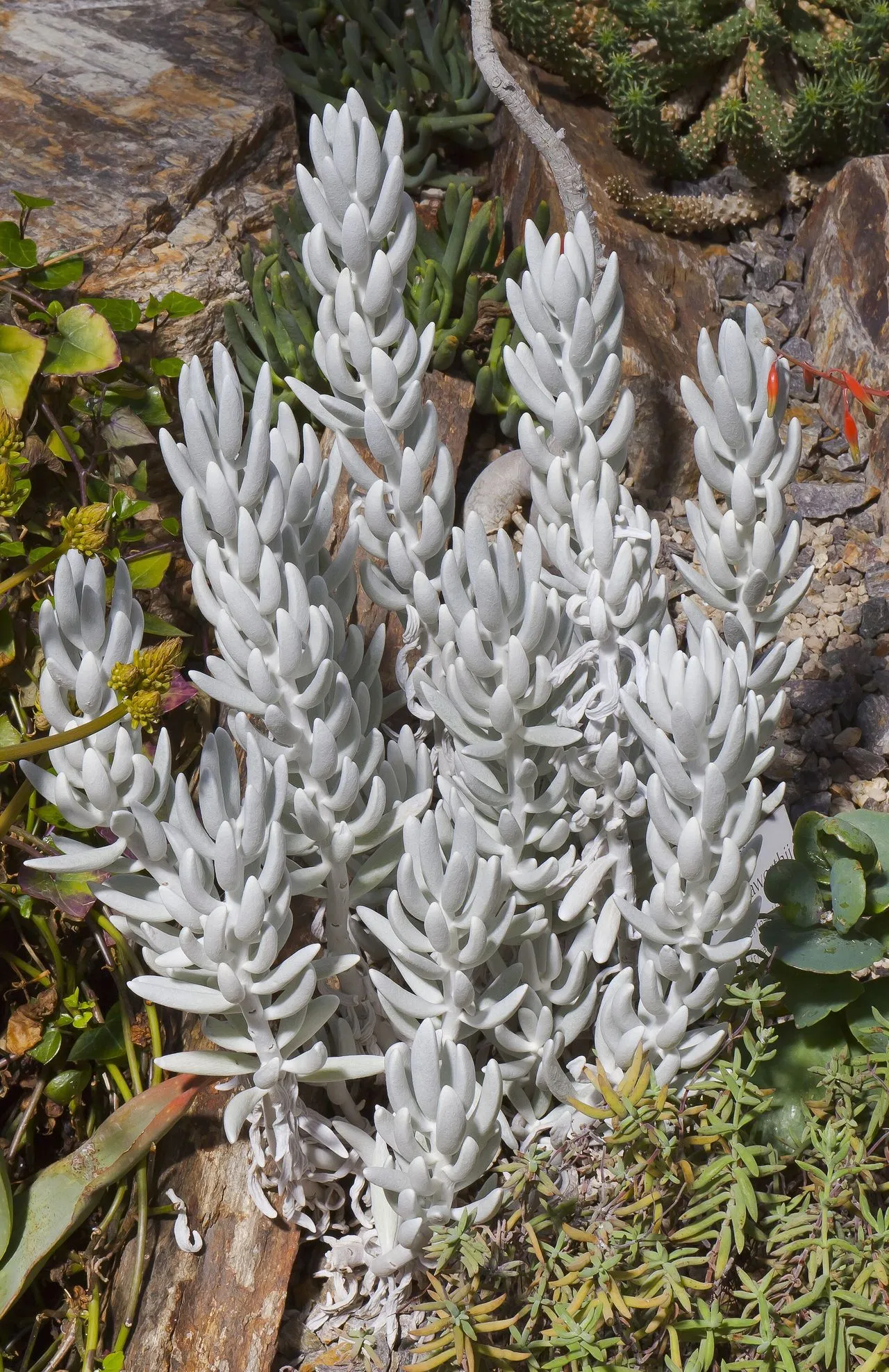
- Senecio haworthii — cocoon plant. Cylindrical leaves covered in dense white wool.
- Senecio barbertonicus — succulent bush senecio. Fast-growing shrubby species with bright yellow winter flowers.
- Senecio jacobsenii — trailing jade; reclassified to Kleinia petraea. Broader flat leaves than the Curio trailers.
- Senecio macroglossus — wax ivy. Climbing semi-succulent with ivy-shaped leaves.
- Senecio candicans — "Angel Wings" and related cultivars. Broad silver-woolly leaves; not strictly succulent but grouped with the genus.
- Senecio kleiniiformis — spear head; now in Curio. Unusual flat-bladed leaves shaped like arrowheads.
Shorter notes on species you may encounter: Senecio cineraria (silver ragwort) is a woolly garden bedding plant, not truly succulent; Senecio mikanioides (German ivy) and Senecio angulatus are climbing semi-succulent vines; Senecio vulgaris (common groundsel) is a non-succulent European weed included here only for disambiguation since shoppers sometimes arrive looking for it. A handful of North American wildflowers — Senecio aureus, Senecio triangularis, and Senecio integerrimus — are occasionally sold as native-garden plants rather than succulents; they are largely Packera under current taxonomy. Named cultivars such as Senecio 'Skyscraper' and Senecio 'Himalaya' are upright selections usually derived from S. crassissimus or its relatives.
Closing
If you are new to the group, start with Curio radicans (string of bananas) rather than C. rowleyanus. It tolerates a wider watering window, roots more aggressively, and will survive your first few mistakes. Once you have kept one alive through a full seasonal cycle, the rest of the group becomes legible: the same light, the same mineral mix, the same restraint with the watering can. The fact that so many of them look nothing like each other is, in the end, a gift — one genus can fill half a collection without repetition.
If you are arriving at succulents for the first time, the beginner's guide to succulents covers the cross-genus basics — light, water, substrate, and the common early mistakes — and is the right starting point before any single-genus deep dive.
Frequently Asked Questions
Are succulent Senecio now called Curio?
Most popular succulent Senecios have been transferred into Curio, while some species remain in Senecio or sit in other segregate genera. Trade labels still often use Senecio.
How much light do Senecio and Curio succulents need?
Most need 4–6 hours of direct sun or strong indirect light. Farinose and silver species tolerate full outdoor sun, while bead-leaved trailers prefer bright dappled light.
What substrate works for Senecio succulents?
Use a free-draining mineral-heavy mix such as 50% pumice or perlite, 25% coarse grit, and 25% peat-free loam-based compost.
What is the easiest trailing Senecio for beginners?
Curio radicans, string of bananas, is the recommended starting plant because it roots aggressively and tolerates more watering mistakes than string of pearls.