| Question | Short Answer |
|---|---|
| Is Senecio himalaya a real species? | No. |
| What plant is usually sold as Senecio 'Himalaya'? | Most trade plants are tall selections of Senecio crassissimus. |
| How do I identify a Senecio 'Himalaya' plant? | Flat vertical paddle leaves point to S. |
| Does Senecio 'Himalaya' need succulent care? | Only if it matches S. |
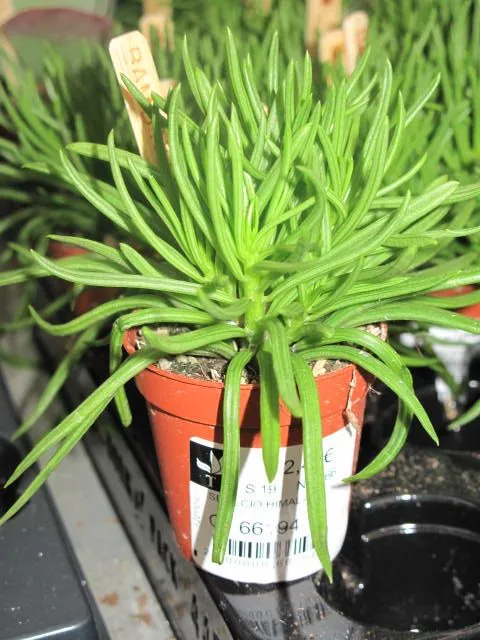
"Senecio 'Himalaya'" or "Senecio himalaya" is a trade name, not a botanical species. No valid binomial Senecio himalaya exists in the World Checklist of Vascular Plants or in any reputable taxonomic database. The name appears on nursery tags, social-media posts, and some general plant-care sites, but it is a marketing label attached to one or more existing species, not a distinct taxon.
Part of the Complete Senecio Guide.
What the plant is likely to be
In most cases observed in the European and North American trade, a plant sold as "Senecio Himalaya" is one of the following:
- A tall selection of Senecio crassissimus Humbert (vertical leaf plant, Madagascar origin despite the "Himalaya" marketing). This is by far the most common identity.
- A cultivar of Senecio articulatus (candle plant) sold under a trade name.
- A mislabelling of a genuine non-succulent Himalayan Senecio (such as S. graciliflorus or members of what is now the genus Ligularia). These are cold-hardy perennials of the subalpine Himalayas, not succulents, and cultivation differs.
Check the plant in front of you against photos of the species above. If it has flat vertical paddle leaves on an upright stem, it is almost certainly S. crassissimus. If it has segmented blue-grey jointed stems, it is S. articulatus. If it looks like a tall upright perennial with soft pinnate foliage and yellow daisy heads, you have a genuine Himalayan Senecio relative that does not belong in a succulent collection.
Brief care
For the two plausible succulent identities:
- If S. crassissimus: follow the Senecio crassissimus satellite. Full sun, gritty free-draining mix, standard Senecio watering.
- If S. articulatus: follow the Senecio articulatus satellite. Summer-dormant, sparing water, deciduous.
If you cannot match the plant to either species, or to any other known succulent Senecio or Curio, it is very likely not a succulent at all and needs a general perennial care regime rather than a mineral-mix succulent one.
Why the name persists
The "Himalaya" label trades on the impression of hardiness and exotic origin. In practice, neither S. crassissimus nor S. articulatus comes from anywhere near the Himalayas: both are African. The name is pure marketing.
This is not unique. Several succulent Senecios are sold under suggestive trade names — 'Skyscraper', 'Mount Everest', 'Iceberg' — that refer to visual or climatic associations rather than biogeography or taxonomy. When the nursery tag gives only a trade name, ask for or look up the parent species before setting a care regime.
Notes
If a plant is genuinely from the Himalayas and sold to a succulent buyer, it is almost certainly a member of the broader Asteraceae but not a succulent. Appropriate care is the care of a subalpine perennial: moderate moisture, cooler summers, tolerance of winter cold well below freezing — the opposite of the regime in the Complete Senecio Guide.
See also
- Senecio crassissimus — the most likely true identity.
- Senecio 'Skyscraper' — another trade-name selection usually derived from S. crassissimus.
- Senecio articulatus — candle plant.
Frequently Asked Questions
Is Senecio himalaya a real species?
No. The post states that no valid binomial Senecio himalaya exists in major taxonomic databases.
What plant is usually sold as Senecio 'Himalaya'?
Most trade plants are tall selections of Senecio crassissimus. Some may be Senecio articulatus or a non-succulent Himalayan relative.
How do I identify a Senecio 'Himalaya' plant?
Flat vertical paddle leaves point to S. crassissimus. Segmented blue-grey jointed stems point to S. articulatus.
Does Senecio 'Himalaya' need succulent care?
Only if it matches S. crassissimus or S. articulatus. If it looks like a soft perennial, it is probably not a succulent and needs different care.