| Question | Short Answer |
|---|---|
| Why did Senecio articulatus lose its leaves? | Summer leaf drop is normal for this species. |
| How tall does Senecio articulatus grow? | Plants usually reach 30–60 cm tall, with upright to sprawling segmented stems. |
| Is Senecio articulatus related to string of dolphins? | Yes. |
| How do you propagate candle plant? | Detach a stem joint at its groove, callus for 2–3 days, and stand it 1 cm into dry grit. |
Senecio articulatus (L.f.) Sch.Bip. is the candle plant or sausage plant. Some authors now move it to Curio articulatus, but the majority of recent treatments keep it in Senecio sensu stricto; both names appear in current literature and the trade. It is the most architecturally distinctive member of the succulent Senecio group, with pale jointed stems that break cleanly at the joints like sausages on a string.
Native to the Western and Eastern Cape of South Africa, where it grows on dry slopes and in rock crevices. Part of the Complete Senecio Guide.
Identification
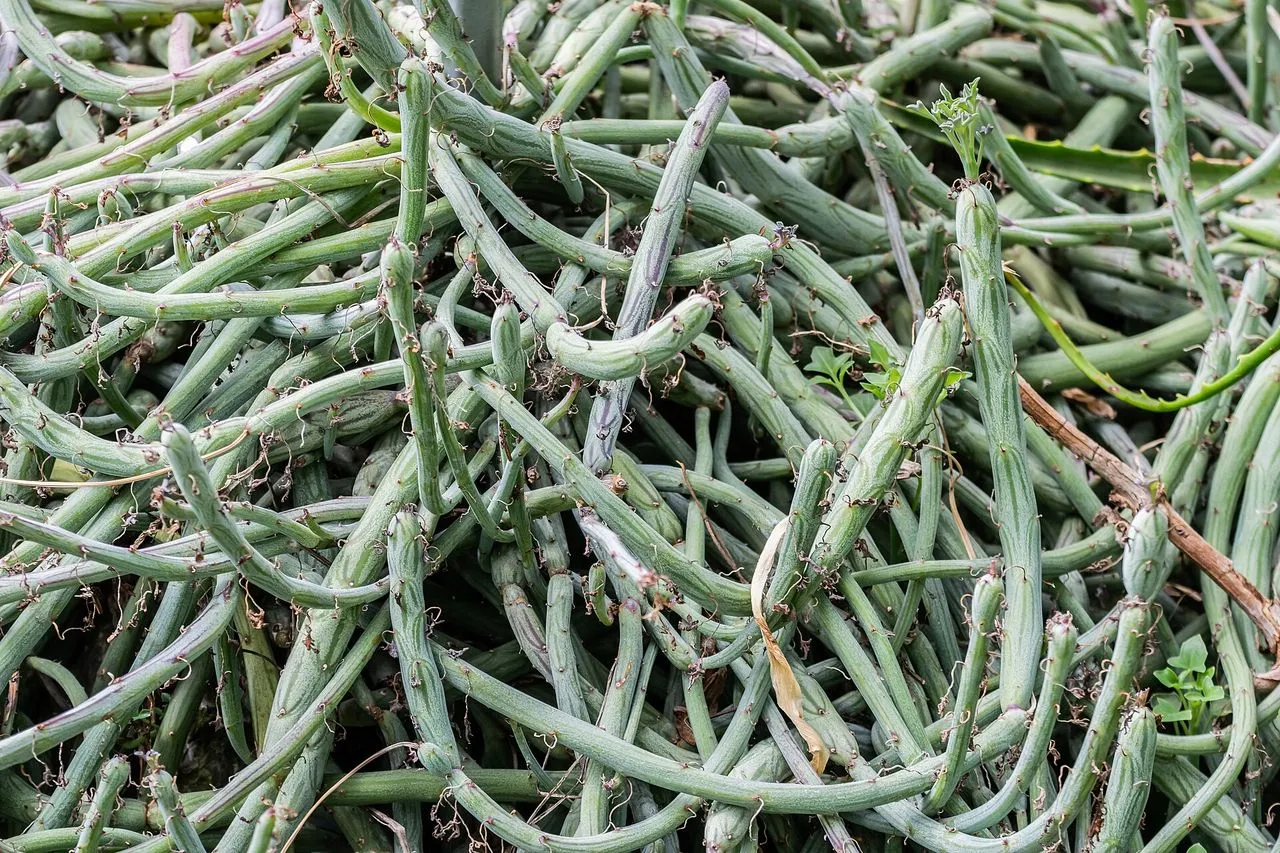
- Upright to sprawling stems 30–60 cm tall, pale blue-grey with a waxy bloom.
- Stems segmented into cylindrical joints 3–6 cm long, each joint narrower at the base than at the tip, producing a link-sausage silhouette.
- Leaves fleshy, trilobed, 4–6 cm long, borne at the stem tips only; they fall in drought, leaving bare segmented stems for much of the year.
- Capitula small, yellow or cream, in loose heads on short peduncles.
The segmented pale-blue stems are diagnostic. The plant is one parent of the Curio × peregrinus (string of dolphins) hybrid; the fin-like lateral lobes on dolphin leaves trace back to this species' trilobed leaf form.
Cultivation
Summer-deciduous by default. Where it diverges from the pillar's general advice:
- Summer dormancy. The plant typically drops its leaves in high summer as a water-conserving response. Do not panic and increase watering; reduce it further. Growth and leaves resume in autumn.
- Light. Full sun outdoors or brightest indoor position. The blue waxy bloom intensifies with light exposure.
- Water. Sparing. The thick jointed stems store water well. Indoor frequency runs every 2–3 weeks in active growth, roughly monthly during summer dormancy.
- Substrate. Free-draining mineral mix, with a shallow to medium pot. The root system is modest.
Stem joints break at the slightest knock. This is a dispersal adaptation, not a fault, but handle the plant with care during repotting.
Propagation
Stem segments root trivially. A fallen joint left on dry substrate will form roots within two weeks and become a new plant. For deliberate propagation, detach a joint at its groove, callus for 2–3 days, and stand it upright 1 cm into dry grit. This is one of the most reliable propagations in the whole group.
Seed is viable but unnecessary.
Notes and quirks
The deciduous habit makes S. articulatus look dead to owners unfamiliar with the genus. Bare blue segmented stems in summer are the plant's normal state, not a crisis. Leaves return in autumn with cooler nights.
As a parent of string of dolphins (Curio × peregrinus), the species carries cultivation relevance beyond its own display value. Collectors sometimes hybridise it deliberately with C. rowleyanus to reproduce the cross.
Mildly toxic to pets and livestock.
See also
- Senecio peregrinus — string of dolphins, the hybrid offspring.
- Senecio stapeliiformis — pickle plant, another erect Senecio.
- Senecio crassissimus — vertical leaf plant.
Frequently Asked Questions
Why did Senecio articulatus lose its leaves?
Summer leaf drop is normal for this species. Bare blue segmented stems in summer are a water-conserving dormant state, not a sign of death.
How tall does Senecio articulatus grow?
Plants usually reach 30–60 cm tall, with upright to sprawling segmented stems. Each joint is about 3–6 cm long.
Is Senecio articulatus related to string of dolphins?
Yes. It is one parent of Curio × peregrinus, the string of dolphins hybrid, and contributes the trilobed leaf form.
How do you propagate candle plant?
Detach a stem joint at its groove, callus for 2–3 days, and stand it 1 cm into dry grit. Roots can form within two weeks.