| Question | Short Answer |
|---|---|
| How do you identify Senecio stapeliiformis? | Look for erect purple-and-green striped cylindrical stems with shallow grooves and red-orange daisy-like flower heads. |
| Is pickle plant a Stapelia? | No. |
| What pot does Senecio stapeliiformis need? | It needs a deeper pot than Curio trailers because of the underground rhizome, but not an oversized container that stays wet. |
| How do you propagate pickle plant? | Rhizome division is easiest. |
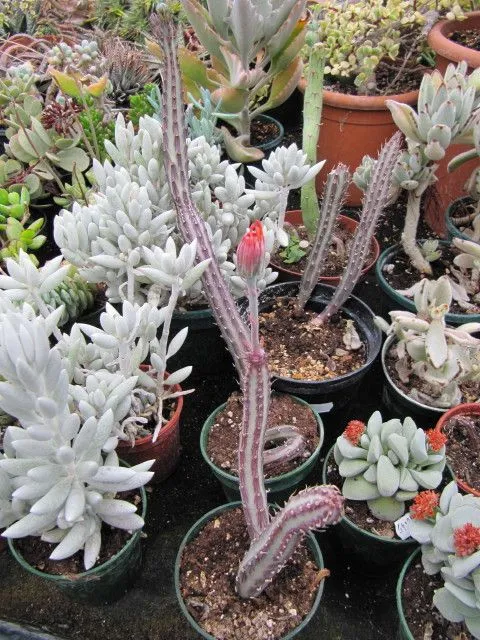
Senecio stapeliiformis E.Phillips is the pickle plant or inchworm plant. It remains in Senecio sensu stricto under current taxonomy. The common name reflects its erect cylindrical stems, which are segmented and patterned like small gherkins pushed into the soil.
Native to the Limpopo and Mpumalanga provinces of South Africa, where it grows partially buried on rocky slopes, with only the tips of the stems emerging from leaf litter. Part of the Complete Senecio Guide.
Identification
- Erect cylindrical stems, 1–2 cm thick, 15–25 cm tall, segmented by shallow circumferential grooves.
- Stem surface patterned with longitudinal purple and green stripes; small tooth-like vestigial leaves along the ridges.
- Flower heads brilliant red-orange, 3–4 cm across, solitary on short peduncles at the stem tip.
- Underground rhizome from which new stems emerge.
The erect striped stems and scarlet daisy flowers are diagnostic. Confusion is occasional with Stapelia species on a superficial look at the stems alone, but a flowering specimen resolves the question immediately: Stapelia flowers are star-shaped and foetid, S. stapeliiformis flowers are Asteraceae capitula and pleasant-smelling.
Cultivation
Follow the pillar's standard regime with a few adjustments:
- Light. Bright but not scorching. Full afternoon sun behind glass bleaches the stem striping. Morning sun plus bright afternoon shade gives the best colour.
- Water. More drought-tolerant than most in the group because of the thick rhizome. Water thoroughly, then let the medium dry completely. Monthly is often enough indoors in winter.
- Substrate. A deeper pot than Curio trailers need, to accommodate the rhizome. Free-draining, mineral-heavy, but with enough depth that the rhizome has room to wander.
- Cold. Frost-sensitive. Protect below 5 °C.
Stem rot at soil level is the main failure mode; see Senecio root rot for recovery if collapse occurs. Avoid burying the crown when potting up.
Propagation
Rhizome division is the easiest route. Lift a mature clump, cut the rhizome into sections each bearing one or more stems and their roots, and replant into dry substrate.
Stem cuttings also work. Cut a segmented stem at a groove, callus for 3–5 days, and stand it upright 2 cm deep in dry grit. New roots form from the buried base; a new stem often emerges from the rhizome within a couple of months.
Seed is viable but rarely used in cultivation.
Notes and quirks
The red-orange flowers are exceptional for the genus; most succulent Senecio produce white or yellow capitula. The strong colour attracts sunbirds in its native range and hummingbirds where it is cultivated in the Americas.
Because the plant spreads by rhizome, a young pot that appears half-empty usually fills quickly. Do not pot into oversized containers; the unused substrate stays wet and the rhizome rots.
Mildly toxic to pets and livestock, following the general Senecio pattern.
See also
- Senecio articulatus — candle plant, another segmented-stem Senecio.
- Senecio haworthii — cocoon plant.
- Senecio kleiniiformis — spear head.
Frequently Asked Questions
How do you identify Senecio stapeliiformis?
Look for erect purple-and-green striped cylindrical stems with shallow grooves and red-orange daisy-like flower heads.
Is pickle plant a Stapelia?
No. It can superficially resemble Stapelia stems, but its flowers are Asteraceae capitula rather than star-shaped foetid Stapelia flowers.
What pot does Senecio stapeliiformis need?
It needs a deeper pot than Curio trailers because of the underground rhizome, but not an oversized container that stays wet.
How do you propagate pickle plant?
Rhizome division is easiest. Stem cuttings also root if cut at a groove, callused for 3–5 days, and stood 2 cm deep in dry grit.