| Question | Short Answer |
|---|---|
| What is the current name for Senecio kleiniiformis? | The current name used in the post is Curio kleiniiformis. |
| How do you identify spear head succulent? | Look for flat, three-lobed arrowhead leaves. |
| Can Senecio kleiniiformis tolerate frost? | No. |
| How do you propagate Curio kleiniiformis? | Use stem cuttings. |
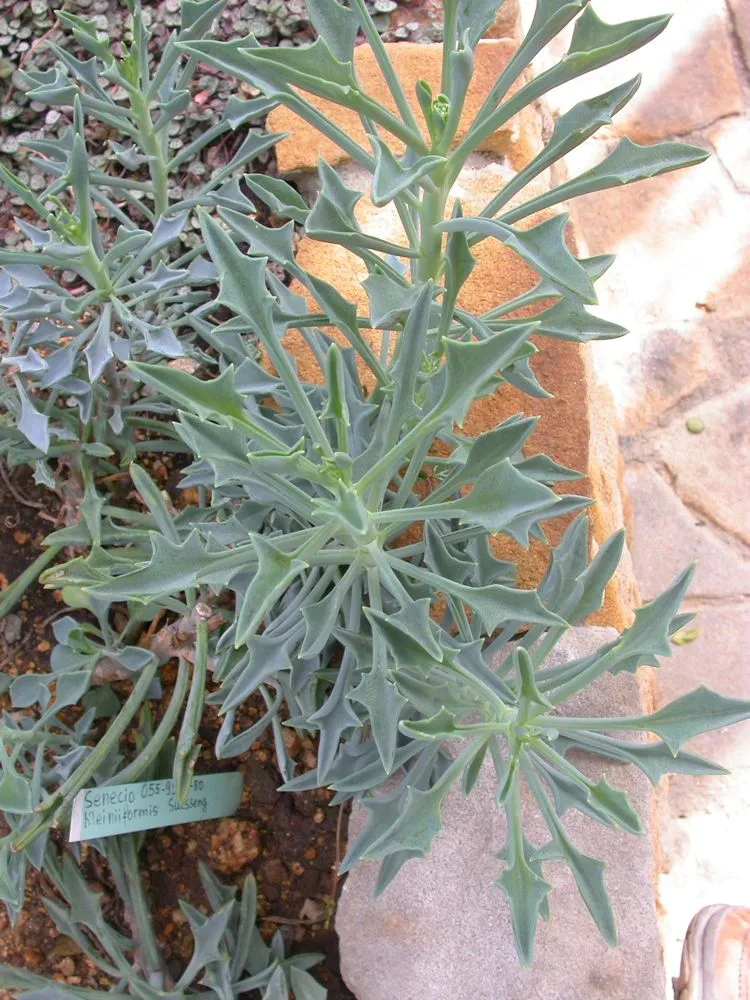
Curio kleiniiformis (Suess.) P.V.Heath, syn. Senecio kleiniiformis Suess., is the spear head or flat-leaf spear succulent. Reclassified into Curio along with the other trailing and ground-cover succulent Senecios, but still widely sold under Senecio kleiniiformis.
Native to the Cape region of South Africa, where it grows in seasonally dry shrubland. Part of the Complete Senecio Guide.
Identification
- Upright to sprawling stems, 20–40 cm tall.
- Leaves blue-green, thickened, shaped like narrow arrowheads or small spearpoints with a basal lobe on each side; 3–5 cm long.
- Capitula yellow, in small terminal heads.
- Waxy bloom on young leaves that wears off on older foliage.
The flat three-lobed arrowhead leaf shape is diagnostic. No other common succulent has this silhouette; even other Curio species with lobed leaves (C. articulatus, C. × peregrinus) carry their lobes on cylindrical rather than flat leaves.
Cultivation
Follows the pillar's general Curio regime with a few adjustments:
- Light. Bright light, including several hours of direct sun. The leaf colour deepens under strong light; shaded plants fade to dull mid-green and lose the blue cast.
- Water. Moderate. More forgiving than bead-leaved trailers. The standard 10–14 day summer indoor schedule is appropriate; water every 4–6 weeks in winter rest.
- Substrate. Gritty free-draining mineral mix. Shallow to medium depth.
- Cold. Frost-sensitive; tissue damages below −1 °C.
Overwatering in winter is the most common killer; the stem blackens at soil level and the plant collapses within days. For recovery from stem collapse, see Senecio root rot.
Propagation
Stem cuttings are reliable. Cut a 10 cm section, strip the lower leaves, callus for 2–3 days, and insert into dry grit. Roots form within two weeks, and new growth appears within a month.
Leaf propagation fails almost entirely; the flat lobed leaves do not initiate roots or shoots after detachment.
Notes and quirks
The arrowhead leaf shape is one of the stranger silhouettes in the succulent world and gives the species strong display value in small-scale arrangements. It pairs particularly well with rosette succulents of contrasting shape.
Occasionally mislabelled as Senecio scaposus or as "compass plant", neither of which is correct. Check the leaf shape before buying: S. scaposus has cylindrical finger-leaves in a rosette, not flat arrowheads.
Mildly toxic to pets and livestock.
See also
- Senecio articulatus — candle plant, another lobed-leaved Senecio.
- Senecio crassissimus — vertical leaf plant.
- Senecio peregrinus — string of dolphins.
Quick answer: keep Spear Head bright, dry, and gritty
Senecio kleiniiformis is forgiving only if the roots dry between waterings. Give it bright light, a small pot with drainage, and a mineral-heavy mix. If the plant leans, stretches, or turns mushy near the base, fix light and moisture before fertilizing.
As an Amazon Associate, we earn from qualifying purchases, at no extra cost to you. A gritty succulent and cactus soil such as Bonsai Jack Succulent and Cactus Soil Gritty Mix helps the roots dry faster than peat-heavy potting mix.
Why is my Senecio kleiniiformis stretching?
Stretching usually means the plant wants more light. Move it closer to a bright window or add a grow light gradually. Do not jump from shade to harsh afternoon sun in one day, or the leaves can scorch.
How often should you water it?
Water when the mix is dry most of the way down, then soak until water drains out. In winter or in a cool room, that may be far less often than your other houseplants.
Frequently Asked Questions
What is the current name for Senecio kleiniiformis?
The current name used in the post is Curio kleiniiformis. It is still widely sold under Senecio kleiniiformis.
How do you identify spear head succulent?
Look for flat, three-lobed arrowhead leaves. Other Curio species with lobed leaves carry those lobes on cylindrical, not flat, leaves.
Can Senecio kleiniiformis tolerate frost?
No. The post notes that tissue damages below about −1 °C.
How do you propagate Curio kleiniiformis?
Use stem cuttings. A 10 cm section, callused for 2–3 days and inserted into dry grit, roots within about two weeks.