| Question | Short Answer |
|---|---|
| Is string of dolphins a wild species? | No. |
| How do you identify true string of dolphins? | Each leaf has a small lateral fin on both sides. |
| Why did my string of dolphins lose its fin shape? | Overwatering can bloat the leaves into plain crescents. |
| How do you propagate string of dolphins? | Use stem cuttings only. |
Curio × peregrinus, syn. Senecio peregrinus, is the string of dolphins. It is not a wild species but a horticultural hybrid, almost certainly between Curio rowleyanus (string of pearls) and Curio articulatus (candle plant, now often placed in Curio rather than Senecio). The hybrid was popularised by Japanese nurseries in the 2010s under the name "Hato no mure" (flock of doves) and spread globally through social media as "string of dolphins".
Being a hybrid, the plant is vegetatively propagated only; every specimen in circulation is a clone. Part of the Complete Senecio Guide.
Identification
- Trailing stems to around 50 cm, somewhat more rigid than C. rowleyanus.
- Leaves 2–3 cm long, curved and visibly finned, with a small lateral protrusion on each side that produces the "jumping dolphin" silhouette. Translucent stripe present along the upper surface.
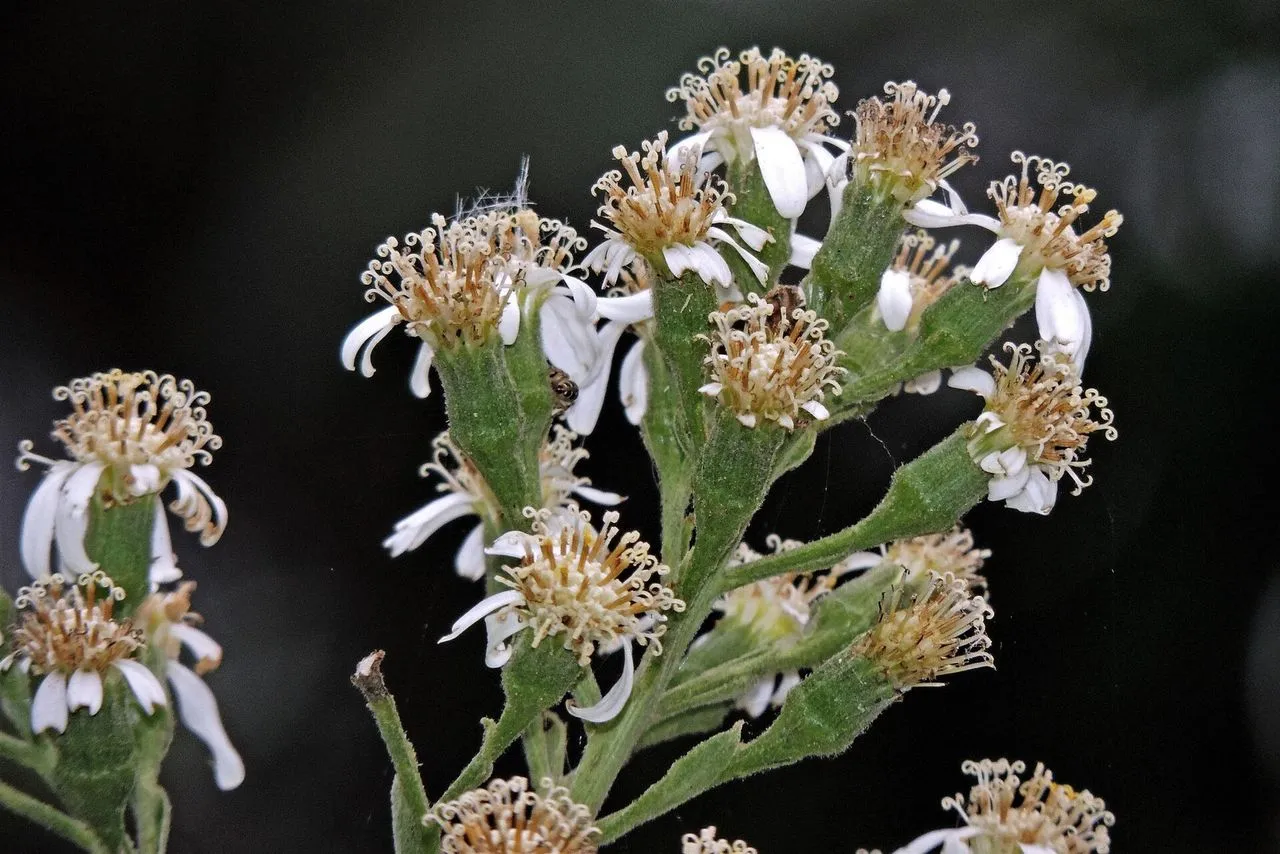
- Flowers pom-pom capitula, white with a cinnamon scent, on short erect stalks; flowers less frequently than either parent.
The fin pair on each leaf is diagnostic. A plain crescent is C. radicans; a pure sphere is C. rowleyanus; a clear fin-on-each-side silhouette is the dolphin.
Cultivation
Care sits midway between the two parents and is closer to C. rowleyanus than many sellers admit. Use the same mineral-rich shallow substrate and bright indirect light. Direct afternoon sun behind glass bleaches the leaves and flattens the dolphin shape to a thin curl.
The watering window is narrow. Water only once the substrate has fully dried and the leaves have just begun to lose gloss. A bloated, overwatered plant loses the characteristic fin shape first; the leaves swell into plain crescents and then collapse. If you see the fins disappearing, stop watering rather than adjust any other variable.
Cold tolerance is limited; below 5 °C growth stops and stems blacken. Keep the plant frost-free through winter.
Propagation
Stem cuttings only. Cut a 15 cm length, callus for 2–3 days, coil on mineral substrate, and pin at the nodes. Rooting is slower than C. rowleyanus but normally complete in 3–4 weeks. Because the plant is a hybrid clone, any seed produced either fails to germinate or yields variable, typically inferior offspring; do not bother with seed propagation.
Notes and quirks
The dolphin silhouette is most pronounced in cool bright conditions and least pronounced in warm low-light conditions. A plant that has lost its fins through a stretch of indoor winter will often regain them outdoors the following spring, given enough light and restrained watering.
Genuine string of dolphins is still sold at a mild premium over string of pearls and string of bananas. Mislabelled cuttings of C. radicans occasionally reach the market as "string of dolphins"; check for the lateral fins before buying.
Mildly toxic to pets.
See also
- Senecio rowleyanus — string of pearls, one parent.
- Senecio articulatus — candle plant, the other parent.
- Senecio radicans — string of bananas, often mislabelled as dolphins.
Frequently Asked Questions
Is string of dolphins a wild species?
No. It is a horticultural hybrid, almost certainly between Curio rowleyanus and Curio articulatus.
How do you identify true string of dolphins?
Each leaf has a small lateral fin on both sides. Plain crescents are string of bananas, and spheres are string of pearls.
Why did my string of dolphins lose its fin shape?
Overwatering can bloat the leaves into plain crescents. Warm low-light winter conditions can also reduce the dolphin silhouette.
How do you propagate string of dolphins?
Use stem cuttings only. Coil a 15 cm callused strand on mineral substrate and pin it at nodes for rooting in 3–4 weeks.