| Question | Short Answer |
|---|---|
| Why is string of pearls hard to grow? | Its shallow fine roots collapse quickly in saturated substrate. |
| How do you identify Curio rowleyanus? | True string of pearls has spherical 6–10 mm beads, each with one narrow translucent stripe. |
| Can string of pearls take cold? | Cold tolerance is poor. |
| How do you propagate string of pearls? | Take a 15–20 cm stem, strip several lower beads, callus for two days, then coil and pin nodes on barely damp substrate. |
Curio rowleyanus (H.Jacobsen) P.V.Heath, syn. Senecio rowleyanus H.Jacobsen, is the string of pearls. It is the archetypal trailing bead-leaved succulent and the single most-sold hanging succulent worldwide. Nursery tags almost always still read Senecio rowleyanus; both names refer to the same plant.
The species is endemic to the drier parts of the Eastern Cape of South Africa, where it sprawls across rocky slopes and under low shrubs in dappled shade rather than full exposure. That shade preference is the first clue to what goes wrong indoors: string of pearls is not a desert plant. Part of the Complete Senecio Guide.
Identification
- Trailing stems to 60 cm or more, thin and wiry.
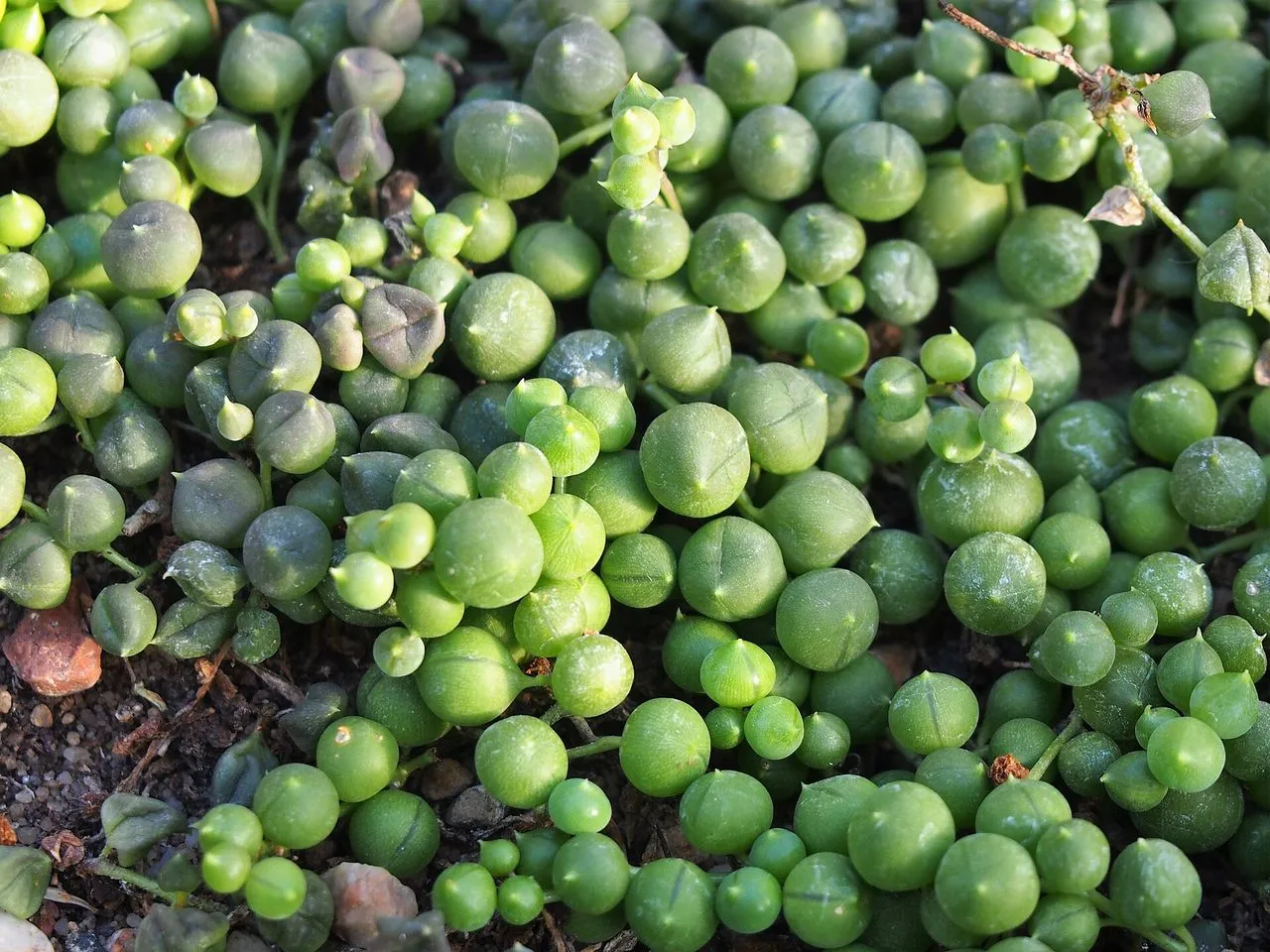
- Spherical leaves ("beads") 6–10 mm in diameter, green, each with a narrow translucent epidermal window running down one side. That window is a functional light slit, not damage.
- White pom-pom flower heads on short erect peduncles, with a strong cinnamon-vanilla scent.
- Exudes a thin watery latex from broken stems.
Confusion occurs most often with Curio herreianus (string of watermelons), which has larger, slightly pointed leaves with more pronounced stripes, and with Curio radicans (string of bananas), which has curved crescent leaves rather than spheres. If the leaves are true spheres with one stripe each, it is C. rowleyanus.
Cultivation
This species diverges from the pillar's general advice in two ways worth knowing.
Light. Avoid full afternoon sun behind glass. Bright indirect light, or morning direct sun followed by afternoon shade, gives the firmest beads without scorching. Beads turn reddish-purple under genuine stress, including cold and excess UV; a subtle bronze tint is fine, but pale bleached spots are irreversible sunburn.
Water. More sensitive to overwatering than any other common succulent. The root system is shallow and fine, and saturated substrate pushes it into anoxia within 48 hours. Water only when the beads just begin to lose their tight gloss, the top 3 cm of medium is bone dry, and the pot feels genuinely light. A shallow wide pot with a pure mineral mix (50% pumice, 25% grit, 25% loam) is safer than any deep container.
Cold tolerance is poor. Below about 5 °C the beads discolour and the stems become brittle. Keep it indoors or under cover if your winter nights approach freezing.
Propagation
Stem cuttings at near 100% success. Take a 15–20 cm length of healthy stem, strip the lowest three or four beads, let the cut callus for two days, then coil the strand on the surface of barely damp substrate and pin it with a hairpin at several nodes. Roots emerge from every pinned node in 2–3 weeks, producing a full pot from a single cutting. Do not bury the stem; nodes root on contact, and buried stems rot.
Leaf propagation, routine in Echeveria, fails almost entirely here. A detached bead calluses but seldom develops a growing point.
Notes and quirks
The translucent stripe on each bead is an epidermal window of the same order as those in Fenestraria and Haworthia truncata. It allows light to reach chlorophyll tissue buried deeper inside the sphere, maximising photosynthetic surface while minimising water loss. A bead with no stripe is either a badly etiolated specimen or a different species altogether.
The plant is mildly toxic to cats and dogs. Ingestion typically causes drooling and vomiting rather than serious harm, but hang baskets high enough to be out of reach. See the toxicity section of the pillar guide for context.
A final practical note: nearly all string-of-pearls failures trace back to one of three causes: a peat-heavy substrate, a deep pot, or watering on a weekly calendar. Fix the first two and the third self-corrects.
See also
- Senecio radicans — string of bananas, the forgiving sibling.
- Senecio peregrinus — string of dolphins, the C. rowleyanus × C. articulatus hybrid.
- Senecio haworthii — cocoon plant, a very different Senecio form.
Frequently Asked Questions
Why is string of pearls hard to grow?
Its shallow fine roots collapse quickly in saturated substrate. The post notes that anoxia can develop within 48 hours.
How do you identify Curio rowleyanus?
True string of pearls has spherical 6–10 mm beads, each with one narrow translucent stripe. Crescent leaves are string of bananas.
Can string of pearls take cold?
Cold tolerance is poor. Below about 5 °C the beads discolour and stems become brittle.
How do you propagate string of pearls?
Take a 15–20 cm stem, strip several lower beads, callus for two days, then coil and pin nodes on barely damp substrate.