| Question | Short Answer |
|---|---|
| Is Senecio mandraliscae the same as Curio repens? | The post treats the cultivated mandraliscae plant as Curio repens, or as a garden form or hybrid in that complex. |
| How do you tell blue chalksticks from dwarf blue chalksticks? | C. |
| Can blue chalksticks tolerate cold? | Mature plants survive brief −4 °C events if dry and can recover from foliage burn by resprouting from the root crown. |
| How do you propagate blue chalksticks? | Cuttings root at near 100%. |
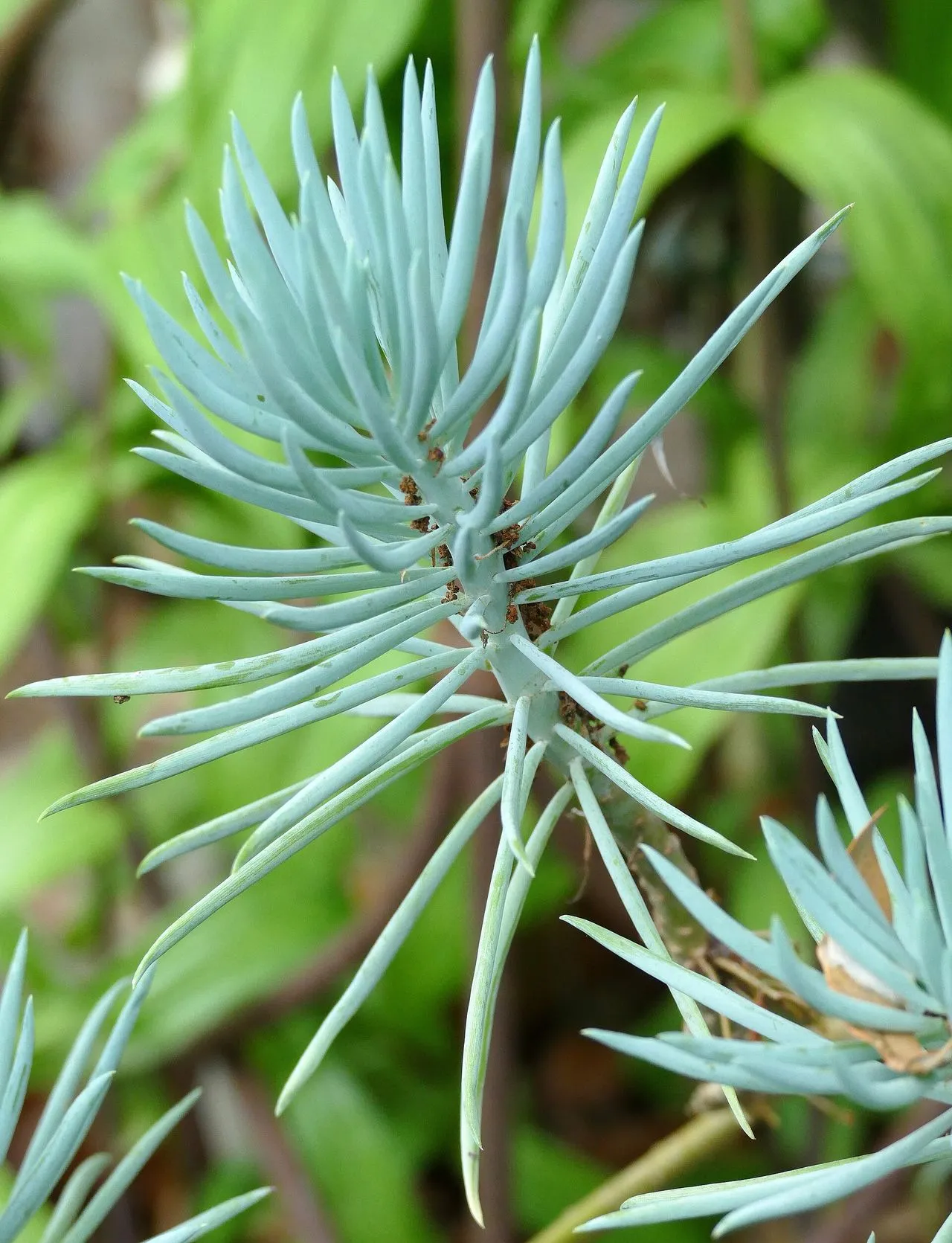
Curio repens (L.) P.V.Heath, still widely sold as Curio mandraliscae or Senecio mandraliscae, is blue chalksticks. Taxonomic opinion now treats the commonly cultivated "mandraliscae" as a form of C. repens, or as a garden hybrid with C. ficoides in its parentage; both names point to the same tough, pale-blue ground cover on the nursery shelf.
The species complex is native to the Eastern Cape of South Africa, where it grows on dry slopes and rocky flats in full sun. Part of the Complete Senecio Guide.
Identification
- Creeping decumbent stems forming a dense mat 30–45 cm tall.
- Leaves cylindrical, 8–10 cm long, blunt-tipped, curved slightly upward, coated in a waxy pale-blue bloom (farina).
- Capitula small, dirty-white, on short stalks in summer.
- Stems root readily where they touch the ground.
Distinguishing from Curio serpens (dwarf blue chalksticks) comes down to size: C. serpens stays compact at 15–20 cm with shorter finger-length leaves. Senecio vitalis, another "blue chalksticks" lookalike, grows strictly upright with straighter leaves.
Cultivation
This is one of the easier succulents to grow outdoors in Mediterranean and mild-coastal climates. It tolerates full sun, poor soil, salt spray, and drought once established. Cultivation where it diverges from the pillar:
- Full outdoor sun is preferred. The farina layer functions as sunscreen; the colour intensifies with light exposure. A shaded specimen goes dull green.
- Cold tolerance is above average for the group. Mature plants survive brief −4 °C events if dry, and recover from foliage burn by resprouting from the root crown.
- Substrate can be ordinary gritty garden soil rather than a premium mineral mix, provided it drains.
Water less than the pillar default for established outdoor plants; a monthly deep soaking is enough during a dry summer. Container specimens follow the standard 10–14 day indoor schedule.
Propagation
Cuttings root at near 100%. Detach a 10–15 cm length, strip the lower leaves, callus for 2–3 days, and stick into dry substrate. Roots form within two weeks. Division of older clumps works equally well; each piece needs a growing tip and a handful of roots.
Notes and quirks
Blue chalksticks is one of the go-to plants for commercial low-water landscaping in California, southern Spain, and coastal Australia. It is not widely naturalised outside cultivation but is considered mildly invasive in parts of South Africa outside its native range.
Avoid rubbing the leaves. The farina coating does not regenerate on damaged surfaces; handling leaves permanent fingerprint-shaped marks.
Mildly toxic to livestock in quantity; occasional nibbling by pets rarely causes serious harm.
See also
- Senecio serpens — dwarf blue chalksticks, the compact relative.
- Senecio vitalis — upright blue-finger species, often confused.
- Senecio haworthii — cocoon plant, a very different woolly Senecio.
Frequently Asked Questions
Is Senecio mandraliscae the same as Curio repens?
The post treats the cultivated mandraliscae plant as Curio repens, or as a garden form or hybrid in that complex.
How do you tell blue chalksticks from dwarf blue chalksticks?
C. mandraliscae reaches 30–45 cm with 8–10 cm leaves. C. serpens stays 15–20 cm tall with shorter finger-length leaves.
Can blue chalksticks tolerate cold?
Mature plants survive brief −4 °C events if dry and can recover from foliage burn by resprouting from the root crown.
How do you propagate blue chalksticks?
Cuttings root at near 100%. Use a 10–15 cm piece, callus it for 2–3 days, and insert it into dry substrate.