| Question | Short Answer |
|---|---|
| How is Senecio serpens different from blue chalksticks? | C. |
| Can dwarf blue chalksticks tolerate frost? | Brief −3 °C events are survivable if the plant is dry. |
| How often should Senecio serpens be watered? | Mature outdoor plants tolerate long drought. |
| How do you propagate Curio serpens? | Cut 5–10 cm stems, callus for 1–2 days, and root in dry grit. |
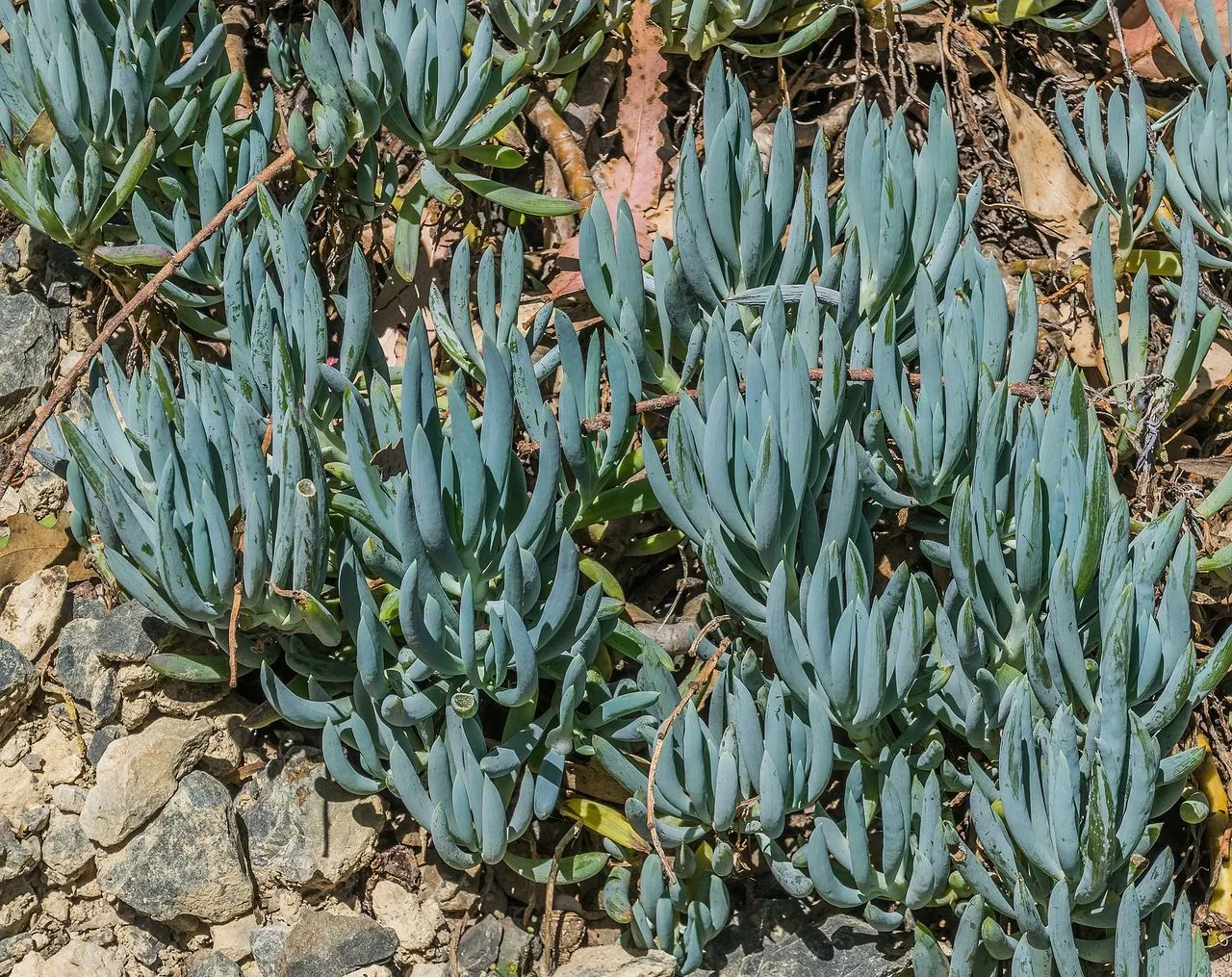
Curio serpens (G.D.Rowley) P.V.Heath, syn. Senecio serpens G.D.Rowley, is dwarf blue chalksticks. It is the compact counterpart to Curio repens / mandraliscae, with similar form but about half the size. In the trade both species are often muddled under the same "blue chalksticks" label; the difference matters only at maturity.
Native to the drier parts of South Africa, where it creeps through gravelly flats in full exposure. Part of the Complete Senecio Guide.
Identification
- Prostrate to decumbent stems, clumps 15–20 cm tall, spreading to 40 cm.
- Leaves cylindrical, 3–5 cm long, pointed, thickly farinose so the colour reads pale silver-blue.
- Capitula small, white, on short peduncles in summer.
- Self-rooting along creeping stems.
Distinguished from C. repens (also sold as C. mandraliscae) by the shorter finger-length leaves and tighter habit. At maturity C. serpens never exceeds 20 cm tall; C. repens reaches 30–45 cm.
Cultivation
Care is very close to the pillar's default for sun-loving farinose species. Specific notes:
- Full sun is preferred. As with C. repens, the farina layer acts as UV protection, and exposure intensifies the blue.
- Cold tolerance is marginally better than C. rowleyanus or C. radicans; brief −3 °C events are survivable if the plant is dry.
- Watering is sparing. A mature outdoor patch in gritty soil tolerates months of drought; container specimens want a thorough soak every 2–3 weeks in active growth.
- Substrate. Any free-draining mineral-rich mix. Pure mineral media (pumice and grit with a minor organic fraction) gives the best colour.
The species rots readily if the crown sits in pooled water after rain. Plant on a gentle slope or in a raised bed rather than a flat low depression.
Propagation
Cuttings are effortless. Cut a 5–10 cm stem, callus 1–2 days, stick into dry grit. Rooting completes within two weeks. Creeping stems already carry their own roots and can be lifted with a shovel and transplanted directly.
Seed is viable but rarely sown in cultivation; stem propagation is faster and maintains the compact form.
Notes and quirks
Dwarf blue chalksticks is a workhorse in rock-garden and succulent-wall plantings, where its low profile fills space between larger accent plants without overwhelming them. It pairs well with upright Crassula and Aeonium species for colour contrast. If the characteristic blue fades under low light, blue chalksticks discoloring covers the common causes.
Like C. repens, it is mildly toxic to livestock; incidental contact and brief pet ingestion are rarely problematic.
See also
- Senecio mandraliscae — the taller blue chalksticks.
- Senecio vitalis — upright blue-finger species.
- Senecio crassissimus — vertical-leaf airplane plant.
Frequently Asked Questions
How is Senecio serpens different from blue chalksticks?
C. serpens stays 15–20 cm tall with shorter leaves. C. repens or mandraliscae reaches 30–45 cm with longer leaves.
Can dwarf blue chalksticks tolerate frost?
Brief −3 °C events are survivable if the plant is dry. Wet cold is more dangerous.
How often should Senecio serpens be watered?
Mature outdoor plants tolerate long drought. Container specimens need a thorough soak every 2–3 weeks in active growth.
How do you propagate Curio serpens?
Cut 5–10 cm stems, callus for 1–2 days, and root in dry grit. Creeping stems with existing roots can be transplanted directly.