| Question | Short Answer |
|---|---|
| Is Senecio jacobsenii the same as trailing jade? | Yes. |
| Why does trailing jade turn purple? | Cool bright winter conditions produce purple-bronze colour. |
| How much light does Senecio jacobsenii need? | Bright but not direct afternoon sun. |
| How do you propagate trailing jade? | Stem cuttings root freely in 2–3 weeks. |
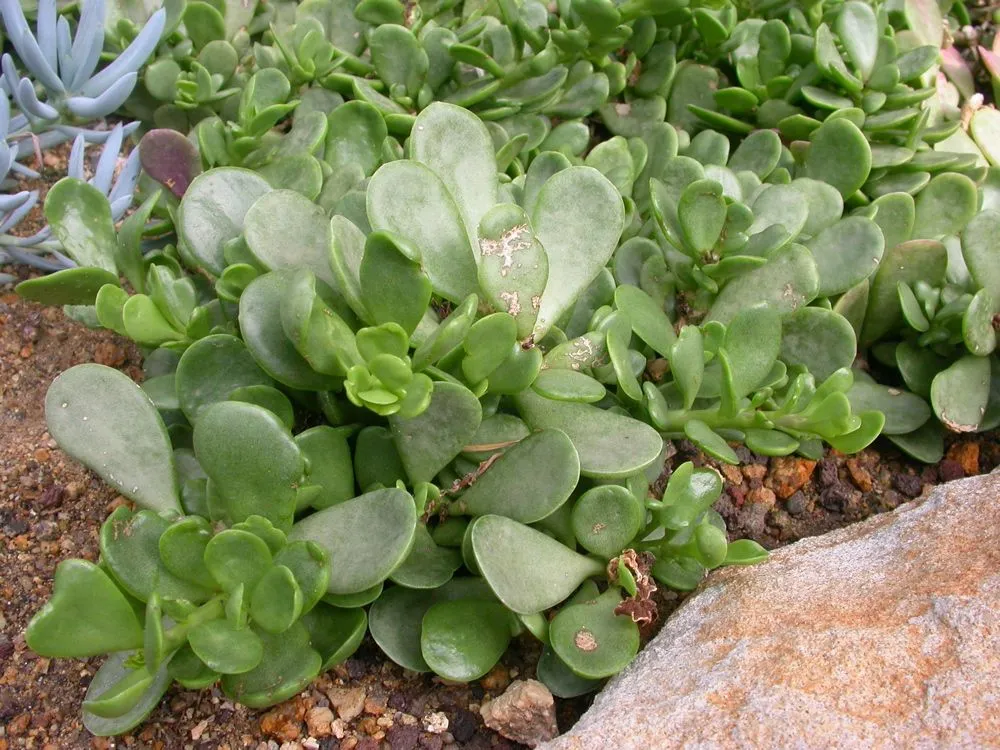
Kleinia petraea (R.E.Fr.) C.Jeffrey, syn. Senecio jacobsenii G.D.Rowley, is trailing jade or weeping jade. It is one of the species that moved to Kleinia rather than Curio under the recent reclassifications. Nursery tags still almost always read Senecio jacobsenii.
Native to montane eastern Africa (Tanzania, Kenya, Uganda) at elevations of 1,500–2,500 m, where it grows over rocks and low shrubs in partially shaded positions. Part of the Complete Senecio Guide.
Identification
- Trailing or decumbent stems, to 75 cm, thicker and more fleshy than Curio trailers.
- Leaves broad, obovate, flat, 4–7 cm long, bright green in active growth, turning purple-bronze under cold or drought stress.
- Capitula orange to yellow, cylindrical, 2–3 cm across, with a strong cinnamon-sweet scent.
- Self-rooting where stems contact soil.
Distinguished from Curio trailers by the broad flat leaves (rather than beads, bananas, or cylinders). The orange flower heads are also unusual for the group; most related trailers produce pale capitula.
Cultivation
An easier trailing succulent than most of the Curio bead-leaved species. Divergences from the pillar:
- Light. Bright but not direct. Full afternoon sun bleaches the leaves. A bright east window or a morning-sun patio position is ideal.
- Water. Moderate and forgiving. The thicker leaves buffer errors better than string of pearls. Water when the top 3 cm of substrate dries, typically every 10–14 days in summer.
- Substrate. Slightly more organic than the pillar default; the montane-origin root system handles a little extra organic content well. Pumice 40% / grit 25% / loam 35% works.
- Cold. More cold-tolerant than most in the group; brief −2 °C is survivable, and the purple-bronze colour actually develops best under cool winter nights.
Aphids and mealybugs are the common pests. Check leaf undersides in spring when new growth is soft.
Propagation
Stem cuttings root freely. Cut a 10–15 cm section, remove the lower leaves, callus for 2–3 days, and either lay the cutting on substrate or insert it upright 2 cm deep. Roots form within 2–3 weeks.
Cuttings from the flowering ends of stems root less reliably than cuttings from vegetative sections; choose non-flowering stem tips where possible.
Notes and quirks
The purple-bronze winter colour is one of the species' selling points. Kept at steady warm temperatures it stays plain green; exposure to a cool bright winter produces deep burgundy tones that persist for months.
The flower scent is strong and pleasant, and the capitula last for about two weeks. Remove spent stalks once bloom finishes.
Mildly toxic to pets and livestock, following the broader Senecio/Kleinia pattern.
See also
- Senecio rowleyanus — string of pearls, the bead-leaved trailer.
- Senecio radicans — string of bananas.
- Senecio macroglossus — wax ivy, a climbing broad-leaved semi-succulent.
Frequently Asked Questions
Is Senecio jacobsenii the same as trailing jade?
Yes. The post gives Kleinia petraea, synonym Senecio jacobsenii, as trailing jade or weeping jade.
Why does trailing jade turn purple?
Cool bright winter conditions produce purple-bronze colour. Constant warm temperatures keep the plant plain green.
How much light does Senecio jacobsenii need?
Bright but not direct afternoon sun. A bright east window or morning-sun patio position is ideal.
How do you propagate trailing jade?
Stem cuttings root freely in 2–3 weeks. Use 10–15 cm non-flowering sections where possible.