| Question | Short Answer |
|---|---|
| How fast does Senecio barbertonicus grow? | It is one of the fastest-growing succulents in the group. |
| How tall does Senecio barbertonicus get? | Mature plants can reach about 1.5 m tall, branching from a woody base with fleshy upper growth. |
| Does Senecio barbertonicus flower? | Yes. |
| How do you propagate Senecio barbertonicus? | Stem cuttings root aggressively. |
Senecio barbertonicus Klatt is the succulent bush senecio or Barberton groundsel. It is one of the species that has stayed in Senecio sensu stricto under the recent reclassifications, rather than moving to Curio. It is also one of the fastest-growing succulents on the market: a 10 cm cutting can become a 1 m shrub in three years under good conditions.
Native to the Barberton region of Mpumalanga in South Africa and adjacent Swaziland, where it grows as a woody shrub on rocky hillsides in full sun. Part of the Complete Senecio Guide.
Identification
- Upright shrub to 1.5 m tall, branching from a woody base.
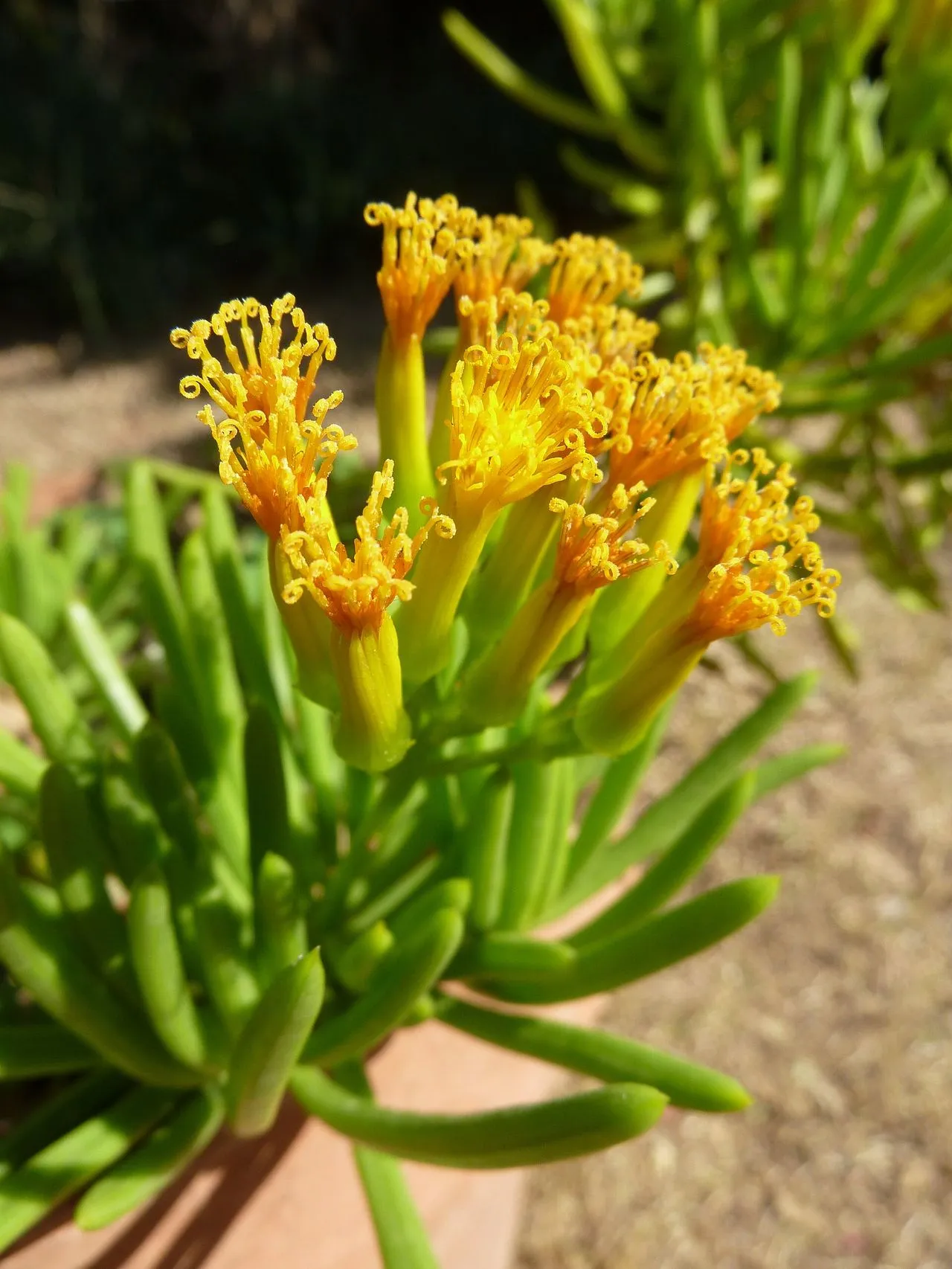
- Leaves linear, cylindrical, 5–7 cm long, bright fresh-green, held upward along the stem in a radiating arrangement.
- Capitula clustered at the branch tips, bright yellow, strongly honey-scented, borne in winter (southern-hemisphere summer for its native range, adjusted to winter in northern cultivation).
- Woody lower stem, fleshy upper growth.
The green linear leaves distinguish it cleanly from the farinose blue-leaved Curio repens and Curio serpens. The woody base and upright habit distinguish it from trailing Curio species.
Cultivation
Fast and easy in any climate warmer than USDA zone 9. Where it diverges from the pillar:
- Light. Full sun produces the tightest, most compact form. Shade produces an open leggy habit.
- Water. Tolerates more water than most succulent Senecio. A weekly soaking in summer is fine if the substrate drains freely.
- Cold. Frost-sensitive; tissue burns at −1 °C. Recovers from the base if the root zone does not freeze.
- Pruning. Responds exceptionally well to hard pruning. Cut back by up to a third in early spring, and the plant bushes out from every remaining node. Older specimens can be rejuvenated by cutting to 20 cm above the ground.
The bright yellow winter flower clusters are unusual for the genus and useful for winter nectar in frost-free gardens.
Propagation
Stem cuttings root aggressively. Cut a 10–15 cm length of semi-hardwood, remove the lower leaves, callus for a couple of days, and stick into gritty substrate. Rooting completes in 2–3 weeks.
Hardwood cuttings from the older woody base also root, though more slowly. Seed propagation is viable but unnecessary for cultivation.
Notes and quirks
The honey scent of the flowers is strong enough to perfume a greenhouse. It attracts bees and hoverflies in quantity and can be used as a nectar plant in winter-dry climates where few other plants are in bloom.
Because the species grows so quickly, container specimens exhaust the substrate within two years and benefit from repotting annually until mature. Outdoor specimens need little attention beyond occasional shaping. For the care fundamentals shared across the group, the beginner's guide to succulents covers light, water, and substrate.
Mildly toxic to livestock; the wild relatives contain pyrrolizidine alkaloids typical of the broader Senecio group.
See also
- Senecio articulatus — candle plant, another true Senecio.
- Senecio crassissimus — vertical leaf plant.
- Senecio haworthii — cocoon plant.
Frequently Asked Questions
How fast does Senecio barbertonicus grow?
It is one of the fastest-growing succulents in the group. Under good conditions, a 10 cm cutting can become a 1 m shrub in three years.
How tall does Senecio barbertonicus get?
Mature plants can reach about 1.5 m tall, branching from a woody base with fleshy upper growth.
Does Senecio barbertonicus flower?
Yes. It produces bright yellow, strongly honey-scented flower clusters at branch tips in winter.
How do you propagate Senecio barbertonicus?
Stem cuttings root aggressively. Take a 10–15 cm semi-hardwood cutting, callus briefly, and root it in gritty substrate within 2–3 weeks.