| Question | Short Answer |
|---|---|
| Is Senecio ficoides now Curio ficoides? | Yes. |
| How tall does Curio ficoides grow? | Typical mature plants reach 30–60 cm tall and about as wide. |
| How do you tell Curio ficoides from blue chalksticks? | C. |
| How do you propagate Curio ficoides? | Use stem cuttings. |
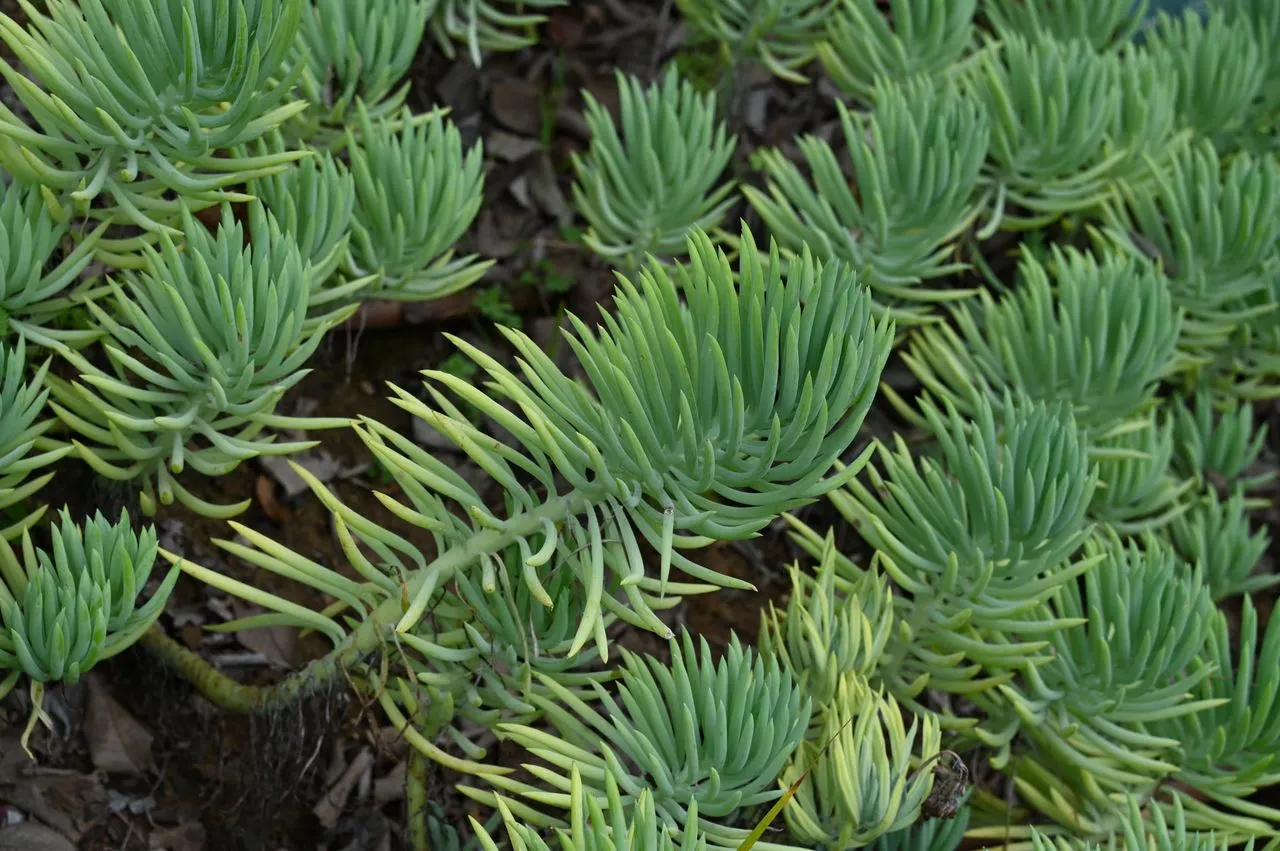
Curio ficoides (P.V.Heath, 1997), formerly Senecio ficoides (Linnaeus, 1753), is an erect-clumping leaf succulent native to the Eastern and Western Cape of South Africa, where it grows on rocky slopes between roughly 100 and 1,500 m elevation. The plant carries narrow, finger-shaped, glaucous blue-green to silver-blue leaves on upright stems 30 to 60 cm tall, and the heavy waxy bloom on those leaves is the diagnostic feature behind both common trade names: skyscraper senecio (for the upright habit) and blue chalk fingers (for the colour).
Linnaeus described the species as Senecio ficoides in Species Plantarum (1753), placing it within the vast and largely herbaceous Senecio L. The succulent senecios sat uneasily in that genus for two and a half centuries; molecular work confirmed they form a distinct lineage, and Paul V. Heath formally erected the segregate genus Curio in 1997 to hold them. Kew's Plants of the World Online accepted the segregate in 2018, after which the major aggregators (World Flora Online, GBIF backbone) followed within a year. Both Senecio ficoides and Curio ficoides remain valid in botanical literature; the Curio name is the currently accepted one, and the Senecio name is retained as a synonym in good standing.
In habitat, C. ficoides tolerates a winter-rainfall to summer-rainfall transition zone with hot dry summers and cool wet winters at the western end of its range. The species is not listed under CITES and is assessed as Least Concern under the South African National Biodiversity Institute's Red List of South African Plants. Cultivated stock has been in European glasshouses since the eighteenth century.
Part of the Complete Senecio Guide.
Identification
Habit is erect-clumping: a single plant branches from the base into multiple woody-based stems, and a mature specimen reaches 30 to 60 cm tall and roughly the same wide. The cultivar C. ficoides 'Mount Everest' is a taller selection that pushes 60 to 90 cm under good cultivation.
Leaves are the diagnostic character. They are narrow, cylindrical to slightly flattened on the upper surface, 2 to 5 cm long and 0.5 to 1 cm wide, ending in a soft point. Colour ranges from glaucous blue-green through silver-blue, with a heavy farinose wax that you can rub off with a fingertip; the bloom regrows over a few weeks. Leaves crowd toward the stem tips and are held at a sharply upright angle, almost vertical, which is what gives the plant its skyscraper appearance.
Flowers are small white-to-pale-yellow daisy heads in loose corymbs above the foliage in summer. They are not showy, and the species is grown almost entirely for its foliage.
Distinguish from look-alikes:
- C. mandraliscae (blue chalksticks). Lower spreading habit at 15 to 30 cm tall, forms wide ground-covering mats; leaves slightly broader and shorter, and the colour leans more toward blue-grey than silver-blue. The two are routinely confused on retail labels, but a C. mandraliscae sprawling low across a pot is visually nothing like a C. ficoides clumping vertically above one. If the plant is taller than wide, it is almost certainly C. ficoides.
- C. talinoides (blue chalk fingers complex). Taxonomic muddle: some authors treat C. ficoides as a synonym of C. talinoides subsp. mandraliscae, others keep all three apart. Where they are kept apart, C. talinoides is generally taller and laxer, with leaves that lean rather than stand bolt upright. Trade names in this circle are not reliable; check the habit on the plant in front of you, not the label.
- C. ficoides 'Mount Everest', a selected cultivar with the same upright habit but a noticeably greater height (60 to 90 cm in cultivation) and slightly longer leaves. Care identical to the type; the difference is scale.
Cultivation
Light: full sun to bright filtered light. In Mediterranean and warm-temperate gardens C. ficoides takes full midday sun without issue once acclimatised, and the waxy bloom acts as natural sunscreen. Indoors, a south-facing window with at least 5 to 6 hours of direct light keeps the leaves blue and the habit upright. Below that threshold, you will see green-tinged new growth, longer internodes, and stems that lean toward the light source within a few weeks.
Water: dry-and-soak, with a longer dry interval than most leaf succulents. A 15 cm terracotta pot in a Mediterranean summer typically wants water every 10 to 14 days; the same pot through winter wants water every 4 to 6 weeks. The simplest cue is the leaves themselves. They store water in the cylinder and remain firm when hydrated; once they begin to wrinkle longitudinally or feel slightly soft when squeezed gently, the plant is ready for water. Soak until water runs from the drainage holes, then withhold until the substrate is dry to within 2 to 3 cm of the bottom of the pot.
Substrate: highly mineral. A working blend is roughly 70 to 80 percent mineral grit (pumice, lava, coarse perlite, or 2 to 6 mm horticultural grit) with 20 to 30 percent organic material (sieved coir or composted bark), pH near neutral. The substrate sold for cacti at most garden centres is too peat-heavy for Curio and should be cut at least 1:1 with grit before potting.
Temperature: comfortable across 10 to 30 °C in active growth. Frost limit is approximately -3 °C, and only when the plant is bone dry; below that, leaf damage and stem collapse become likely within hours. In USDA zone 9b and warmer it lives outdoors year-round; in colder zones it overwinters indoors or in an unheated bright glasshouse kept above freezing. A cool dry winter rest at 5 to 12 °C produces denser, more compact growth in the following spring than a warm winter under indoor heating.
Pot: terracotta is the standard recommendation for the same reasons it suits other dry-rest succulents. Gas exchange through the wall, evaporative cooling at the base, and weight stability for a top-heavy plant all matter here. A 1 to 2 cm gap between the rootball and the pot wall at potting is enough; this species does not need depth, but it does need a stable base because the upright stems give it a high centre of gravity.
Propagation
Stem cuttings are reliable, fast, and the only method most growers ever need. Cut a 5 to 10 cm tip from a healthy stem in late spring or early summer when the plant is in active growth. Trim cleanly with a sharp blade immediately below a node, strip the lower 2 to 3 cm of leaves, and let the cut callus in shade for 3 to 5 days before potting into dry, faintly damp mineral substrate. Water lightly after a further week, then treat as an established plant. Roots typically appear within 2 to 4 weeks at 18 to 25 °C; success rates with this protocol approach 90 to 95 percent on healthy stem material.
Single-leaf propagation does not work for this species. The detached leaves callus and persist for weeks but rarely produce roots or rosettes; do not waste effort on it.
Seed-grown propagation is possible but slow and largely unnecessary in cultivation. Seedlings reach finger-leaf morphology only in the second season, and clones from cuttings are uniform in colour and habit, whereas seedlings vary noticeably in foliage hue.
Notes
Pests: C. ficoides is reasonably resistant. The most common issue is mealybug clustering in the leaf axils, especially on indoor specimens kept in still air. Check axils monthly with a torch, and treat with a 70 percent isopropyl swab on contact or a systemic if the colony is established. Aphids occasionally cluster on flower stems in spring; they respond to the usual soft-soap or strong-jet rinse.
Trade and ID: the C. ficoides / C. mandraliscae / C. talinoides group is taxonomically unsettled, and the same plant may be sold under any of the three names within the same retail chain. Buy by habit and leaf shape, not by label. The cultivar 'Mount Everest' commands a small premium and is worth seeking out for the upright look at maximum size.
Toxicity: like other curios and senecios, C. ficoides contains pyrrolizidine alkaloids and is mildly to moderately toxic if ingested in quantity. The bitter sap deters most pets and children, but cats that browse houseplants should not have routine access. Skin contact with fresh sap irritates a small fraction of people; wear gloves when taking large numbers of cuttings.
Related fundamentals on light, watering, and substrate sit in the Beginner's Guide to Succulents, and the genus-level care patterns shared with other Curio species are covered in the Complete Senecio Guide.
See also
- The Complete Senecio Guide: genus overview, the Senecio / Curio segregate split, and care patterns shared across the succulent group.
- Senecio skyscraper — trade name often applied to upright C. ficoides selections, particularly 'Mount Everest'.
- Senecio mandraliscae — the low-spreading blue chalksticks ground-cover, the species most often confused with C. ficoides at point of sale.
Frequently Asked Questions
Is Senecio ficoides now Curio ficoides?
Yes. The post gives Curio ficoides as the accepted name, with Senecio ficoides retained as a valid synonym in botanical literature.
How tall does Curio ficoides grow?
Typical mature plants reach 30–60 cm tall and about as wide. The cultivar 'Mount Everest' can reach 60–90 cm.
How do you tell Curio ficoides from blue chalksticks?
C. ficoides grows upright and taller than wide. C. mandraliscae sprawls low across the pot as a ground-covering mat.
How do you propagate Curio ficoides?
Use stem cuttings. A 5–10 cm tip cutting callused for 3–5 days can root in 2–4 weeks at 18–25 °C.