| Question | Short Answer |
|---|---|
| Does Senecio fulgens belong in Curio? | No. |
| How do you identify Senecio fulgens? | The flower head is decisive: coral-orange to red ray florets, 6–10 cm across, on a fleshy upright plant. |
| How cold-hardy is coral senecio? | It is hardy to about 0 °C if kept dry. |
| How do you propagate Senecio fulgens? | Take a 6–10 cm tip cutting in late spring or early summer, callus it for 3–5 days, and root it in mineral substrate. |
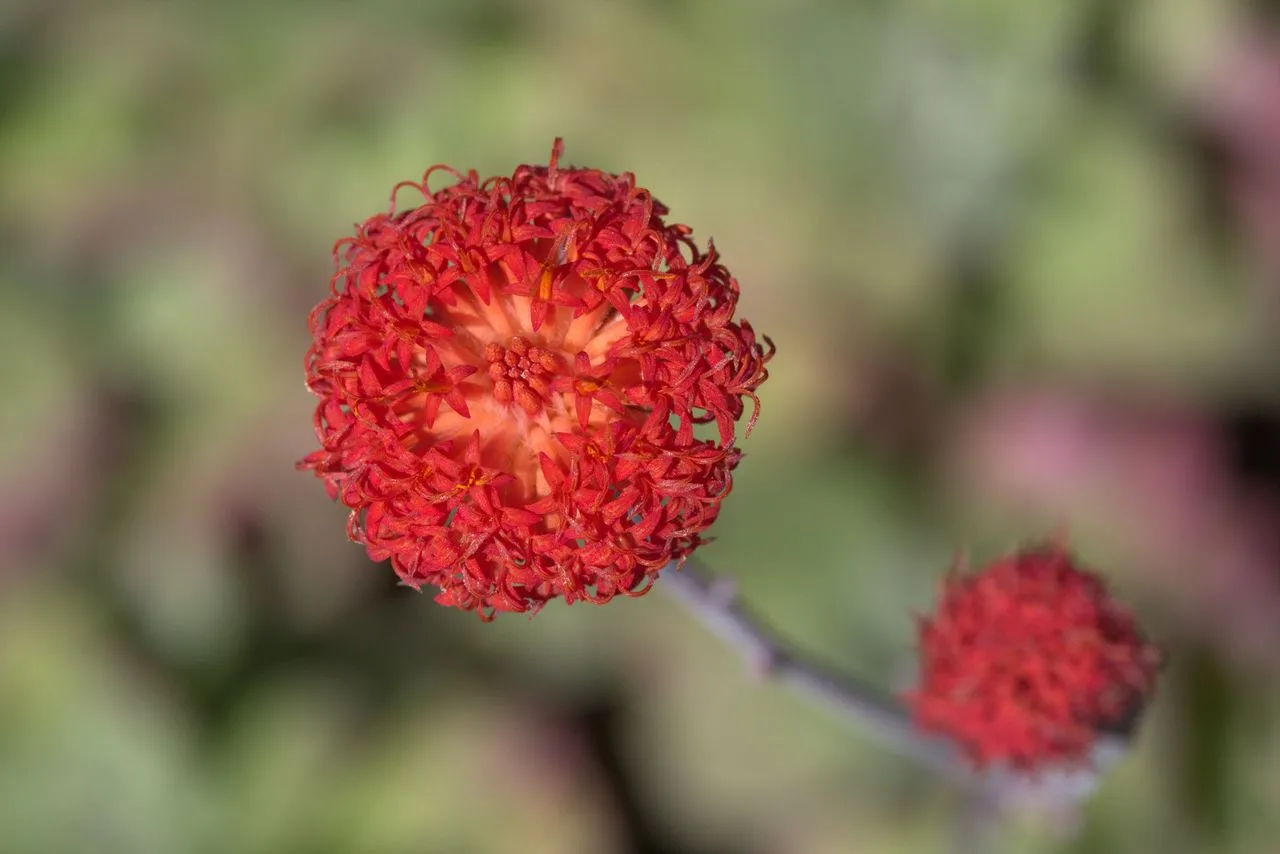
Senecio fulgens is a stem-forming southern African succulent described by Joseph Dalton Hooker (Hooker f.) in 1866 and figured shortly afterwards in Curtis's Botanical Magazine. The plant reaches 15 to 30 cm in height, with fleshy obovate-cylindrical green leaves 3 to 5 cm long, glabrous and clustered toward the upper portion of the stem. Its diagnostic feature is unmistakable in flower: brilliant coral-orange to red daisy-like inflorescences 6 to 10 cm wide, carried on terminal scapes in late summer. The horticultural common name is coral senecio.
Part of the Complete Senecio Guide.
The natural range sits in South Africa, restricted to the Eastern Cape and KwaZulu-Natal provinces, where the species grows on rocky sandstone and dolerite outcrops between roughly 100 and 1,200 m elevation. Habitats are summer-rainfall grassland and thicket margins, often on shallow soils that drain rapidly after storm events. Climate at these elevations is mild, with summer maxima around 28 °C and winter minima rarely below freezing in occupied populations. Conservation status under the South African Red List is Least Concern; the species is not CITES-listed.
A note on taxonomy. Most popular trailing succulent "Senecios" (Curio rowleyanus, C. radicans, and relatives) were transferred out of Senecio into the segregate genus Curio during the molecular re-evaluations of the early 2000s. Senecio fulgens remains in Senecio sensu stricto under those same treatments and was not moved to Curio. You will sometimes encounter the older synonym Kleinia fulgens in catalogue copy and on photo-archive databases; that name circulates but does not reflect the position adopted by the World Checklist of Vascular Plants for the species under the Curio split. For the wider context on Senecio versus Curio, see the complete Senecio guide.
Identification
In vegetative state S. fulgens is unremarkable: a soft-fleshed, semi-woody erect stem with smooth obovate leaves arranged spirally, sea-green to faintly glaucous on the upper surface and slightly lighter beneath. The stem thickens with age into a low woody caudex at the base, and leaves crowd toward the apex while the lower stem becomes leafless and visible.
The flower head is the unambiguous field separator from every species commonly confused with it.
- Coral-orange to red ray florets, 6 to 10 cm across the head, carried on a terminal peduncle that lifts the inflorescence well above the foliage. Most other succulent Senecio and almost all Curio species produce yellow, white, or cream daisies. A vivid orange-red capitulum on a fleshy succulent stem is, in this group, close to a single-species character.
- Glabrous obovate leaves, hairless, 3 to 5 cm long, lightly fleshy. This rules out S. haworthii, the cocoon plant, whose cylindrical leaves are densely covered in white wool and look entirely different at first glance.
- Continuous unsegmented stems. Each stem is a single fleshy column rather than a chain of joints. This rules out Senecio articulatus, the candle plant, whose stems break naturally into sausage-shaped segments with leaves attached at the joints.
- Erect or sub-erect habit. Curio rowleyanus (string of pearls) trails from a hanging pot and bears small spherical leaves a few millimetres across; the two are not confusable in person, only in catalogue listings that use "senecio" loosely. Curio articulatus (the Curio-treatment counterpart of S. articulatus) shares the segmented stems and likewise separates cleanly from S. fulgens.
If you have only the vegetative plant in front of you, read the leaf shape and the stem. Smooth obovate leaves on an unsegmented upright stem, with no wool, puts you in S. fulgens territory, particularly when the plant sits alongside other South African Senecios on the bench.
Cultivation
Coral senecio is more forgiving than the trailing Curio group. It tolerates the kind of mistakes that kill string of pearls within a week.
Light. Full sun outdoors in temperate climates; in hot Mediterranean and subtropical settings, light afternoon shade prevents leaf scorch on the upper foliage. Indoors, place within 30 cm of a south or south-west window (northern hemisphere) and target 5 hours of direct exposure. Insufficient light causes the stem to elongate and the flowering scapes to abort or never form; the plant will hold leaves under poor light but will not bloom.
Substrate. A free-draining mineral mix following the complete Senecio guide recipe: roughly 50% pumice or perlite, 25% coarse grit, 25% loam-based compost, with a target dry-down within 4 to 6 days of watering. Add a top dressing of 5 to 8 mm grit to keep the stem base dry between waterings.
Water. During summer growth, water thoroughly when the top 3 cm of substrate reads below 15% on a moisture probe, typically once every 10 to 14 days indoors. Reduce frequency through autumn into winter; once every 4 to 6 weeks during dormancy is usually enough at 8 to 12 °C. Tissue rehydrates visibly within 24 hours of watering when the plant has been allowed to dry properly between drinks.
Temperature. Hardy to about 0 °C if kept dry. Brief exposure slightly below 0 °C causes only cosmetic leaf-tip damage; sustained frost, or wet cold below freezing, collapses the stem at ground level. Move outdoor specimens under cover when overnight temperatures fall below 4 °C if rain is forecast. The upper limit is comfortable to 32 °C; above 35 °C stems may go briefly dormant, and watering should ease back rather than increase.
Pot. Terracotta, 1 to 2 cm wider than the root ball, with at least one drainage hole. The species has a modest root system and resents oversized pots; substrate stays damp at depth and rots the stem base. Repot every 3 to 4 years, refreshing the entire substrate rather than only top-dressing.
Propagation
Stem cuttings, the standard method for the wider group, work reliably for S. fulgens.
Take a 6 to 10 cm tip cutting in late spring or early summer, shortly before the active growth flush. Strip the lowest leaves, leaving 4 to 6 leaves on the upper portion. Allow the cut surface to callus in shade for 3 to 5 days, longer if humidity is high. Insert 2 cm into a dry mineral substrate (pumice plus a small fraction of perlite is sufficient), hold the pot in bright shade, and mist the surface lightly once a week without saturating the medium. Roots form within 18 to 28 days at 22 to 26 °C. Once new growth appears at the apex, transition to the standard substrate and watering schedule. Strike rates of 80 to 90% are realistic for clean material.
Seed germination is possible but slow, with seed-grown plants taking 3 to 4 years to flower. Most growers do not bother, given how readily cuttings strike.
Division of mature clumps is feasible in spring. Lift the plant, separate it so each new clump retains at least one independent rooted stem, and replant immediately into dry medium with watering held off for 7 days.
Notes
Mealybugs (Pseudococcus spp.) settle in the leaf axils of stem-forming Senecios, and S. fulgens is no exception. Check the upper leaves monthly during the growing season; a 70% isopropyl alcohol swab clears infestations before they reach root level. Aphids occasionally cluster on the flowering peduncles in spring and are knocked back by a strong water jet.
The species circulates under several names in trade. "Coral senecio", "scarlet kleinia", and the older synonym Kleinia fulgens all refer to the same plant. Buyers occasionally receive Senecio stapeliiformis (pickle plant) when ordering coral senecio, since both produce brilliant red-orange capitula; the segmented columnar stems of S. stapeliiformis are immediately distinguishable from the smooth obovate-leafy stems of S. fulgens in any vegetative state. Ask the seller for a vegetative photo if you cannot inspect in person.
Toxicity has not been individually surveyed for S. fulgens. Treat as mildly toxic to cats and dogs in line with the genus default, and keep ingestion away from grazing pets and curious children.
If this is your first succulent, the beginner's guide to succulents covers the cross-genus basics on light, water, and substrate before any single-species deep dive.
See also
- The complete Senecio guide, the genus-level pillar covering taxonomy of the Senecio versus Curio split and cultivation principles shared across the wider group.
- Beginner's guide to succulents, the cross-site master pillar on light, water, and substrate for new growers.
Frequently Asked Questions
Does Senecio fulgens belong in Curio?
No. The post states that S. fulgens remains in Senecio sensu stricto, though older synonym Kleinia fulgens appears in trade.
How do you identify Senecio fulgens?
The flower head is decisive: coral-orange to red ray florets, 6–10 cm across, on a fleshy upright plant. Most related succulent Senecios have yellow, white, or cream heads.
How cold-hardy is coral senecio?
It is hardy to about 0 °C if kept dry. Sustained frost or wet cold below freezing collapses the stem.
How do you propagate Senecio fulgens?
Take a 6–10 cm tip cutting in late spring or early summer, callus it for 3–5 days, and root it in mineral substrate.