| Question | Short Answer |
|---|---|
| Is Senecio vulgaris a succulent? | No. |
| Why is common groundsel on a succulent site? | The post includes it for disambiguation and toxicity context, because searchers sometimes confuse the Senecio name with succulent species. |
| How fast does Senecio vulgaris grow? | It can germinate year-round in mild climates, complete its life cycle in 5–8 weeks, and set several hundred seeds per plant. |
| How should Senecio vulgaris be controlled in pots? | Hand-pull before flowering. |
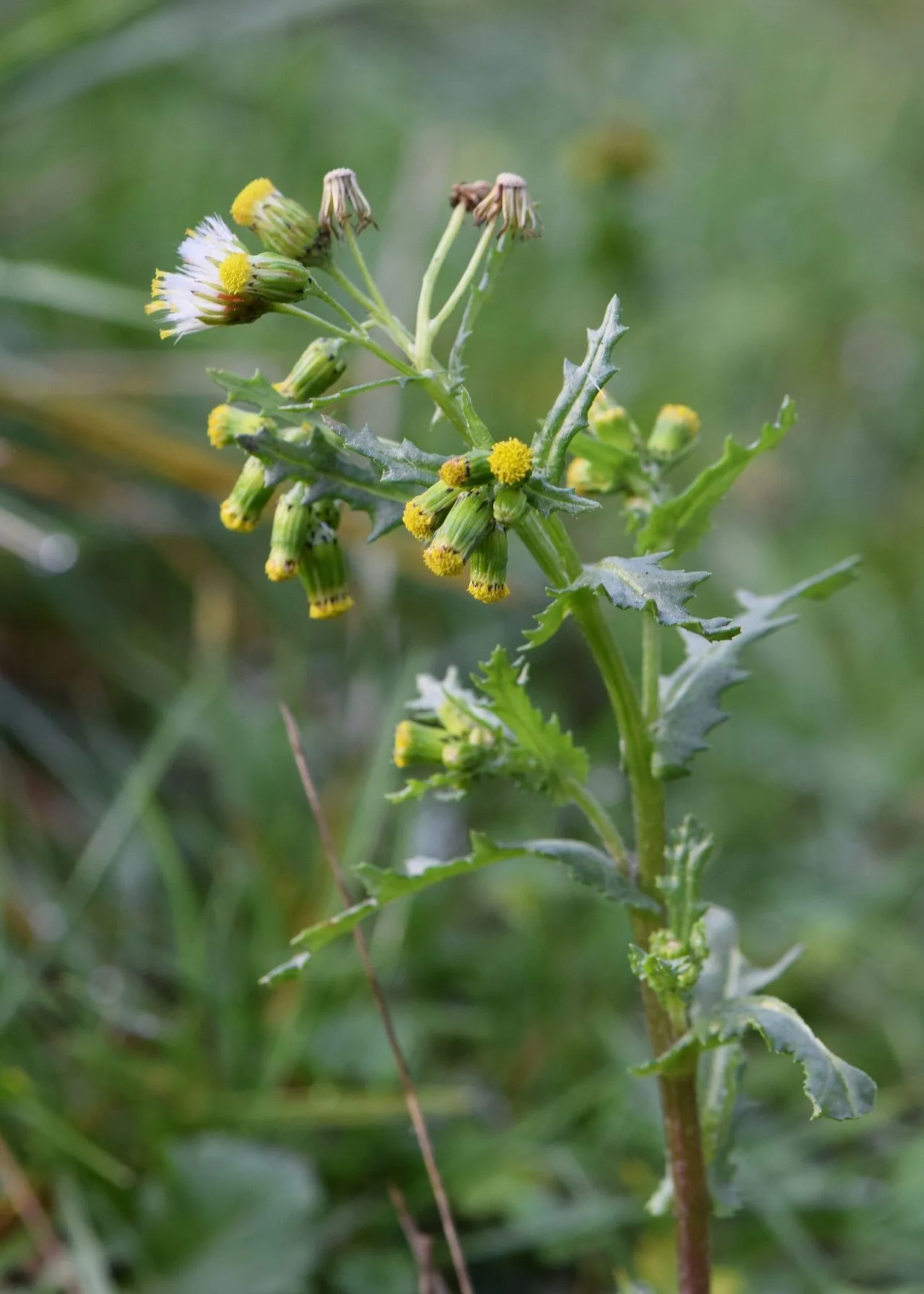
Senecio vulgaris L. is common groundsel. It is a small annual weed of disturbed ground, native to Europe and North Africa and now naturalised almost worldwide. It is not a succulent and has never been cultivated as an ornamental.
This page exists to disambiguate, since search queries occasionally arrive at succulent websites looking for "senecio vulgaris care". Part of the Complete Senecio Guide.
What the plant actually is
- Annual herb, 10–40 cm tall, with a shallow taproot.
- Stems hollow, soft, branching.
- Leaves alternate, deeply pinnately lobed with coarsely toothed margins, 3–10 cm long; thin and non-succulent.
- Flower heads small yellow rayless capitula, 5–10 mm long, in loose terminal clusters.
- Seeds carry a silky pappus and disperse on wind.
Germinates year-round in mild climates, completes its life cycle in 5–8 weeks, and sets several hundred seeds per plant. It is a common weed of arable land, gardens, and pavements.
Why this is on a succulent site
Most visits to this page are accidental, often from people misreading "vulgaris" as a succulent epithet. The only legitimate reason to include S. vulgaris in a succulent-site reference is the toxicity discussion: the species is one of the species that gave Senecio its pyrrolizidine-alkaloid reputation, and any general toxicity notes about the genus trace back to this plant and to S. jacobaea (ragwort).
Brief notes
- No horticultural care required. The plant is a weed.
- Control is mechanical (hand-pulling before flowering) or chemical in agricultural settings.
- All parts contain pyrrolizidine alkaloids. Ingestion by livestock, particularly cattle and horses, causes chronic hepatotoxicity. Contamination of hay or silage with S. vulgaris is a reportable agricultural problem.
- Not useful as an ornamental; not edible; not safe as a herbal remedy despite occasional historical use.
If you were expecting a succulent
The succulent members of the Senecio / Curio group are all southern African in origin and bear no resemblance to common groundsel beyond the composite (daisy) flower type shared with the wider genus. Start with:
- Senecio rowleyanus — string of pearls.
- Senecio mandraliscae — blue chalksticks.
- Complete Senecio Guide — overview of the succulent group.
Notes
If you are dealing with S. vulgaris as a weed in a succulent collection, the practical point is: it is harmless to the succulents themselves (no parasitism, no disease vectoring) but its seed load can colonise freshly prepared pots quickly. Weed it out before it flowers and the problem does not recur.
See also
- Senecio aureus — golden ragwort, another non-succulent relative.
- Senecio integerrimus — North American Packera.
- Senecio cineraria — silver ragwort, non-succulent bedding plant.
Frequently Asked Questions
Is Senecio vulgaris a succulent?
No. It is a thin-leaved annual weed and has never been cultivated as an ornamental succulent.
Why is common groundsel on a succulent site?
The post includes it for disambiguation and toxicity context, because searchers sometimes confuse the Senecio name with succulent species.
How fast does Senecio vulgaris grow?
It can germinate year-round in mild climates, complete its life cycle in 5–8 weeks, and set several hundred seeds per plant.
How should Senecio vulgaris be controlled in pots?
Hand-pull before flowering. It is not parasitic, but its seed load can quickly colonise freshly prepared pots.