| Question | Short Answer |
|---|---|
| Is Senecio angulatus invasive? | Yes, it is listed as invasive in parts of southern Australia, New Zealand, southern France, and coastal California. |
| How is Senecio angulatus different from Senecio macroglossus? | S. |
| Does Senecio angulatus tolerate frost? | Frost damages the plant below 0 °C. |
| How do you propagate Senecio angulatus? | Stem cuttings root with little effort. |
Senecio angulatus L.f. is the Cape ivy or creeping groundsel. Like its relative S. macroglossus, it is a semi-succulent climber rather than a classic rosette or trailing succulent. It remains in Senecio sensu stricto.
Native to the Cape region of South Africa, where it scrambles over coastal shrubs and rocks in frost-free low-altitude sites. Part of the Complete Senecio Guide.
Identification
- Scrambling or climbing stems to several metres, becoming semi-woody with age.
- Leaves triangular to hastate (arrow-shaped) with two basal lobes, 3–6 cm long, fleshy, glossy green.
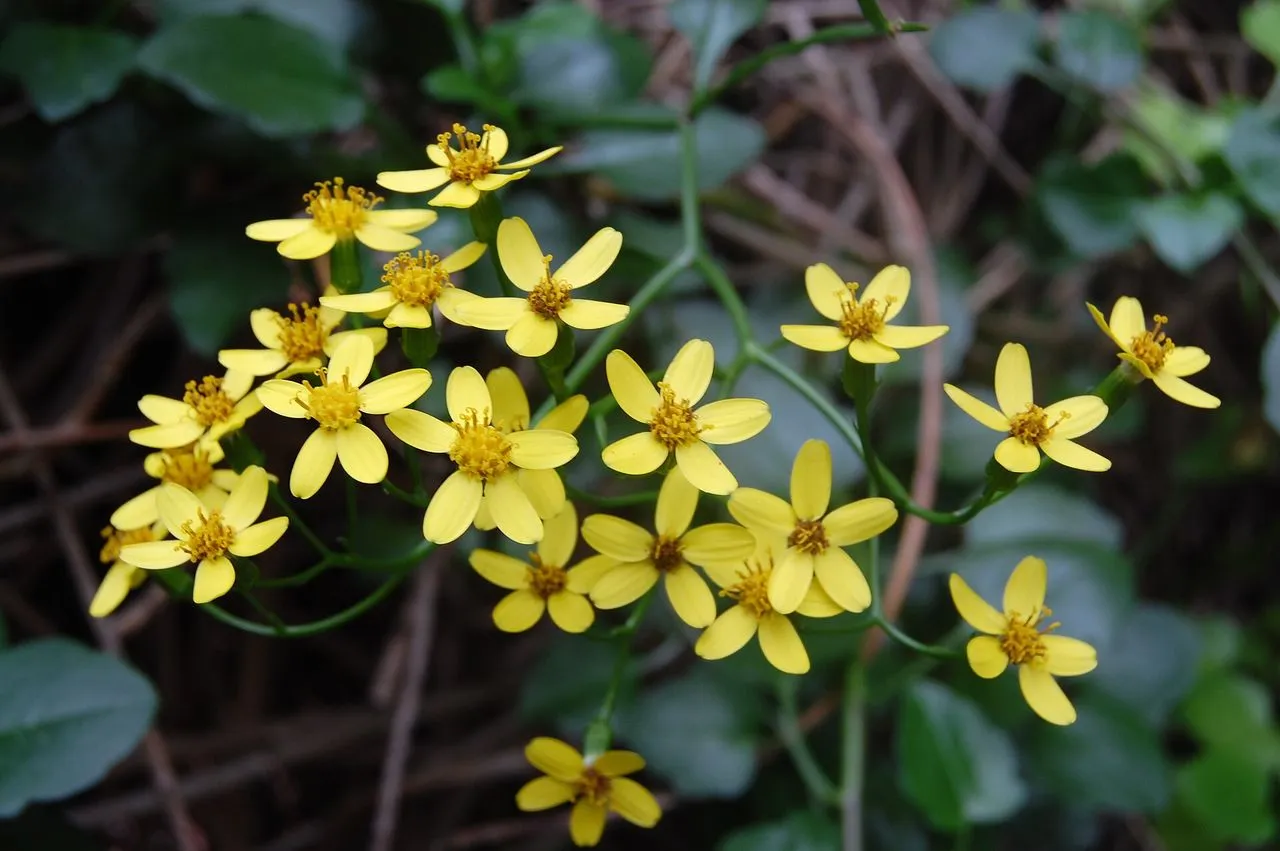
- Capitula bright yellow, ray-bearing, in dense terminal clusters; flowers profusely in late autumn and early winter.
- Mildly latex-exuding from broken stems.
Distinguished from S. macroglossus (wax ivy, with 3–5-lobed ivy-shaped leaves) by the simpler arrow-shaped leaves with two basal lobes and by the dense clustered flower heads. Distinguished from S. mikanioides (German ivy) by the fleshier leaves and less aggressive growth rate.
Cultivation
Easy in frost-free climates, invasive in some of them. Divergences from the pillar:
- Light. Bright to full sun outdoors. Tolerates fairly deep shade as a houseplant but flowers only in bright positions.
- Water. Moderate. The fleshy leaves buffer short dry spells but prolonged drought drops lower leaves. Weekly watering in active growth, fortnightly in cool winter rest.
- Substrate. Free-draining but somewhat more organic than the pillar default. 40% loam / 30% pumice / 30% grit works.
- Cold. Frost-damages below 0 °C; mature plants often resprout from the base after a mild frost.
- Support. Needs a trellis, fence, or shrub to scramble over outdoors; adapts to a moss pole indoors.
Vigorous. Prune routinely to keep the plant within bounds.
Propagation
Stem cuttings root with no effort. A 15 cm section pushed into any substrate and kept lightly moist will root within two weeks. The species spreads so freely from fragments that fallen pruning material often roots in the compost heap.
Notes and quirks
Listed as invasive in parts of southern Australia, New Zealand, southern France, and coastal California, where escaped garden specimens have smothered native vegetation. In garden use, keep it contained and dispose of prunings responsibly; do not compost live stem fragments.
The winter yellow flower display is dense and attracts bees in significant numbers. As a seasonal cut-flower element for outdoor arrangements it is underrated.
Moderately toxic to livestock; the pyrrolizidine alkaloid content is closer to pasture Senecio levels than to most succulent species, and grazing animals should not have access.
See also
- Senecio macroglossus — wax ivy, the tamer climbing cousin.
- Senecio mikanioides — German ivy, a more aggressive climber.
- Senecio vulgaris — common groundsel, another widespread Senecio weed.
Frequently Asked Questions
Is Senecio angulatus invasive?
Yes, it is listed as invasive in parts of southern Australia, New Zealand, southern France, and coastal California. Keep garden plants contained and dispose of prunings responsibly.
How is Senecio angulatus different from Senecio macroglossus?
S. angulatus has simpler triangular to hastate leaves with two basal lobes. S. macroglossus has clearer 3–5-lobed ivy-shaped leaves.
Does Senecio angulatus tolerate frost?
Frost damages the plant below 0 °C. Mature plants may resprout from the base after a mild frost, but it is not reliably hardy.
How do you propagate Senecio angulatus?
Stem cuttings root with little effort. A 15 cm section kept lightly moist can root within two weeks.