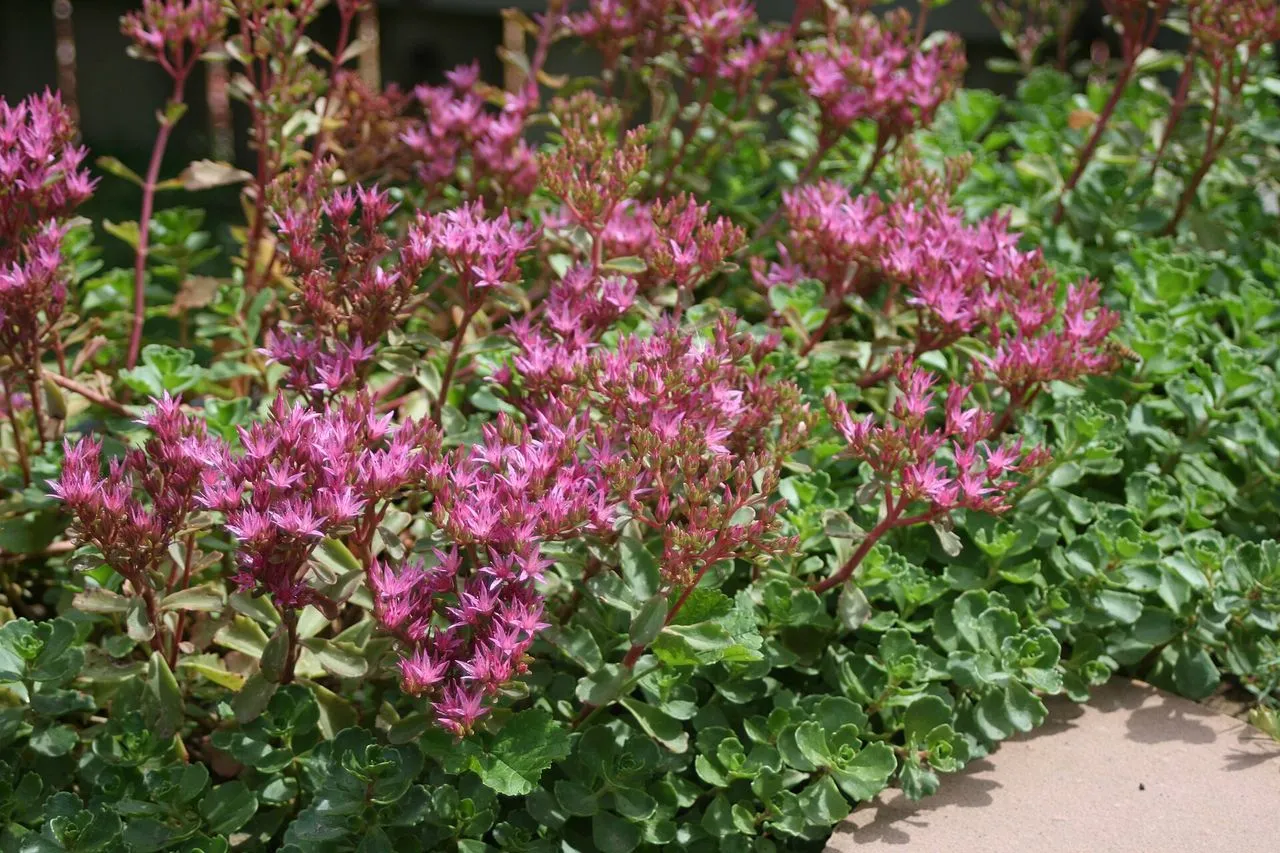
Stretching — the technical term is etiolation — is the single most common cultural problem for Sedum grown indoors. The genus evolved mostly in high-light environments: rock faces, cliff ledges, dry hillsides, roof tiles. The internodal distance in a correctly lit Sedum is very short: leaves are packed close together, stems are short and stout, and the plant has a compact, sculptural quality. Deprive it of light, and auxin-driven cell elongation kicks in immediately. Stems lengthen toward the light source, leaves space apart, and the plant loses its characteristic form within weeks.
The diagnosis is usually obvious. The fix is a combination of better light for new growth and selective pruning to restore compact form. Part of the Complete Sedum Guide.
Insufficient light indoors
This is the cause in almost all indoor cases. Sedum is not adapted to the typical brightness levels of a north-facing room or a position more than 1 m from any window. A lux meter placed at the plant position in mid-afternoon will often read below 500 lux in what appears to the eye as a reasonably lit room. Compact sedum growth requires roughly 2,000–10,000 lux for 8–10 hours per day, and 10,000–25,000 lux is common in an east-facing window with direct morning sun; the same indoor-light threshold logic is covered in the indoor succulent care guide.
The symptoms develop progressively. First the plant leans toward the brightest point. Then new leaves emerge with slightly more spacing between them than older leaves. Then the internodes become clearly visible as gaps between leaves. Finally, the growing tips consist of a small tuft of correctly-sized leaves above a section of pale, bare, or widely-spaced stem.
Trailing species — Sedum morganianum (donkey's tail), S. rubrotinctum (jelly beans), S. nussbaumerianum — show the most dramatic etiolation because their normal appearance depends on closely-packed leaves. A well-grown S. morganianum tail is a dense cylinder of plump leaves with no visible stem between them. In low light, that same tail becomes a string of widely-spaced leaves with gaps of 1–3 cm of visible stem — the entire visual quality is lost, much like the loose strands described in the Senecio leggy and stretched guide.
Upright ground-cover types — S. album, S. acre, S. dasyphyllum — also stretch, but the effect is less immediately obvious because their normal structure has some visible stem between leaves even in good light. They become more gangly and less compact rather than completely changing form.
Warm temperature combined with low light
Warm indoor temperatures in winter and spring accelerate etiolation. A plant in a heated room at 20–22 °C has active metabolism and growth hormones moving through the stem. With adequate light, that metabolic activity produces compact leaf and stem growth. Without adequate light, it produces only internode elongation. The warmth drives the growth; the light deficiency determines its form.
This is particularly relevant in autumn, when days shorten significantly. A plant that was adequately lit in July on a south windowsill may begin etiolating noticeably by October as the sun angle drops and day length shortens — even though it has not been moved.
Seasonal window position changes
Even a correct summer position can become insufficient in winter. The sun's angle decreases 47° from summer to winter solstice in mid-latitudes, and a south-facing window that received 6 hours of direct sun in June may receive only 2–3 hours of weak winter sun by December. If the plant's winter stretching is seasonal and corrects itself in spring without other intervention, the position is marginal rather than completely unsuitable — consider supplemental grow lighting for winter months.
How to assess the degree of etiolation
| Observation | Degree | Suggested action |
|---|---|---|
| Plant leaning toward window, no visible stem gaps | Early | Rotate pot; move closer to window |
| Some leaves slightly spaced, minimal stem visible | Mild | Move to brighter position; no pruning yet |
| Visible stem sections of 1–3 cm between leaf clusters | Moderate | Prune and re-root tips; improve light |
| Long bare stem sections, small tuft of leaves at tips | Severe | Hard prune; root multiple cuttings |
Solutions
Improve light first
Move the plant to the brightest available position before any pruning. An east or south-facing window with direct morning or midday sun, or a full-spectrum grow light placing 3,000–10,000 lux at the plant canopy for 12–14 hours per day. A plant pruned and then returned to the same dim position will re-stretch in the same pattern within 4–6 weeks.
Note the light-transition rule: leaves adapted to low light will burn in direct summer sun. Move gradually — a week in a bright indirect position, then into direct-sun exposure — to avoid adding sunburn to the list of problems.
Prune and re-root the tips
For moderate-to-severe etiolation, take stem tip cuttings from the compact upper portions. Each cutting should be 5–10 cm long with at least 3–4 leaves at the tip. Remove the lower 2–3 leaves, allow the cut end to callus for 24–48 hours in dry shade, then insert into a small container of dry mineral mix. Place in bright indirect light and begin light watering after 7 days. Roots form in 2–4 weeks.
The cuttings from a well-lit, correctly-compact top section will grow compactly from the start, provided they are in adequate light. This is the most reliable way to restore compact form — the stretched sections below the cut nodes will not magically become compact again, but the new rooted cuttings will.
Cut the mother plant back
After removing cuttings, cut the remaining stem back to a healthy node with a compact leaf cluster. If the plant is otherwise healthy, new side shoots emerge from the remaining nodes within 3–5 weeks in bright light. A sedum that looks like a bare stick after a hard pruning often regrows surprisingly vigorously.
Grow lights for winter
A full-spectrum LED panel providing 2,000–5,000 lux at the plant surface for 14 hours per day eliminates winter etiolation entirely. Place the light 15–25 cm above the plant canopy and use a timer to ensure consistency. This is the most reliable indoor solution for species with the highest light requirements.
Prevention
Position all Sedum in the brightest available location from the start — not in a decorative corner shelf because it looks attractive there. East or south windows are the minimum for most species. Rotate pots by 90° every 2–3 weeks to distribute light evenly and prevent directional stretching. If the location is winter-marginal, add supplemental grow light from October to March. Review any plant that is growing without the characteristic compact dense form — it is almost certainly telling you it needs more light.
For the cactus etiolation fix procedure — which applies equally to sedum — the beheading and re-rooting steps are the same whether the plant is a cactus or a trailing stonecrop.
See also
- Cactus etiolation fix — beheading, callusing, and re-rooting the compact top; the same procedure applies to sedum.
- Sedum morganianum — the trailing sedum most dramatically affected by etiolation; includes light requirements for maintaining the characteristic dense tail.
- Indoor succulent care — light levels, grow lights, and window position strategies for keeping sedum compact year-round.
Frequently Asked Questions
Why is my sedum stretching indoors?
Insufficient light. Sedum is a high-light genus — most species need 4–6 hours of direct sun or the equivalent in bright indirect light to maintain compact internodes. Indoor positions more than 60–100 cm from a south or west window typically fall below the minimum.
Can a leggy sedum go back to its compact shape?
The already-stretched stem does not compact. Prune back to a compact section, re-root the tips as cuttings, and provide adequate light for both the mother plant and cuttings. New growth in correct light will be compact.
My Sedum morganianum is losing its beaded appearance — why?
Almost always etiolation. S. morganianum is particularly dramatic when stretched — the fat, beaded leaves become spaced apart and the characteristic dense tail is lost. Move to very bright indirect or morning direct light. The stretched sections do not recover, but new growth in correct light is compact.
Does sedum need direct sun?
Most species prefer 4–6 hours of direct sun outdoors or the equivalent in very bright indirect indoor light. Some compact ground-cover sedums (S. dasyphyllum, S. album) grow in slightly less. Trailing types (S. morganianum, S. rubrotinctum) are among the highest-light requirements in the genus.