| Question | Short Answer |
|---|---|
| Is Lime Zinger a sedum or Hylotelephium? | It is sold as Sedum Lime Zinger, but it belongs with the compact Hylotelephium hybrids in the SunSparkler series. |
| How large does Lime Zinger grow? | Plants form a low dome 10–15 cm tall and 30–40 cm wide, suitable for the front of a border. |
| How is Lime Zinger different from Angelina? | Lime Zinger is a herbaceous clumping perennial with rounded chartreuse leaves edged red. |
| Does Lime Zinger need staking or Chelsea chop? | No. |
'Lime Zinger' is a compact herbaceous perennial sedum in the SunSparkler series bred by Chris Hansen in the United States and released around 2013. As with its sibling 'Dazzleberry', the cultivar is most correctly placed in Hylotelephium ('Lime Zinger'), though the horticultural trade uses the simpler Sedum form on labels.
The breeding combines Sedum cauticola with larger H. telephium ancestry to produce a low mounding plant with distinctive yellow-green leaves edged in cherry red.
Part of the Complete Sedum Guide.
Identification
A compact herbaceous perennial, 10 to 15 cm tall and 30 to 40 cm wide, forming a tight low dome rather than an upright stand.
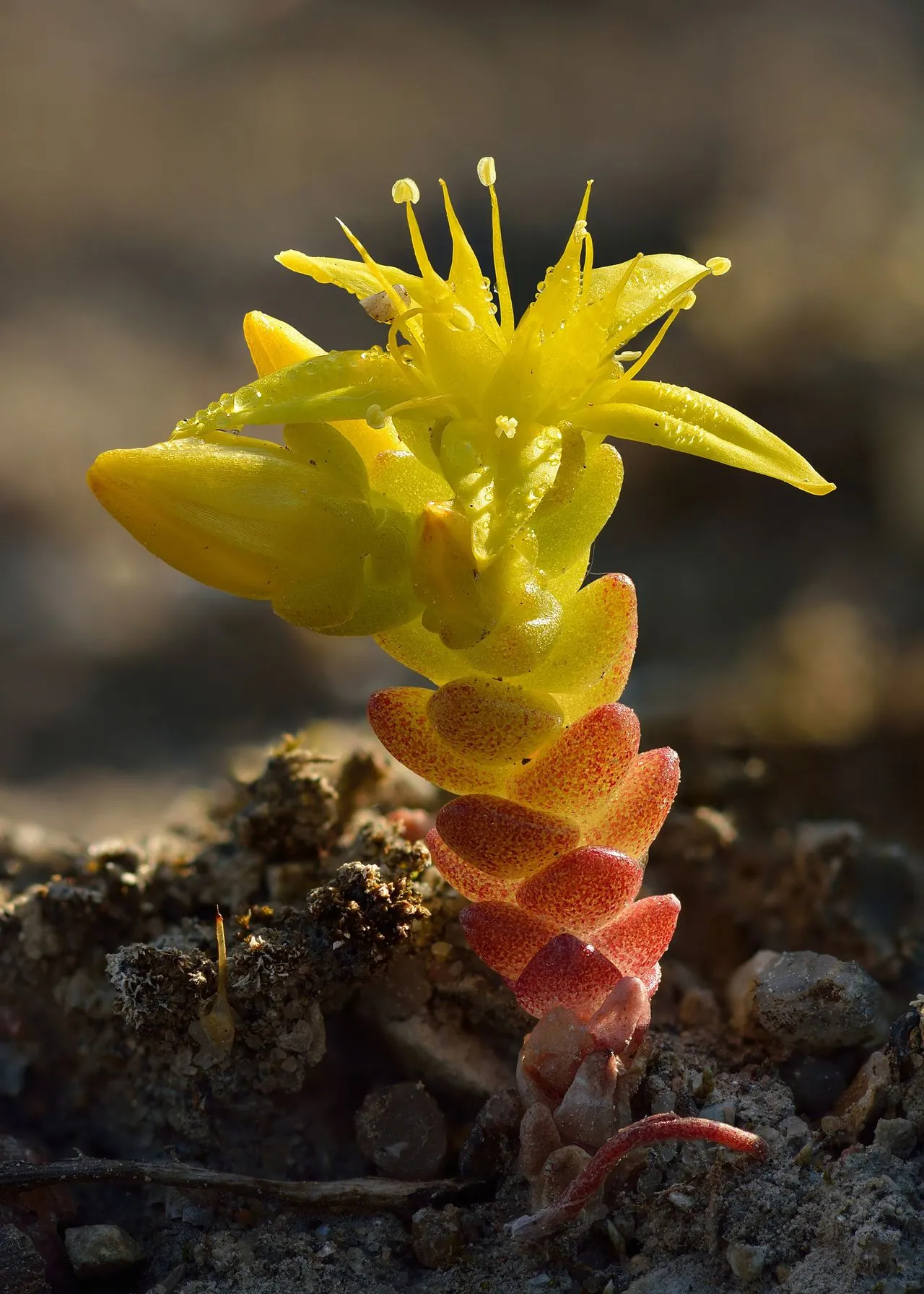
- Leaves. Rounded to obovate, 2 to 3 cm long, thickly fleshy, bright chartreuse to lime-green with a distinct cherry-red edge. The leaf margin pigmentation is the diagnostic feature; under cooler weather the red intensifies and widens.
- Stems. Short and sturdy, radiating from a central crown. Does not produce tall stems needing support.
- Inflorescence. Flat-topped cymes 8 to 10 cm across of bright pink five-petalled flowers, opening in late August and persisting through September. Flower colour is less saturated than that of 'Dazzleberry' but still clear pink.
Tell 'Lime Zinger' from 'Angelina' (chartreuse mat-forming creeper, no red edge, needle-like leaves) by leaf shape and growth habit. 'Lime Zinger' is a herbaceous clumping perennial; 'Angelina' is an evergreen creeping mat. The two cultivars have chartreuse colour in common but nothing else.
Cultivation
Grow as for the other SunSparkler hybrids: full sun, sharp drainage, lean soil, no fertiliser. Cold-hardy to USDA zone 4. Dies back to ground level each winter and re-emerges from crown buds in spring.
Light is the main lever for both foliage colour and flowering. The chartreuse leaf colour is brightest in full sun and fades toward plain green in part shade. The red leaf margin is also sun-dependent. For the named effect, plant where the cultivar receives at least six hours of direct sun daily.
Compactness is a bred feature. 'Lime Zinger' does not need the Chelsea chop or any staking. Plant in the front row of a border at 30 cm spacing.
Does not tolerate sustained wet feet; the compact root system is susceptible to crown rot in waterlogged winter conditions. Plant into gritty substrate or raise the bed on heavy clay.
Propagation
Stem cuttings are the standard method. Take a 10 cm non-flowering shoot in late spring, strip the lower leaves, push into gritty substrate. Roots within two weeks.
Division is straightforward but rarely needed; the compact habit means clumps hold their form for years without requiring renewal. If the centre begins to die out after five or so years, lift in early spring and split.
'Lime Zinger' is patent-protected in the US and several other jurisdictions. Home propagation for personal use is unrestricted; commercial propagation requires a licence.
Notes
'Lime Zinger' fills a specific design niche: a compact, front-of-border late-flowering perennial with chartreuse foliage. Before the SunSparkler series there was no straightforward way to get that combination of traits in a single plant. The cultivar is particularly useful in three situations.
First, as a low edge along a path where summer-long foliage interest matters more than flowers. The red leaf edges carry visual interest from May through October.
Second, as a chartreuse accent in a composition of darker plants. It combines well with Heuchera 'Obsidian', small purple-leaved Phormium, and dark-leaved ornamental grasses.
Third, as a late-season pollinator plant in a pollinator-focused border. The pink flowers in late August and September are heavily worked by bees, hoverflies, and small butterflies at a time when many garden plants have finished blooming.
In a mixed Sedum planting, 'Lime Zinger' pairs particularly well with 'Dazzleberry' (raspberry flowers, smoky foliage) and with 'Firecracker' (coral flowers, dark foliage). The three together produce a long ribbon of contrasting foliage and flower colour at the front of a border.
Deer and rabbit resistant. No significant pest issues under normal conditions.
See also: Sedum Dazzleberry, SunSparkler Sedum, Sedum Autumn Fire.
Frequently Asked Questions
Is Lime Zinger a sedum or Hylotelephium?
It is sold as Sedum Lime Zinger, but it belongs with the compact Hylotelephium hybrids in the SunSparkler series.
How large does Lime Zinger grow?
Plants form a low dome 10–15 cm tall and 30–40 cm wide, suitable for the front of a border.
How is Lime Zinger different from Angelina?
Lime Zinger is a herbaceous clumping perennial with rounded chartreuse leaves edged red. Angelina is an evergreen creeping mat with needle-like leaves and no red edge.
Does Lime Zinger need staking or Chelsea chop?
No. Compactness is bred into the cultivar, so staking and Chelsea chop are unnecessary under normal full-sun, lean-soil conditions.