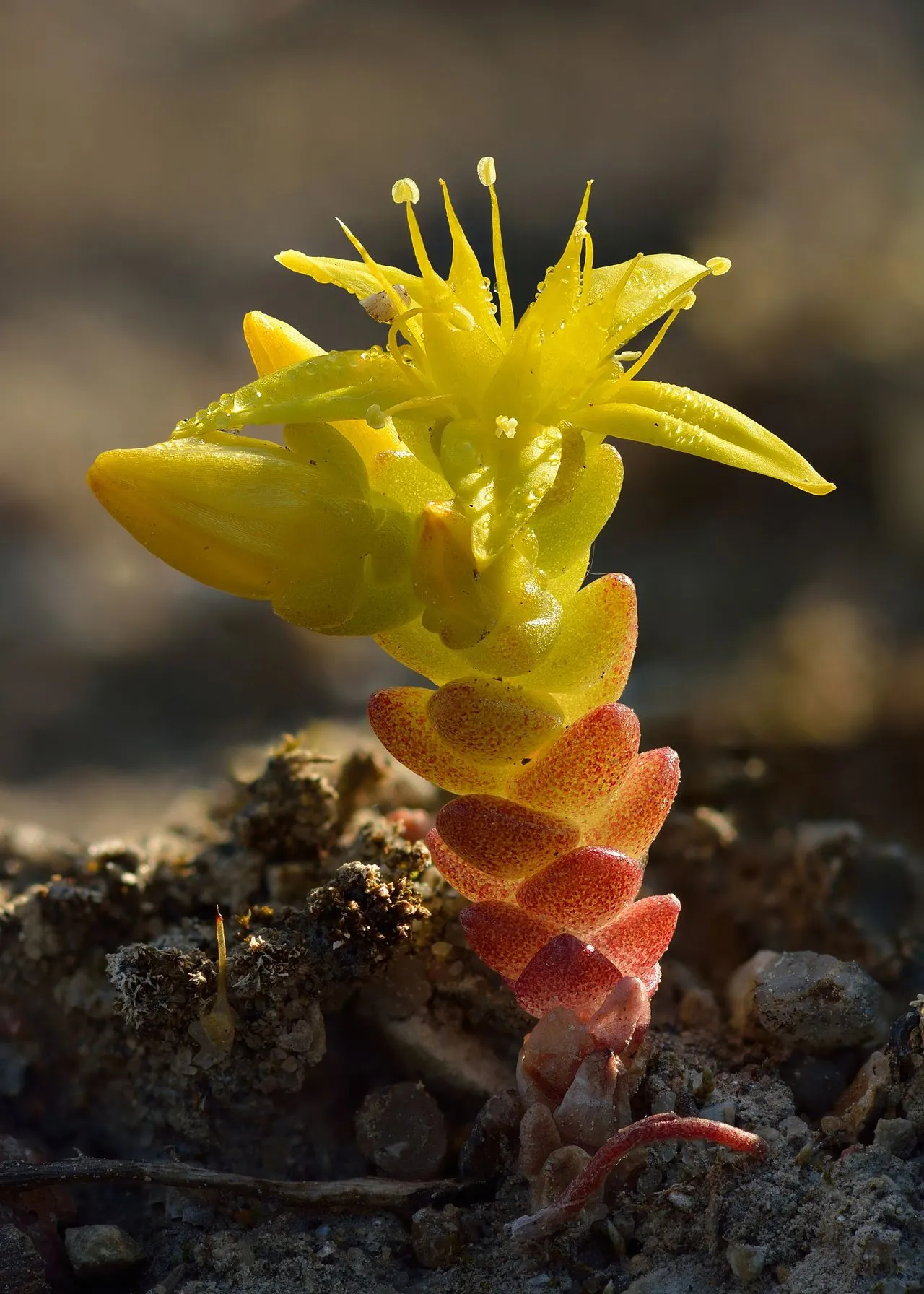
Most Sedum and Hylotelephium are reliable annual flowerers given correct conditions. When a sedum fails to produce flowers — or produces buds that stall and drop before opening — the cause is almost always one of four things: insufficient light, too much nitrogen, insufficient cold dormancy in the border types, or a plant that has not yet reached flowering age. These causes are distinct, and the fix for each is different. Identifying which applies before the next growing season is what determines whether next year's display improves.
Part of the Complete Sedum Guide.
Insufficient light
Insufficient light is the most common cause of non-flowering across the entire genus. Sedum evolved predominantly on exposed rock faces, cliff ledges, dry hillsides, and open grassland where light levels in the growing season rarely fall below 10,000 lux during daylight hours. The plant requires a light threshold not only for photosynthesis but for the photoperiodic and biochemical signalling that switches growth from vegetative to reproductive mode. A plant receiving adequate light to survive and grow is not necessarily receiving enough to flower.
In outdoor borders: a sedum shaded by adjacent shrubs, trees, or building structures for more than half of a summer day will grow but rarely flower. The classic scenario is a border sedum planted three to four seasons ago when the surrounding shrubs were smaller — it flowered reliably for the first two seasons and has not flowered since as the shrubs closed in. The sedum has not changed; its light environment has.
In indoor settings: tender sedum on a windowsill with fewer than four hours of direct sun per day will remain in vegetative growth. A south or east window with direct morning or midday sun is the minimum. Note that windows can be significantly dimmer than they appear — a plant 90 cm from a south-facing window typically receives roughly 20–30% of the light available at the glass. A lux meter placed at the plant canopy often reveals that what felt like a bright spot registers below 1,500 lux.
The border Hylotelephium types — 'Autumn Joy', 'Autumn Fire', 'Matrona', 'Purple Emperor' — are plants of open Central Asian and European steppes. Even partial afternoon shade reliably reduces flowering in many years. They are not shade-tolerant plants, and placing them anywhere that is not in full open sun for most of the day is accepting the risk of irregular or absent flowering. This applies equally to the compact modern cultivars. See sedum leggy stretched if the non-flowering plant is also showing visible etiolation — both symptoms share the same root cause and the same fix.
Fix: move outdoor sedum to the sunniest available position. Remove or hard prune overhanging vegetation. For indoor tender sedum, a south or east window or a full-spectrum grow light at 4,000–10,000 lux for 12–14 hours per day resolves light-driven flowering failure. Expect the plant to respond in the following seasonal cycle, not immediately.
Excess nitrogen
High nitrogen in the substrate directs the plant's metabolic resources toward vegetative growth at the expense of reproductive growth. A sedum that has received heavy fertilisation — particularly from lawn feeds broadcast across a border, from over-generous compost mulching, or from high-nitrogen granular fertilisers — produces abundant lush green growth and few or no flowers. This is especially common in Hylotelephium types planted near a lawn where fertiliser drift reaches the bed, and in container sedum that has been watered with liquid plant food throughout the season.
Diagnostic picture: the plant is large and leafy, with normal or deeper green colour than expected for the cultivar, but flower buds either fail to form or form late and abort. The stems are taller than expected and somewhat soft rather than firm. Foliage is lush. In some cultivars, the characteristic reddish or bronze leaf tones are reduced or absent because high nitrogen suppresses anthocyanin production.
Fix: eliminate all supplemental fertiliser for a full growing season. For sedum in a heavily amended border, top-dress with unfertilised coarse grit to dilute the nitrogen at the surface layer. The following spring, at most a light top-dressing of balanced low-nitrogen compost — no liquid feed, no granular fertiliser. Sedum evolved on nutrient-poor substrates; its flowering performance is better at marginal fertility than under abundance. This runs counter to most gardening instinct but the evidence from rock-garden practice is consistent. See sedum telephium for the specific nutritional profile appropriate for border sedums.
Insufficient cold dormancy — border types only
Hylotelephium telephium and related border sedums are temperate perennials adapted to climates with cold winters. Flower bud initiation in these plants is partly regulated by a chilling requirement — a minimum number of weeks spent below approximately 5 °C. Plants grown in mild-winter climates (broadly USDA zone 8b and warmer), kept in heated conservatories over winter, or brought indoors at warm temperatures before the dormancy period is complete may accumulate insufficient chilling hours to trigger reliable bud formation the following season.
This is not a concern for the mat-forming hardy species such as S. acre, S. album, and S. kamtschaticum, which have lower or absent chilling requirements and initiate flowers more simply. The chilling requirement is specific to the large Hylotelephium types — the tall late-summer border plants. Gardeners in southwestern England, the Pacific Northwest, or parts of Australia and New Zealand trying to grow 'Autumn Joy' in-ground sometimes encounter this problem: the plant grows vigorously but flowers inconsistently or not at all.
Fix: allow Hylotelephium plants to experience their full natural dormancy period outdoors. Do not move them into heated conditions before the tops have died back naturally. Do not begin feeding until new spring growth is 5–10 cm above the crown. In genuinely mild-winter climates (rarely below 5 °C overnight), the tall Hylotelephium types are not ideal choices. Consider replacing with the compact modern SunSparkler series — see sedum sunsparkler — which have been selected for performance in a wider range of winter conditions, or with tender rosette species such as S. nussbaumerianum and S. adolphi that flower without a chilling requirement.
Plant too young
Sedum does not flower in its first growing season from a cutting or division in most cases. Mat-forming species (S. acre, S. album, S. spurium) typically take one to two growing seasons from a cutting to their first flower. Upright Hylotelephium types require two to three seasons from a division or cutting before producing a substantial first flowering. Tender rosette types (S. nussbaumerianum, S. rubrotinctum) may take two to three seasons from cutting, and seed-grown plants of any species take longer than vegetatively propagated material.
If a plant was acquired, divided, or propagated within the last 12–18 months and has not flowered, verify that light and fertility are correct, and then allow time. A sedum that flowered reliably and then skipped one year after being divided is also expected behaviour — the transplant stress redirects metabolic resources toward root re-establishment rather than reproduction. Both the freshly divided plant and the mother plant may skip one flowering season after the procedure.
Flower buds formed but dropped before opening
If visible flower buds form but then stall, dry, or drop without opening, the cause is usually acute environmental stress at a critical developmental moment. The most common triggers: a severe drought during bud elongation (even one week of complete substrate dryness during active bud development can abort buds), a frost event below –2 °C on frost-tender bud tissue in spring, or a heavy aphid infestation on the flower buds themselves. See sedum aphid infestation if the buds are distorted, sticky, or surrounded by clustering small insects.
For border sedums: check soil moisture during the period from bud set to flowering. The substrate should be uniformly moist but not waterlogged. Drought-check indicators include a lightweight pot, dry substrate 3–4 cm below the surface, and any associated wrinkling on newer leaves.
Identifying the cause
| Observation | Most likely cause |
|---|---|
| Plant large, leafy, dark green, no bud formation | Excess nitrogen |
| Plant compact but in shade or dim window | Insufficient light |
| Correct sun and nutrition; mild-winter climate | Insufficient cold dormancy |
| Plant propagated or divided within last 18 months | Too young for reliable flowering |
| Buds form then drop or dry before opening | Environmental stress at bud stage |
Risk and severity
Failure to flower is not a health risk. A non-flowering sedum is otherwise a healthy plant. The urgency is proportional to the purpose of the planting. For Hylotelephium types planted specifically for late-summer ornamental flowering and pollinator value, non-flowering represents a significant loss of the plant's garden function. For mat-forming sedum used as ground cover, flowering is secondary to structure and foliage — a missed flowering year is a minor aesthetic matter.
Solutions
Light correction
Move to full sun — outdoors, a position receiving 6+ hours of direct sun daily. Indoors, the brightest available window or a grow light at 4,000–10,000 lux for 12–14 hours. Results appear in the next season's bud cycle. See sedum autumn fire for an example of a cultivar that demonstrates the full flowering potential of correctly sited Hylotelephium.
Nutrition reset
Stop all supplemental fertiliser for the current and following growing season. Top-dress with unfertilised grit. Reintroduce only a minimal balanced compost top-dressing the spring after that.
Cold dormancy management
Allow Hylotelephium types full outdoor winter exposure within their hardiness range. Do not move to heated spaces for winter. Do not feed until new shoots are established in spring.
Young plants
Maintain correct light, drainage, and minimal fertility. Allow time — 2–3 seasons from a cutting is the normal maturation window.
Prevention
Plant all sedum in the sunniest available position from the start. Feed at most once per year with balanced fertiliser at half the label rate. Allow Hylotelephium types to complete full outdoor dormancy each winter. Divide border sedums every 3–4 years to rejuvenate crowns, as old congested crowns produce fewer flowering stems than vigorous younger divisions.
See also
- Sedum leggy stretched — etiolation and non-flowering share the same cause; a stretched plant and a non-flowering plant in similar conditions need the same fix.
- Sedum autumn fire — a Hylotelephium cultivar selected for reliable and robust late-season flowering performance.
- Sedum telephium — the parent species of the border sedum group; seasonal behaviour, cold-hardiness requirements, and the conditions under which it flowers most reliably.
Frequently Asked Questions
Why is my Sedum 'Autumn Joy' not blooming?
The most common causes in order: insufficient light (needs 6+ hours direct sun), excess nitrogen from lawn feed or over-fertilisation, and — in mild-winter climates — not enough cold dormancy below 5 °C. Check all three before the next season. A plant grown in the right conditions is a reliable annual bloomer.
How old does sedum have to be before it flowers?
Mat-forming species such as S. acre and S. album typically flower in their second growing season from a cutting. Hylotelephium cultivars take two to three seasons from division or cutting to their first substantial flower display. Plants grown from seed may take three or more seasons.
My sedum grew well all summer but did not flower — why?
Vigorous vegetative growth with no flowering points to excess nitrogen — the plant has channelled energy into leaf and stem production rather than reproduction. Reduce or eliminate fertiliser, ensure full sun, and allow at least one full unfertilised growing season before expecting flowers.
Do all sedums flower every year?
Under correct conditions yes. Mat-forming species flower in early-to-mid summer; Hylotelephium types flower in late summer through autumn. A sedum that consistently misses flowering years is telling you something about its cultural conditions.