| Question | Short Answer |
|---|---|
| Is Sedum telephium now Hylotelephium? | Yes. |
| How tall does Sedum telephium grow? | Typical clumps are 30–60 cm tall with broad flat flower heads in late summer. |
| What is the Chelsea chop for Sedum telephium? | Cutting the clump back by a third to a half in late May or early June produces shorter, sturdier stems and reduces flopping in rich gardens. |
| How is Sedum telephium propagated? | Divide crowns in early spring, take non-flowering stem cuttings in May or June, or sow seed for the wild species. |
Sedum telephium L., now formally Hylotelephium telephium (L.) H.Ohba, is the orpine or livelong, a cold-hardy herbaceous perennial native across Eurasia from western Europe to Japan. Linnaeus described it in Species Plantarum (1753), and for two centuries it was the garden species; only in the 1970s did Hideaki Ohba reassign it and its tall relatives to the segregate genus Hylotelephium. Plant labels, seed catalogues, and most garden writing still call it Sedum. Both names are in current use.
Part of the Complete Sedum Guide.
Identification
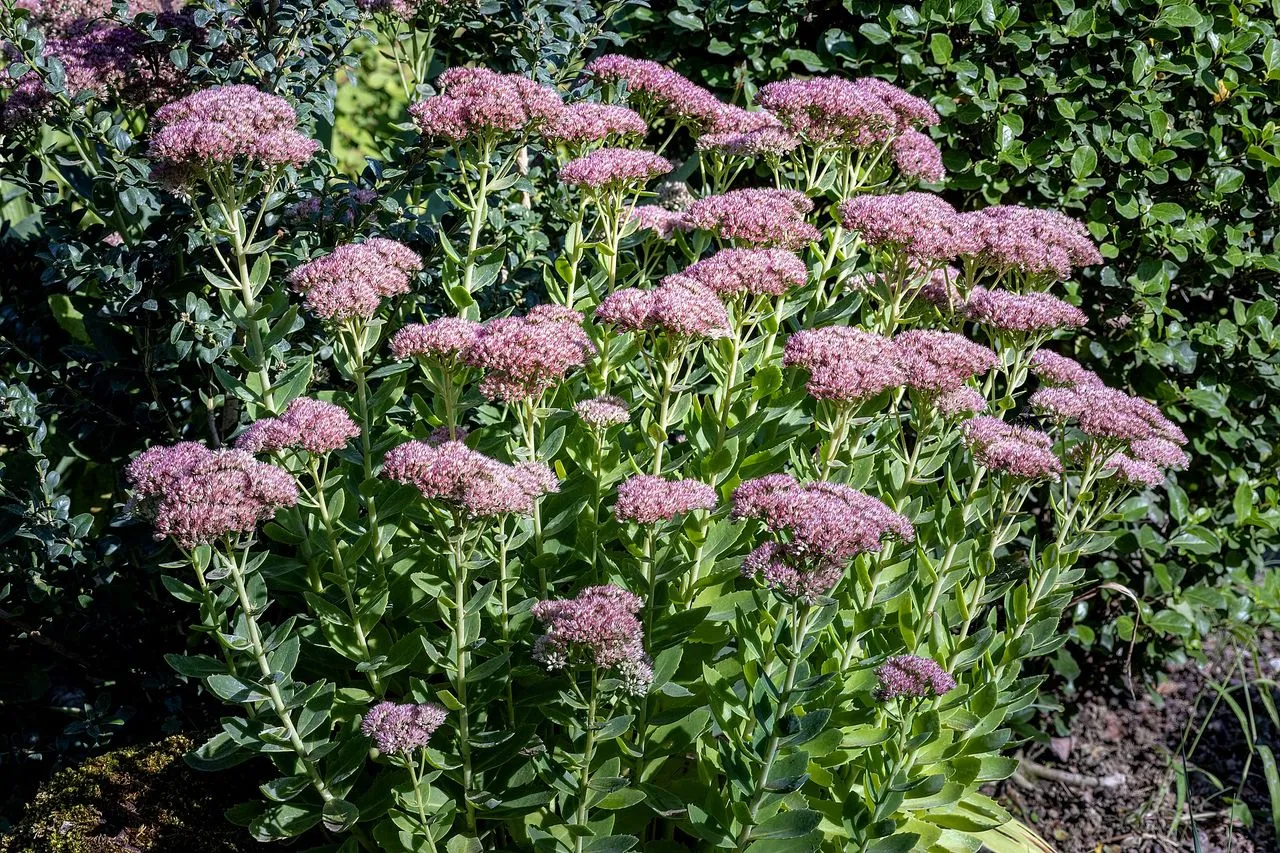
- Upright clump 30 to 60 cm tall, re-emerging each spring from a fleshy tuberous rootstock.
- Stems unbranched, stout, carrying flat obovate grey-green leaves 3 to 8 cm long arranged alternately or in opposite pairs.
- Leaves fleshy but thinner than the tender tropical sedums; deciduous, dying right back to the ground in autumn.
- Inflorescence a broad flat-topped cyme 10 to 15 cm across in late summer, purple-pink to dusky red.
- Tuberous roots are diagnostic; unlike creeping sedums which root at the nodes, H. telephium relies on a thickened underground storage organ to overwinter.
Several subspecies and related species commonly sold under the telephium name: subsp. maximum with larger leaves and yellow-green flowers; subsp. ruprechtii with cream-flushed foliage. The dark-leaved cultivars ('Purple Emperor', 'Matrona', 'Karfunkelstein') are hybrids or selections of the broader H. telephium complex.
Cultivation
Cold-hardy to USDA zone 3. Standard treatment for the hardy Hylotelephium group in the pillar guide. Specific to this species:
- Full sun for upright sturdy growth. Shade produces tall floppy stems.
- Tolerates poor, dry, and alkaline soils; exceptional on chalk.
- Dislikes heavy waterlogged clay. Raise the bed or amend with grit.
- Needs no feeding. A rich bed encourages flop.
The Chelsea chop (cutting the clump back by a third to a half in late May or early June) produces shorter sturdier stems and cleaner late-summer flowering. This is particularly useful in rich gardens; on thin soils H. telephium holds itself upright without intervention.
Propagation
Three reliable routes:
- Division in early spring as the crown buds break. Lift, split, discard the woody centre, replant outer segments.
- Stem cuttings of non-flowering shoots in May or June root in a fortnight in gritty compost.
- Seed if you want to propagate the wild species rather than a cultivar. Surface-sow in early spring, 18 to 22 degrees Celsius bottom heat, germination in 2 to 3 weeks. Cultivars do not come true.
Notes
The species has a long ethnobotanical record. The young leaves were eaten as a spring potherb across medieval Europe. The thickened roots were used as a folk remedy for wounds and burns, hence "livelong". Modern phytochemistry has identified a range of flavonoids and organic acids in the foliage; the plant is neither a potent medicinal nor a notable toxin.
Pollinator value is considerable. The flat cymes bring in hoverflies, honeybees, bumblebees, and late butterflies including peacocks and red admirals through August and September, when most other garden perennials are finished.
See also
- Sedum Autumn Fire
- SunSparkler Sedum
- How to divide sedum
- How to dry sedum — the flat cymes of H. telephium types are the principal subjects for wreath and winter-arrangement drying.
Frequently Asked Questions
Is Sedum telephium now Hylotelephium?
Yes. The current formal name is Hylotelephium telephium, but labels and garden writing still commonly use Sedum telephium.
How tall does Sedum telephium grow?
Typical clumps are 30–60 cm tall with broad flat flower heads in late summer. They die back to the ground in autumn.
What is the Chelsea chop for Sedum telephium?
Cutting the clump back by a third to a half in late May or early June produces shorter, sturdier stems and reduces flopping in rich gardens.
How is Sedum telephium propagated?
Divide crowns in early spring, take non-flowering stem cuttings in May or June, or sow seed for the wild species. Cultivars do not come true from seed.