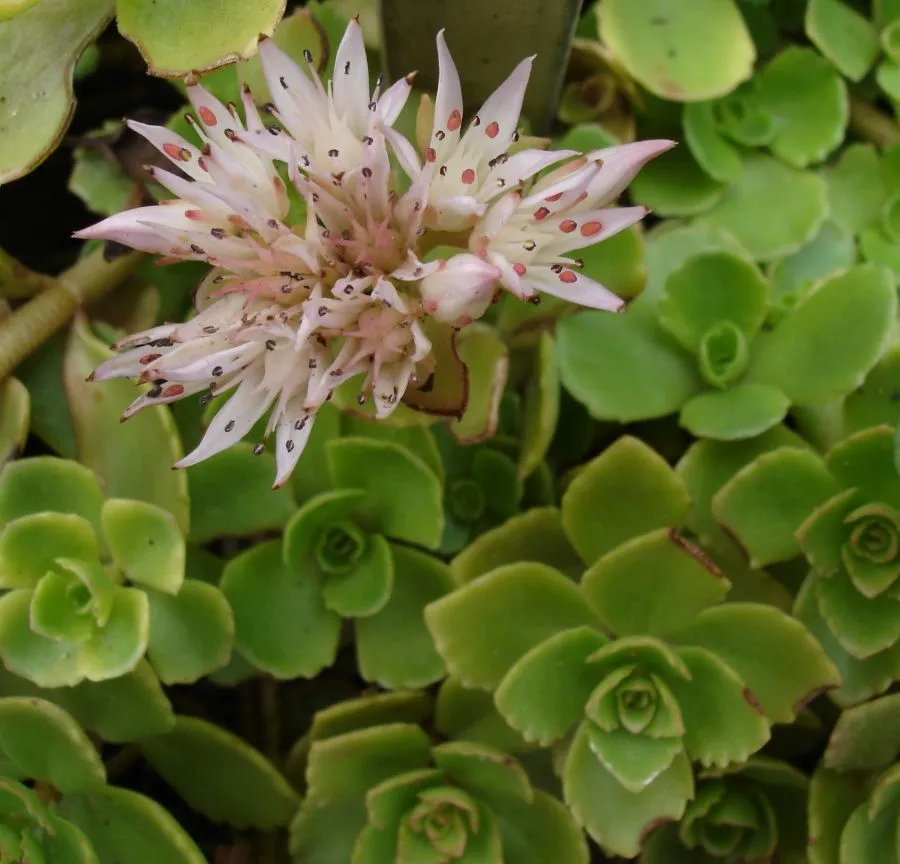
Sedum leaves drop for fundamentally different reasons depending on the species involved. Knowing which sedum is dropping is as important as knowing why the leaves are falling. Sedum morganianum drops leaves at the slightest disturbance — this is a fixed species characteristic, not a symptom. Most other sedum species hold their leaves firmly until something is wrong: too much water, too little, a root system under stress, or a sudden environmental change.
Part of the Complete Sedum Guide.
Sedum morganianum — fragile leaf attachment by design
Sedum morganianum (donkey's tail, burro's tail) has a leaf-attachment mechanism that is deliberately fragile. In its native habitat in southern Mexico and Honduras, leaves that fall and land on soil or rock can root and establish as new plants — the plant uses leaf drop as a propagation strategy. The abscission layer between the leaf base and the stem is minimally developed, which means leaves detach at the slightest contact: repotting, moving the pot, a passing pet, strong airflow, or even a curious finger.
This is not a disease, a deficiency, or a sign of stress (unless it is occurring on a plant that has never been moved and is suddenly shedding heavily). The leaves of S. morganianum are plump and water-filled, and intact leaves placed on dry substrate will root independently. Collect fallen leaves and lay them flat on the surface of a tray of dry mineral mix in bright indirect light — within 3–6 weeks, small plantlets emerge from the base.
The practical management is simple: place S. morganianum in a position where it will not be touched or disturbed. Wall-mounted brackets and high shelves are ideal. Do not move the pot unnecessarily. Accept that any contact will produce some leaf loss, and treat that loss as a propagation opportunity.
Overwatering and root rot
For sedum species other than S. morganianum, soft or mushy leaves detaching from the stem is the most significant symptom of overwatering. When roots are waterlogged and failing, they stop regulating water uptake; the leaves fill with excess water, lose structural integrity, and eventually detach at the stem rather than drying in place.
Mushy dropped leaves feel wet, may be translucent or glassy, and often have a sour smell. The substrate is heavy and wet. The remaining attached leaves may also be soft and yellowing. This presentation requires immediate action: stop all watering, unpot the plant, remove substrate, and inspect roots. Black, hollow, or slimy roots confirm root rot. Cut away all dead root tissue with a sterile blade, allow the plant to dry bare-root in shade for 3–5 days, then repot into a fresh, dry mineral mix. See root rot diagnosis for the full procedure.
Drought stress
The opposite cause produces dry, papery leaf drop. When Sedum is severely under-watered, it draws stored water from older or lower leaves to protect the growing tips. Those leaves lose turgor, shrink slightly, dry to a papery or leathery texture, and eventually detach. Unlike mushy overwatering drop, drought-dropped leaves are fully dry, flat, and may still be intact rather than damaged.
The substrate is bone dry, the pot is light, and leaves elsewhere on the plant may be wrinkling. A thorough soak — slow watering until it exits the drainage hole, then complete drainage — corrects mild-to-moderate drought within 24–48 hours. Already-lost leaves do not return, but growing tips firm back up and new leaf production resumes.
Repotting shock and root disturbance
Root disturbance during repotting — root trimming, vigorous substrate removal, physical root tearing — reduces the root system's capacity to support the plant's existing leaf mass. The plant responds by dropping some leaves to balance what it can support with what it can absorb. Expect 10–20% leaf loss in the 2–4 weeks following repotting, particularly if the root system was reduced.
Reduce this drop by: repotting when the plant is actively growing (spring); disturbing roots as minimally as possible; and using a pot only 1–2 cm wider than the root ball so the plant is not dealing with a large new volume of unoccupied substrate. Water sparingly for the first 2 weeks post-repotting — a reduced root system needs less water than a full one, and wet conditions around cut root tips risks rot before callusing is complete.
Temperature shock and relocation stress
Moving a Sedum from one light or temperature regime to another — from outdoor summer conditions to indoor winter conditions, or from a warm room to a windowsill exposed to cold drafts — triggers a stress response that often includes leaf drop over the following 2–3 weeks. The plant is adjusting its physiology to the new environment and shedding leaves calibrated for the old conditions.
This transition drop is temporary. Do not change watering in response; do not fertilise. Maintain correct light and temperatures, water normally, and the drop should stop within 3 weeks as new leaves calibrated for the new environment begin to emerge.
How to identify the cause
| Leaf texture at drop | Substrate condition | Species | Most likely cause |
|---|---|---|---|
| Plump, intact | Normal or dry | S. morganianum | Normal fragile attachment |
| Mushy, wet, translucent | Heavy and wet | Any | Overwatering / root rot |
| Dry, papery, wrinkled | Bone dry | Any | Drought |
| Normal, plump | Normal | Any | Post-repotting shock |
| Normal, some wrinkling | Normal | Any | Relocation/temperature stress |
Risk and severity
S. morganianum drop is ongoing and not a risk — it is a feature. Mushy overwatering drop progressing to root rot is high risk if not addressed within days. Drought drop is low risk and reverses quickly. Repotting and relocation drop is moderate risk — most plants recover, but the stress window increases susceptibility to rot if combined with wet substrate.
Solutions
S. morganianum drop
Collect leaves for propagation. Place the plant in an undisturbed position. Line the bottom of the pot's display area with leaves on dry mineral mix for easy propagation.
Overwatering drop
Stop watering immediately. Unpot, inspect, trim dead roots, dry bare-root 3–5 days. Repot in fresh dry mineral mix. Wait 7 days before the first cautious post-treatment watering.
Drought drop
Water once thoroughly, allow full drainage. Resume a schedule of watering when the top 3–4 cm of substrate is dry.
Repotting drop
Normal and expected — manage it by minimising root disturbance during repotting. Water sparingly for 2 weeks and do not fertilise during this period.
Prevention
Use a correctly sized pot with drainage holes and a fast-draining mineral mix. Water on demand rather than on a schedule. For S. morganianum, choose a permanent undisturbed display position and do not repot unless absolutely necessary — the species performs better in a slightly pot-bound state than it does after a distressing repot. For other sedums, a consistent watering rhythm matched to the substrate drying rate prevents both overwatering drop and drought drop.
See also
- Root rot diagnosis — the full root inspection and recovery procedure when mushy leaf drop has progressed to root damage.
- Sedum morganianum — the species most known for fragile leaf attachment; includes propagation from dropped leaves.
- Beginner's guide to succulents — substrate, drainage, and watering rhythm fundamentals that prevent both major causes of non-normal leaf drop.
Frequently Asked Questions
Why does my Sedum morganianum drop leaves when I touch it?
S. morganianum has a fragile leaf attachment that is characteristic of the species — leaves detach with almost any disturbance. This is a survival mechanism: dropped leaves are viable for propagation and can root where they land. Place the plant somewhere it will not be disturbed, and collect fallen leaves for propagation.
Why is my sedum dropping soft, mushy leaves?
Overwatering and incipient root rot. The roots are failing to regulate water uptake, leaves are becoming waterlogged and then detaching. Stop watering, inspect roots, and treat for rot if necessary.
My sedum dropped a lot of leaves after I repotted it — is that normal?
Common but not ideal. Root disturbance during repotting reduces the plant's ability to support all its leaves; it sheds some to balance with its reduced root capacity. Expect 10–20% leaf loss in the weeks after repotting. New growth from the stem tips signals successful re-establishment.
Can I use dropped Sedum morganianum leaves for propagation?
Yes — intact leaves (not severed, with the base attachment intact) root readily when placed on the surface of dry mineral mix in bright indirect light. They require no burying; they sprout from the base over 3–6 weeks.