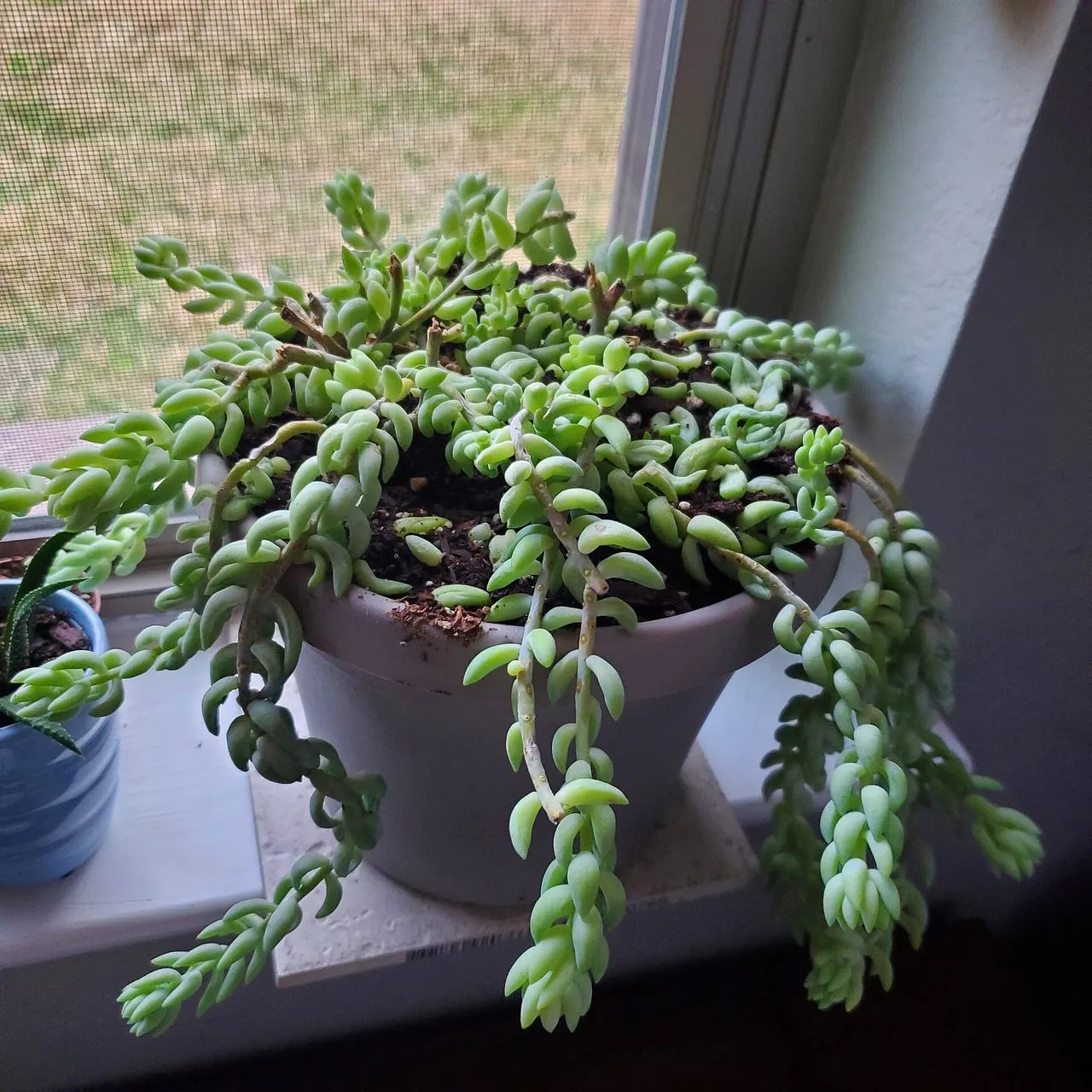
Yellow leaves on Sedum follow the same diagnostic logic as yellowing in other succulent genera, with one important addition: the genus spans a huge range of species and growing conditions, from frost-hardy border perennials to tender indoor trailers, and the season and situation matter as much as the leaf texture. A large outdoor Hylotelephium yellowing in October is probably heading into normal dormancy. A trailing Sedum morganianum with yellow mushy leaves on a November windowsill is in the early stages of root rot.
Part of the Complete Sedum Guide.
Normal basal senescence
Sedum stems shed their oldest leaves as they grow, producing new leaves from the tips and discarding the lower ones. This is the most benign cause of yellowing and is identifiable by:
- Only the lowest one or two leaves on each stem are affected.
- They yellow from the tip inward, dry to a papery tan-brown, and detach cleanly.
- The rest of the plant is firm, compact, and correctly coloured.
- There is no smell from the pot and the substrate is dry between waterings.
Remove papery leaves to prevent them accumulating against the stem. No other intervention is needed.
Overwatering and root rot
The most dangerous cause of yellow sedum leaves. Roots kept in saturated substrate lose the ability to regulate water uptake; leaves become waterlogged and turn yellow, then translucent, then mushy. The yellowing often starts at the lower leaves and progresses upward — unlike normal senescence, which stays confined to the oldest basal leaves.
Mushy yellow leaves are diagnostic: they feel wet, may be glassy or slightly inflated, and often detach at a touch. The substrate is wet, heavy, or sour-smelling. The pot has been watered recently or sits in a saucer with standing water. Act the same day: stop watering, unpot the plant, remove old substrate, inspect roots. Healthy roots are firm and pale; dead roots from rot are black, hollow, slimy, or foul-smelling. Cut all dead root tissue with a sterile blade, dry the plant bare-root in shade for 3–5 days, repot into dry mineral mix, and withhold water for 7 days.
For the full inspection and recovery procedure, see root rot diagnosis.
Under-watering and drought stress
Drought-caused yellowing produces a different texture: the leaves yellow-green rather than bright yellow, wrinkle slightly, and feel dry and flexible rather than mushy. The pot is light, the substrate is dry through the full depth, and leaves lower on the stem are affected first.
Sedum is tolerant of short drought periods, but extended drought — particularly in small terracotta pots in summer — eventually depletes stored water in the leaves. A single thorough soak reverses early drought yellowing within 24–48 hours. Resume a schedule of watering when the top 3–4 cm of substrate is dry.
Low light and chlorophyll loss
New growth on stems tips that emerges pale lime-yellow or yellow-green rather than the species' normal green, bronze, or grey-green indicates insufficient light. In low light, Sedum cannot produce adequate chlorophyll, and new leaves are thin and poorly pigmented. The plant may also be stretching toward the light source, with visible stem between leaf clusters.
Move to brighter light progressively — east or south window, or grow light supplementation. Do not move directly from deep shade to full summer sun: shade-adapted sedum leaves sunburn readily. Step up light intensity over 10–14 days.
Autumn dormancy yellowing (herbaceous sedums)
Hylotelephium (border sedums including the plants still sold as Sedum telephium, S. spectabile, and cultivars like 'Autumn Joy') are herbaceous perennials. They yellow and die back completely each autumn as part of their natural seasonal rhythm. The entire above-ground plant yellows, then browns, then collapses — and this is not a pathology in any way. The crown remains alive underground and will resprout in spring.
Do not treat autumnal dieback in these species as a yellowing problem requiring intervention. Mark the position, leave the stems for winter interest, and cut back to 5 cm in early spring.
Pest-driven yellowing
Aphid infestations on sedum (particularly on soft-stemmed border varieties in the garden) cause yellowing and distortion at growing tips, where the aphids cluster. Check stem tips and flower buds for colonies of green, grey, or black soft-bodied insects. A colony can cause significant yellowing at the growing point while the rest of the plant remains green. The aphid identification guide provides confirmation. Treat with insecticidal soap or a strong water jet to knock colonies off.
Root-feeding aphids and root mealybug can also cause yellowing by disrupting root function without obvious above-ground pests. If the plant yellows uniformly and no above-ground pests are found, unpot and inspect the root zone.
How to identify the cause
| Leaf texture | Location | Season | Most likely cause |
|---|---|---|---|
| Papery, dry, tan | Lowest 1–2 basal leaves only | Any | Normal senescence |
| Mushy, wet, glassy | Lower to mid stem, spreading | Growing season | Overwatering / root rot |
| Yellow-green, wrinkled | Lower leaves first | Any | Drought |
| Pale lime-yellow, thin | New growth at tips | Any | Low light |
| Whole plant, brown-yellow | All stems | Autumn–winter | Normal herbaceous dormancy |
| Yellow at stem tips with visible insects | Tops of stems | Spring–summer | Aphid feeding |
Risk and severity
Normal senescence and autumn dormancy carry no risk. Overwatering with root rot is high risk and should be diagnosed and treated the same day it is identified. Drought and low light are low-to-moderate risk and reverse readily with the correct fix.
Solutions
Papery basal yellowing
Remove dry leaves. Continue normal care. No other action.
Mushy/translucent yellowing
Stop watering. Unpot, trim dead roots, dry bare-root 3–5 days, repot in dry mineral mix. Wait 7 days before first watering.
Wrinkled drought yellowing
Water once thoroughly. Allow full drainage. Resume dry-down schedule.
Pale new growth
Move to brighter position over 10–14 days. Refresh substrate if more than 2 years since last repotting. Feed at quarter strength with balanced fertiliser during active growth.
Autumn dormancy
Accept and manage. Cut back in early spring.
Prevention
Use a freely draining mineral mix in a pot with drainage holes. Water on demand — when the top 3–4 cm is dry — not on a fixed schedule. Maintain bright light (east or south window for indoor plants, full sun for outdoor hardy types). In the garden, plant in well-draining, slightly elevated positions to prevent root zone saturation after rain. Keep wet-dry cycle principles consistent across all sedum species.
See also
- Root rot diagnosis — the full procedure for confirming and treating root rot when yellowing leaves are mushy.
- Sedum acre — a ground-cover sedum that yellows rapidly when waterlogged; useful benchmark for drainage requirements.
- Sedum telephium — the herbaceous border sedum whose autumn yellowing and dormancy is the most commonly misread as disease.
Frequently Asked Questions
Why are my sedum leaves turning yellow and dropping off?
Most likely overwatering. Soft, yellowing leaves that detach easily indicate waterlogged roots that can no longer regulate water uptake. Unpot and inspect roots. If they are black or slimy, treat for root rot.
Is it normal for lower sedum leaves to turn yellow?
Yes — the oldest basal leaves on trailing and upright sedums yellow and dry off as the plant grows. This is normal senescence if only the lowest one or two leaves are affected and they dry papery rather than turning mushy.
Why is my outdoor sedum turning yellow in summer?
In the garden, yellow summer sedum is often drought stress — check soil moisture — or waterlogging after prolonged rain in poorly draining soil. In both cases, inspect the root zone. Also check for aphid infestations, which cause yellowing at growing tips.
Can yellow sedum leaves turn green again?
No. Yellowed tissue has lost its chlorophyll and will not recover. Correct the cause so new growth emerges healthy and green.