| Question | Short Answer |
|---|---|
| How do I distinguish aphids from mealybugs on my succulent? | Aphids have two distinctive cornicles (short tubes) projecting from their rear abdomen - mealybugs are covered in white wax and lack these cornicles. |
| Why do aphids keep coming back after I treat them? | Unless you address the underlying cause (usually overwatering, low light, or poor substrate), new aphids will find the soft, stressed growth attractive. |
| Are systemic insecticides safe for flowering succulents? | Systemic neonicotinoids like imidacloprid translocate into nectar and pollen and can harm pollinators. |
| What is the first step for aphids on succulent flower stalks: id & control? | A strong water spray followed by insecticidal soap at 1-2% concentration is sufficient for most flower-stalk infestations. |
Question: are the small soft-bodied insects clustering on your aloe's flower spike actually aphids, and do you need to treat them on succulents that almost never host aphids on the foliage? The bottom-line answer: yes, they are likely aphids if each insect carries a pair of short tubes (cornicles) on its rear abdomen, and a focused water jet followed by an insecticidal soap spray is enough for most flower-stalk infestations. Aphids on succulent leaves themselves are unusual and usually a symptom of an unhealthy plant rather than a pest problem in their own right. Here is the rest of the picture.
Quick Answer
- Aphids on succulents are identified by their cornicles - two short tubes projecting from the rear of the abdomen. No other common succulent pest has this feature.
- A strong water spray followed by insecticidal soap at 1-2% concentration is sufficient for most flower-stalk infestations. Systemic insecticides are rarely needed.
- Aphids on foliage (not flower stalks) indicate underlying plant stress - correct the light, water, or substrate issue first before treating the pests.
Part of the Beginner's Guide to Succulents.
What it is
Aphids are sap-feeding insects in the family Aphididae, in the same hemipteran order as mealybugs and scale. Three species turn up most often in succulent collections, all of them broad generalists rather than succulent specialists. Aphis gossypii, the cotton or melon aphid, is the most common visitor and the species most likely to swarm an emerging Aloe or Echeveria inflorescence. Macrosiphum euphorbiae, the potato aphid, is larger and more elongated, often green or pink, and shows up on softer flower spikes in cool weather. Myzus persicae, the green peach aphid, is the smallest of the three and the most likely to arrive on a plant brought in from a vegetable garden or an open balcony.
The key feature that separates aphids from other small soft-bodied insects is the pair of cornicles, two short tubes projecting from the rear of the abdomen. These are unique to Aphididae. Mealybugs do not have them, scale insects do not have them, and the woolly aphids occasionally seen on woody hosts have them but rarely settle on succulents. If you can see two tiny tail-pipes under a hand lens, you are looking at an aphid.
Aphids feed by inserting a fine stylet into phloem tissue and drawing out sap under the plant's own pressure. They excrete the excess as honeydew, a sticky clear fluid that drips onto leaves below the colony and supports a black sooty mould (Capnodium spp.) within a few weeks if the colony stays active. Honeydew plus sooty mould on a flower stalk is a strong secondary signal that aphids are present, even if the colony itself is partly hidden among the bracts.
How to identify it
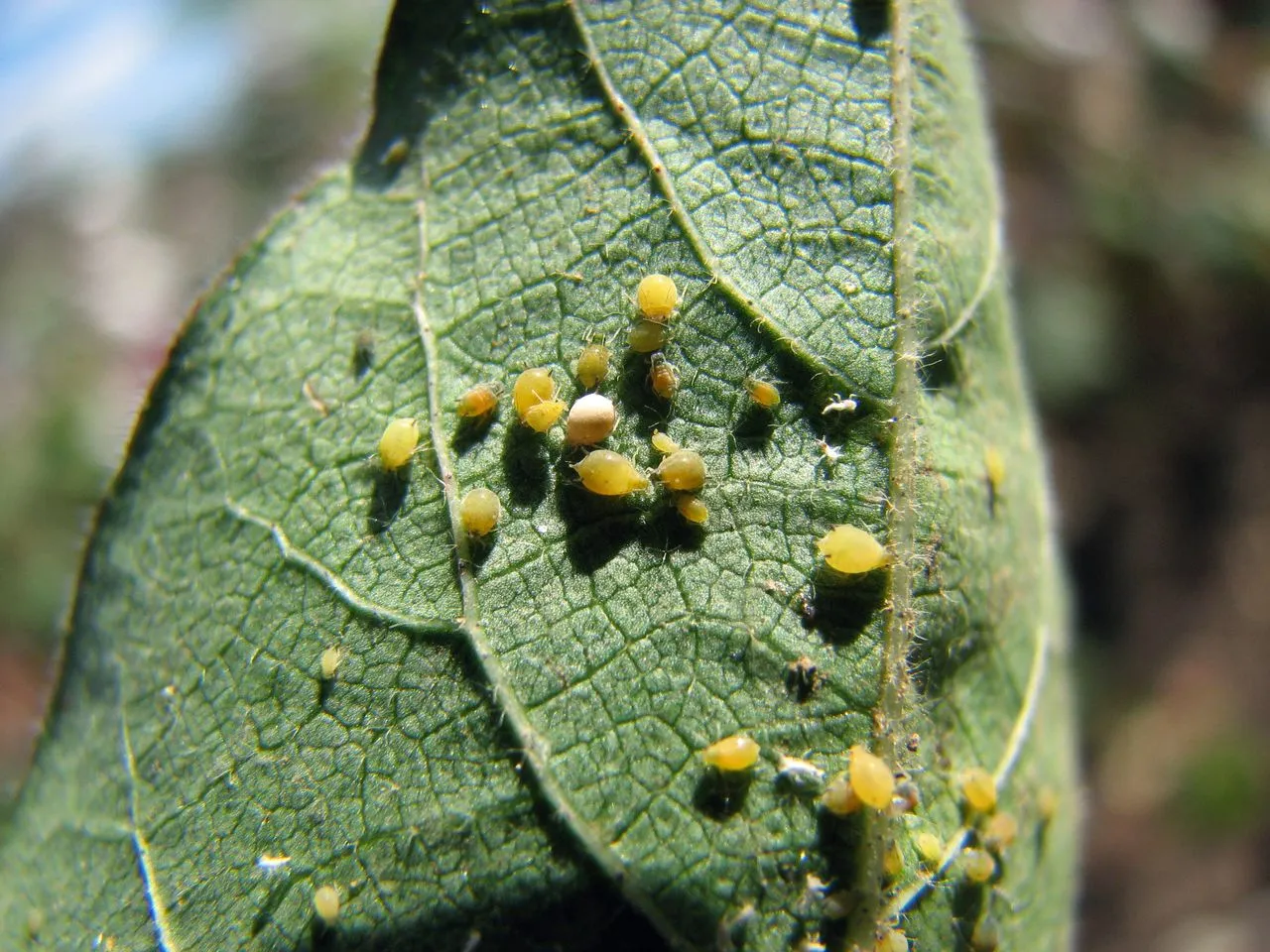
Most aphids you find on succulents are apterous, meaning wingless. These are adult females, oval to pear-shaped, 1 to 3 mm long, soft, and clustered tightly along the upper portion of a flower stalk or in the developing inflorescence. They sit still while feeding and only move when disturbed. A second form, the alate or winged morph, develops when populations grow crowded or host quality drops. Alates have two pairs of clear membranous wings folded over the body and disperse to find fresh hosts; they are the form responsible for arrivals on a previously clean plant.
Colour is reasonably reliable in the field once you have the species in mind:
- A. gossypii varies more than the others. Summer apterous individuals can be pale yellow, lemon-green, dark green, or nearly black, often within the same colony. The alates are darker green to black with a paler abdomen and clear wings.
- M. euphorbiae is medium to large for an aphid (up to 3 mm), elongated rather than pear-shaped, and usually pale green or pink. The cornicles are noticeably long, roughly half the length of the body, which is the field separator from the other two species.
- M. persicae is small (1 to 2 mm) and apterous individuals are typically pale yellow-green or pink. The alates show a distinct dark patch on the dorsal abdomen.
Use a 10x hand lens. Look for cornicles first, then estimate size, then assess colour. A single plant can carry more than one species at a time, so do not assume uniformity in a colony.
Honeydew shows as a glossy or sticky film on lower leaves, often with airborne dust trapped in it. Sooty mould appears as a grey-black powdery layer that grows on the honeydew rather than on plant tissue and can be wiped off without damaging the leaf cuticle.
Why it appears
Aphids on succulents differ in one important way from aphids on garden plants: they almost never colonise the leaves of a healthy succulent. The thick, often waxy or farina-coated leaf cuticle, the low free-water content of the tissue, and the slow phloem flow of a plant adapted to drought all make succulent foliage a poor feeding site. What aphids do find attractive is the developing flower stalk and the bracts, sepals, and unopened buds of the inflorescence. These tissues are softer, more nitrogen-rich, and have higher phloem pressure during bloom. An Aloe vera or Agave attenuata sending up its first flower spike is the classic susceptible target.
The biology behind a sudden infestation is parthenogenesis. Through summer in temperate climates and year-round under warm indoor conditions, aphid females produce live young as clones of themselves without mating. A single founding female can build a visible colony in five to ten days, and a flower stalk that looked clean on a Friday inspection can carry a hundred individuals by the next weekend. Winged morphs then appear and disperse to neighbouring plants, usually triggered by overcrowding or a decline in sap quality at the original site.
The diagnostic question worth asking is where on your succulent the aphids actually are. Aphids on a flower stalk are a normal seasonal pest event in any collection that flowers. Aphids on the foliage of an Echeveria, Crassula, or Haworthia outside the flowering period are a different signal. Foliar aphid colonies almost always indicate a plant that is already weakened: chronic overwatering that has triggered soft, thin growth, low light forcing etiolated leaves with thin cuticles, or a recent move to humid conditions where the plant has produced uncharacteristically tender tissue. In those cases, treating the aphids without addressing the cause leaves a plant that will attract them again within weeks. Find the underlying stress (almost always light, water, or substrate) and correct that first; the aphids often disappear on their own once the plant returns to firm, well-cuticled growth.
How to fix it
Treatment for flower-stalk aphids works in escalating stages. For most infestations, the first stage is enough.
Strong water spray. Hold the plant pot horizontally and direct a focused jet of water along the stalk for ten to fifteen seconds. This dislodges 70 to 80% of an apterous colony in a single pass. Aphids cannot reattach quickly to a non-host surface, so most knocked-off individuals fail to return. Repeat every three to four days for two weeks to catch newly emerging young that were too small to see on the first pass.
Insecticidal soap at 1 to 2% v/v. A potassium-salt fatty-acid soap diluted to 1 to 2% (10 to 20 ml of concentrate per litre of water) breaks down the soft aphid cuticle on contact. The mechanism is direct cell membrane disruption, not poisoning, so the spray must wet each insect to work. There is no residual activity, which is both a limitation (you must hit the colony) and an advantage (no persistent residue, no harm to insects that arrive after the spray dries). Apply when the plant is out of direct sun to avoid leaf burn, especially on farina-coated species. Repeat at five to seven day intervals for two to three rounds.
Neem oil at 0.5 to 1%. Neem, with azadirachtin as the active component, acts as both a feeding deterrent and an insect growth regulator that disrupts nymphal moulting. Use it at the lower end of the dilution range on succulents to avoid oily residue on leaves. Like soap, neem requires direct contact for the suffocation effect; the growth-regulator effect carries through ingestion as the residue persists briefly on the plant.
Systemic imidacloprid at 0.05%. For ornamental succulents that recur with aphids each flowering season, a soil drench at 0.05% (around 0.5 ml of a 20% concentrate per litre, applied to the substrate) is taken up through the roots and reaches feeding insects through the sap. Imidacloprid suits indoor ornamentals and plants kept away from pollinators. It is not appropriate for A. vera harvested for gel use, nor for any plant whose flowers are visited by bees or other pollinators while the chemical remains active in the tissue.
Bee safety on Aloe and Agave. The flower nectar of Aloe and Agave species is a significant food source for wild bees, sunbirds in southern African plantings, bats for some agave species, and many other visitors. Systemic neonicotinoids including imidacloprid translocate into nectar and pollen and can poison those visitors. Neem can also harm soft-bodied bee larvae if residues reach a hive. During bloom on these genera, restrict treatment to water sprays and to insecticidal soap applied directly to the aphid colony in the early morning before pollinator activity, and avoid systemic insecticides entirely. Once the inflorescence is no longer attractive to visitors, systemic options can resume if the plant has a persistent problem.
How to prevent it
Encourage natural predators outdoors. Ladybird beetles (especially Coccinella septempunctata and Harmonia axyridis), green lacewing larvae (Chrysoperla carnea), hoverfly larvae, and parasitoid wasps in the genus Aphidius clear small founding populations on outdoor succulents within days. A garden or balcony with flowering yarrow, fennel, or alyssum nearby keeps the predator population resident. Broad-spectrum insecticides on neighbouring plants kill the predators along with the aphids and leave the surface free for the next aphid arrival, so reserve those products for serious outbreaks rather than routine use.
Quarantine new arrivals for 30 days. Aphids reach indoor collections through two main routes: opened windows in spring and summer (alates landing on a south-facing windowsill) and new plants brought in from a nursery, supermarket, or another grower. The window route is hard to block; the new-plant route is fully avoidable. Keep any incoming plant separate from the main collection for 30 days, inspect the developing growth and any forming flower stalks twice a week with a hand lens, and only release the plant once you have seen no winged or apterous individuals through that period. The full 30-day protocol is in quarantine new arrivals.
Check flower stalks early. The first three to five days after a flower stalk emerges from a rosette are the window when an alate female is most likely to find it. A weekly inspection of any rosette pushing up an inflorescence catches a founding population before parthenogenetic build-up turns it into a hundred-individual colony.
Treat the underlying plant condition for foliar infestations. Aphids on succulent foliage are a symptom, not a primary problem. Move the plant to brighter light, reduce watering frequency until the substrate dries fully between waterings, and reassess after a month. The care baseline in the Beginner's Guide to Succulents covers the light, water, and substrate corrections that resolve most of the underlying causes.
See also
- A Beginner's Guide to Succulents, the care baseline that keeps foliage firm and unattractive to aphids and other sap-feeders.
- Mealybug Identification, how to distinguish cottony Pseudococcidae from cornicled aphids when both can appear in a flowering rosette.
- IPM for Succulents, an integrated pest management approach combining inspection schedules, biological control, and targeted treatment escalation across an established collection.
- Quarantine new arrivals: the full 30-day isolation protocol that catches aphids and crawlers before they reach the main collection
FAQ
How do I distinguish aphids from mealybugs on my succulent?Aphids have two distinctive cornicles (short tubes) projecting from their rear abdomen - mealybugs are covered in white wax and lack these cornicles. Under a 10x lens, aphids also have a more defined body shape while mealybugs appear fuzzy and irregular.
Why do aphids keep coming back after I treat them?Unless you address the underlying cause (usually overwatering, low light, or poor substrate), new aphids will find the soft, stressed growth attractive. Flower stalks are naturally attractive during blooming - inspect weekly during flowering season.
Are systemic insecticides safe for flowering succulents?Systemic neonicotinoids like imidacloprid translocate into nectar and pollen and can harm pollinators. During bloom, stick to water sprays and insecticidal soap. Save systemic treatments for non-flowering periods.
Frequently Asked Questions
How do I distinguish aphids from mealybugs on my succulent?
Aphids have two distinctive cornicles (short tubes) projecting from their rear abdomen - mealybugs are covered in white wax and lack these cornicles. Under a 10x lens, aphids also have a more defined body shape while mealybugs appear fuzzy and irregular.
Why do aphids keep coming back after I treat them?
Unless you address the underlying cause (usually overwatering, low light, or poor substrate), new aphids will find the soft, stressed growth attractive. Flower stalks are naturally attractive during blooming - inspect weekly during flowering season.
Are systemic insecticides safe for flowering succulents?
Systemic neonicotinoids like imidacloprid translocate into nectar and pollen and can harm pollinators. During bloom, stick to water sprays and insecticidal soap. Save systemic treatments for non-flowering periods.
What is the first step for aphids on succulent flower stalks: id & control?
A strong water spray followed by insecticidal soap at 1-2% concentration is sufficient for most flower-stalk infestations. Systemic insecticides are rarely needed.