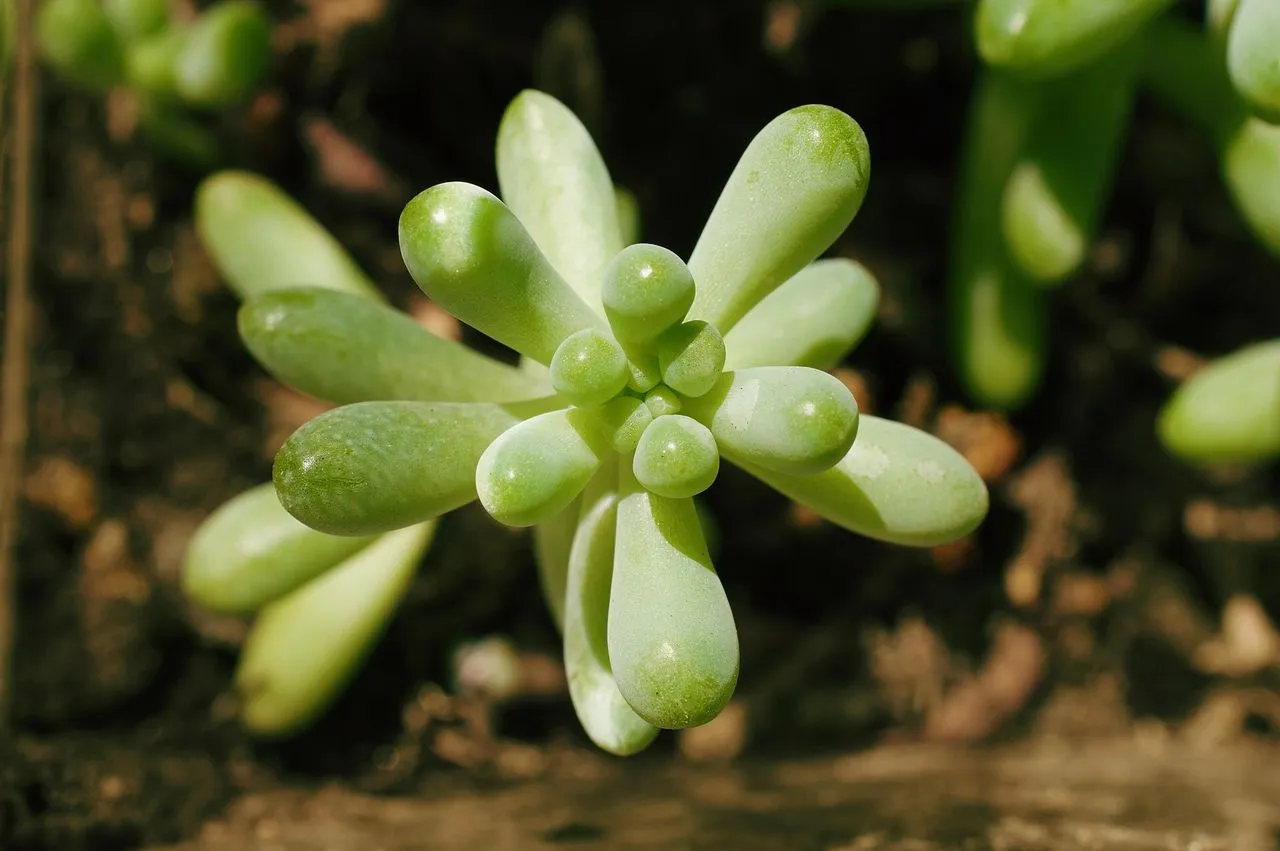
Sedum L. is the largest genus in the family Crassulaceae, with roughly 500 accepted species according to the World Checklist of Vascular Plants at the Royal Botanic Gardens, Kew. The common name for the genus is stonecrop, a name earned from the habit of many species of growing out of rock crevices and gravelly ground where nothing else will. Distribution is broad across the temperate northern hemisphere, with notable diversity in North America, Europe, North Africa, and East Asia. A handful of species reach the southern hemisphere but the genus is fundamentally a northern one.
I'm Dr. Elena Martín, a Certified Advanced Cactus & Succulent Horticulturist and former curator of the succulent collection at the Jardín Botánico de Córdoba. Sedum is probably the genus I field more garden questions about than any other. This guide answers what people actually ask.
A quick taxonomic note before anything else
If you've read a plant label for 'Autumn Joy', 'Matrona', or any of the tall late-summer border sedums, you've seen both Sedum and Hylotelephium used interchangeably. Taxonomists settled this some decades ago. The upright herbaceous perennials formerly treated as Sedum telephium, S. spectabile, and relatives are now formally placed in Hylotelephium H.Ohba. The creeping and rosette-forming species remain in Sedum proper. The horticultural trade still uses the old Sedum names on most labels and packaging, which is why this guide gives both binomials on first mention of the relevant plants. Functionally both groups behave as "sedums" in the garden; the separation matters if you are keying out a specimen or reading the botanical literature.
Taxonomy and Natural Range
The genus Sedum was erected by Linnaeus in Species Plantarum (1753). Its type species is Sedum acre L., the biting stonecrop of European walls and dunes. The genus sits in the subfamily Sedoideae alongside relatives such as Sempervivum, Rhodiola, Phedimus, and the segregate genus Hylotelephium.
Wild distribution spans four continents:
- North America: S. ternatum in eastern woodland; S. spathulifolium on the Pacific coast; S. nevii in the southern Appalachians
- Mexico and Central America: S. morganianum (burro's tail), S. palmeri, S. nussbaumerianum, S. rubrotinctum, S. adolphi. These are the tender, frost-sensitive end of the genus
- Europe and the Mediterranean: S. acre, S. album, S. rupestre, S. dasyphyllum, S. sexangulare. Cold-hardy, often evergreen
- East Asia: S. kamtschaticum, S. sarmentosum, S. lineare, S. sieboldii, and most of what is now Hylotelephium
This split matters because it determines your climate risk. A Mexican sedum such as S. morganianum is hardy only to USDA zone 9b or so. A European or northern-Asian sedum such as S. acre or S. kamtschaticum is hardy to zone 3. "Is sedum hardy" has no universal answer. You have to know which one you bought.
Is a sedum a succulent? Are sedum and stonecrop the same?
Yes and yes. Every Sedum is a leaf succulent, storing water in its fleshy leaves and, in some species, in thickened stems. Every Sedum is also a stonecrop; the terms are synonymous when applied to this genus. You will sometimes see "stonecrop" loosely applied to other low mat-forming Crassulaceae such as Phedimus and Rhodiola, but in a garden centre context the two labels mean the same thing.
Where people get confused: "succulent" is a growth strategy, not a taxonomic group. Cacti, aloes, sedums, echeverias, crassulas, and mesembs are all succulents. "Sedum" is a specific genus within that much larger ecological grouping. If a plant is labelled Sedum and you are not sure whether it is a succulent, yes, it is.
Identification and Morphology
Sedum is morphologically diverse and there is no single feature that separates it from every close relative. What the genus as a whole shares:
- Leaves. Fleshy, alternate or opposite depending on species, usually entire-margined, with shapes ranging from needle-like (S. reflexum, S. lineare) to terete and bead-like (S. rubrotinctum, S. dasyphyllum) to flat and obovate (Hylotelephium telephium). Colour ranges from pure green through blue-grey (S. reflexum 'Blue Spruce') and chartreuse (S. mexicanum 'Lemon Coral') to deep bronze and burgundy.
- Stems. Either creeping and rooting at the nodes, pendant and trailing, or upright herbaceous (the Hylotelephium group). Creeping species root at every node that touches soil, which is why they spread so readily.
- Inflorescence. A terminal cyme of small five-merous star-shaped flowers, usually yellow, white, pink, or red. Flowers are open and accessible, which is why Sedum is such a reliable nectar source for solitary bees, hoverflies, and late-season butterflies.
- Fruit. A cluster of five erect follicles splitting to release fine dust-like seed.
To identify a mystery sedum, start with growth habit. Is it a mat of creeping stems, a pendant trailer, a rosette, or an upright clump a foot or more tall? That narrows the field quickly, and the species guides linked later in this article take you the rest of the way.
How do you pronounce it? Where does the name come from?
"Sedum" is pronounced SEE-duhm in English. The name comes from the Latin sedere, "to sit", referring to the habit of the plants of sitting flat on rocks. Linnaeus adopted it from earlier Latin herbal use.
Cultivation
Light
Most sedums want full sun. "Full sun" here means six hours or more of direct light daily, year-round. Leaf colour is a reliable indicator: a sedum getting enough light will show its cultivar-typical bronze, red, or blue tones, and the rosettes or mats will stay tight. In insufficient light the same plant will turn uniformly green, stretch between leaves, and flop over. The upright Hylotelephium types are especially prone to flopping when light-starved, which is the usual answer to "why does my sedum fall over".
A handful of sedums do tolerate partial shade:
- S. ternatum — the only North American sedum that genuinely prefers woodland shade
- S. spurium (now Phedimus spurius strictly, but still sold as Sedum) and its cultivars
- S. sarmentosum — will grow almost anywhere
- S. kamtschaticum — tolerates half a day of shade
These are the exceptions. The rest will sulk if they don't get sun.
Substrate
Free-draining is non-negotiable, but sedums are less fussy about composition than most succulents. Ordinary garden loam with 30 to 50 per cent added grit works for the hardy ground-cover species. For the tender rosette types (S. nussbaumerianum, S. morganianum, S. rubrotinctum, S. adolphi) use a mineral-heavy succulent mix: 60 per cent pumice or perlite, 40 per cent loam-based compost.
Sedums tolerate poor, shallow, and alkaline soils. This is why they thrive on green roofs where the substrate is only a few centimetres deep. They do not tolerate heavy waterlogged clay. If you have clay soil, raise the bed or plant into a pure grit pocket and let them colonise from there.
Water
Established sedums in the ground rarely need watering at all once their roots are down. Most common question I get is some variant of "why is my sedum wilting" and the usual answer, for outdoor plants, is that something has severed its roots, not that it needs more water. Wilting in an otherwise established sedum points to vole damage, recent transplantation, or fungal crown rot from prolonged wet.
For container plants: water thoroughly, then let the substrate dry completely before watering again. In active summer growth that may mean weekly. In winter, particularly for the hardy species in an unheated greenhouse, monthly or less. Always water the substrate, not the foliage of rosette species where water can pool in the crown.
Most sedum deaths in cultivation are from winter wet combined with cold, not from drought. Improve drainage before adding water.
Temperature and cold hardiness
This is where the genus splits sharply:
- Hardy group (zones 3-6 tolerant): S. acre, S. album, S. spurium, S. kamtschaticum, S. reflexum, S. sexangulare, S. ternatum, S. sarmentosum, S. spathulifolium, and essentially all Hylotelephium. These survive frozen ground, winter wet, and repeated freeze-thaw cycles. In cold climates they go deciduous or herbaceously die back; Hylotelephium dies right to the ground each winter and re-emerges from crown buds in spring.
- Tender group (zone 9 and up): S. morganianum, S. nussbaumerianum, S. rubrotinctum, S. adolphi, S. palmeri, S. mexicanum. Any sustained frost destroys their above-ground tissue. In temperate climates grow them as houseplants or as summer-only patio plants brought in before first frost.
Will sedum freeze? The tender group will. The hardy group won't.
Humidity
Low to moderate humidity suits all sedums. Persistently high humidity with poor airflow invites fungal crown rot, especially in the upright Hylotelephium group during hot wet summers. Outdoor planting in exposed positions with good air movement handles this without intervention.
Propagation
Sedum is the easiest genus in Crassulaceae to propagate. The folk wisdom "break a piece off and throw it on the ground" is literally true for the creeping species.
Stem cuttings
For the creeping mat-formers (S. acre, S. album, S. spurium, S. rupestre, etc.): take a 3 to 8 cm stem fragment any time from late spring through early autumn. Lay it on moist substrate. Within a week to ten days, adventitious roots will issue from the nodes and the cutting will establish. No callusing, no rooting hormone, no humidity tent.
For the pendant trailers (S. morganianum): take longer cuttings of 10 to 15 cm, strip the lower third of leaves, callus the cut for 2 to 3 days, then pot up. These handle rougher than the mat types but still root reliably.
For Hylotelephium types: cut a non-flowering stem in late spring, push the bottom half into substrate. Roots within a fortnight.
Can you root sedum in water? Yes, but it is unnecessary and produces weaker roots than substrate rooting. Water roots are morphologically different from soil roots and have to be replaced when you transfer the cutting to a pot. Skip the step.
Leaf propagation
Works for the bead-leaved and rosette species: S. rubrotinctum, S. pachyphyllum, S. adolphi, S. nussbaumerianum, S. morganianum. Twist off a whole undamaged leaf, lay it on moist substrate, wait 3 to 6 weeks. Success rates above 80 per cent for these species.
Does not reliably work for the flat-leaved mat species or for Hylotelephium. Use stem cuttings instead.
Division
The method for Hylotelephium clumps that have outgrown their space or developed a dead centre after 4 to 5 years. Dig the entire clump in early spring as new shoots emerge, split the crown with a spade or a clean knife, replant the outer vigorous sections, discard the exhausted middle. You can divide in summer if you must but new divisions will need shade and water until established.
Can sedum be divided in summer? Yes with extra care; spring or early autumn is easier.
Seed
Slow and usually unnecessary given how easy vegetative propagation is. Sedum seed is fine and dust-like; surface-sow on moist substrate, do not cover, bottom heat at 18 to 22 degrees Celsius, expect germination in 2 to 4 weeks. Most hybrids and cultivars will not come true from seed, so this route is for species propagation only.
The four growth forms and where to use them
Every Sedum in cultivation falls into one of four forms. Knowing the form tells you immediately where the plant belongs in the garden.
Mat-forming creepers
Low creeping stems rooting at every node; dense ground-cover habit; rarely above 10 cm tall. Examples: S. acre, S. album, S. spurium and its cultivars ('Dragon's Blood', 'John Creech', 'Tricolor'), S. rupestre 'Angelina', S. sexangulare, S. dasyphyllum, S. lineare, S. kamtschaticum, S. sarmentosum, S. mexicanum 'Lemon Coral'.
Use them for: green roofs, living walls, dry gravel gardens, between paving stones, rock-garden carpets, slopes where nothing else will hold. These are the sedums on the sedum mats sold for extensive green-roof systems.
Upright herbaceous (Hylotelephium group)
Erect clumps 30 to 80 cm tall with broad fleshy leaves and large flat-topped flower heads in late summer and autumn. Examples: Hylotelephium telephium ('Autumn Joy', 'Matrona', 'Purple Emperor', 'Autumn Fire', 'Munstead Dark Red'), H. spectabile ('Brilliant', 'Stardust'), H. sieboldii.
Use them for: mixed herbaceous borders, late-season pollinator plantings, prairie-style schemes. The SunSparkler series and Dazzleberry are modern compact hybrids bred for front-of-border use.
Pendant trailers
Long hanging stems densely packed with terete leaves. Examples: S. morganianum (burro's tail, donkey tail), S. burrito (a shorter-leaved relative), some S. clavatum forms.
Use them for: hanging baskets, raised pots where the stems can cascade, frost-free conservatories.
Dwarf rosettes and stem-succulents
Stems tipped with compact rosettes or thick bead-like leaves. Examples: S. nussbaumerianum (coppertone stonecrop), S. adolphi, S. rubrotinctum (jellybean plant), S. palmeri, S. pachyphyllum.
Use them for: mixed succulent arrangements, pots, indoor collections. Tender; treat as houseplants outside zone 9.
Common Problems
| Symptom | Likely cause | Fix |
|---|---|---|
| Lower stems black and mushy, whole plant collapsing | Crown rot from winter wet | Lift, cut to clean tissue, replant in pure grit and keep dry |
| Hylotelephium flopping open in mid-summer | Too much nitrogen or too much shade | Cut flowering stems back by a third in June ("Chelsea chop"); move to fuller sun next season |
| Leaves dropping at the slightest touch | Recent overwatering, or natural autumn senescence in the hardy group | Confirm substrate moisture; if wet, let dry; if dry, this is normal deciduous behaviour |
| Stems turning brown and dying from the base | Fungal stem rot, usually after prolonged humidity | Remove affected stems, improve airflow, apply a copper-based fungicide |
| Rosettes stretching, leaves wider-spaced, paler colour | Insufficient light | Move to full sun; take a cutting of the healthy top and restart |
| White cottony patches in leaf axils | Mealybug (indoor and tender plants) | 70% isopropyl on a cotton swab; repeat weekly for a month |
| Scale insects on stems | Scale | Scrape off manually; horticultural oil for heavy infestations |
| Aphids on flower buds of Hylotelephium | Normal summer aphid cycle | Hose off; biological control from hoverfly larvae usually adequate |
| Sedum attracting flies to flower heads | Normal — Hylotelephium flowers are fly-pollinated among others | No fix; it is a feature, not a fault |
Deer and rabbit resistance
Most Sedum are deer-resistant and rabbit-resistant. The fleshy leaves and mild alkaloid content make them unappealing to browsers. Rated highly by Rutgers' deer-resistance lists and by every practical rock-garden experience I have had. The exception is spring regrowth on Hylotelephium clumps, which deer will occasionally sample; a brief protection for the first weeks of growth usually solves the problem.
Is sedum invasive?
In the horticultural sense yes, some mat-formers spread aggressively. S. acre and S. album will colonise wherever they can root and have naturalised across North America from European garden introductions. S. sarmentosum is listed as invasive in parts of the southeastern US. In a garden bed they may choke out weaker neighbours, including grass, in the strip where they establish. They do not have rhizomes or suckering roots; pulling them up removes them. They are not invasive in the ecological sense of displacing native vegetation from intact habitats in most regions, but check your local authority list before planting in sensitive areas.
Edibility and Safety
This is the question I get most often after "is my dog safe". Both answers need nuance.
Edibility: some Sedum species are traditionally eaten in small amounts. S. telephium (now Hylotelephium telephium) was a medieval European pot-herb; S. reflexum (prick-madam) was eaten raw in salads; S. divergens and S. lanceolatum were minor foods of Indigenous peoples in western North America. The edible species are safe in moderation.
Toxicity: S. acre (biting stonecrop) contains piperidine alkaloids including sedridine and sedamine. It is named "biting" because it has an acrid peppery taste; eating significant quantities causes gastric upset, and it has been implicated in livestock poisoning where animals are forced onto it. A few other species contain comparable alkaloid loads.
For pets: the ASPCA does not list Sedum as systemically toxic to dogs or cats, but it does cause gastrointestinal upset (vomiting, diarrhoea) if eaten in quantity, and the piperidine-alkaloid species will cause more severe reactions. Treat Sedum as mildly toxic to pets. Keep pots out of reach of animals that chew plants, and if ingestion is significant, call your vet.
Do not eat any sedum you have not identified to species, and do not forage from roadside or agricultural-spray plantings.
When to plant, when to cut back, whether to deadhead
Planting and transplanting: hardy sedums can go in the ground any time the soil is workable and not frozen. Spring (April-May) and early autumn (September) give the best root establishment. Summer transplanting works if you can water for a fortnight after; avoid moving plants in active flower.
Cutting back: for Hylotelephium the question is style more than horticulture. The dried flower heads and stems stand through winter and carry useful seed for birds; cutting back in late autumn gives a tidier bed but loses the winter structure. Cut back at ground level either in November or in March before new shoots emerge. Creeping sedums rarely need cutting back beyond removing dead inflorescences.
The "Chelsea chop": if your Hylotelephium 'Autumn Joy' or similar tall cultivar flops every year, cut the entire clump back by a third to a half in late May or early June (hence the name; it corresponds to Chelsea Flower Show week). The plant re-shoots shorter and sturdier, flowers a week or two later, and holds upright through autumn without staking.
Deadheading: optional. It can extend flowering in some species but the flowers are largely terminal and once gone are gone. Most growers leave them for structure and wildlife value.
Fertiliser: sedums evolved on nutrient-poor substrates. Over-fertilised plants flop, lose colour, and rot. A single light top-dressing of compost in spring is plenty. Avoid lawn feed near sedum beds.
Notable Species and Cultivars
Grouped by form. Follow the links for full species and cultivar profiles.
Mat-forming creepers
- Sedum acre — biting stonecrop; small yellow flowers; mildly toxic alkaloids
- Sedum album — white stonecrop; evergreen in mild winters
- Sedum spurium — two-row stonecrop; parent of many cultivars
- Dragon's Blood Sedum — S. spurium 'Dragon's Blood'; deep red autumn colour
- John Creech Sedum — S. spurium 'John Creech'; compact, late-flowering
- Sedum Angelina — S. rupestre 'Angelina'; chartreuse needle leaves, orange winter tints
- Sedum Blue Spruce — S. reflexum 'Blue Spruce'; blue-grey conifer-like foliage
- Sedum kamtschaticum — orange stonecrop; deep yellow flowers
- Sedum sarmentosum — stringy stonecrop; very fast spreader
- Sedum lineare — needle-leaf stonecrop, often with variegated form
- Sedum ternatum — the native woodland sedum of eastern North America
- Sedum dasyphyllum — Corsican stonecrop; tiny blue bead leaves
- Lemon Coral Sedum — S. mexicanum 'Lemon Coral'; chartreuse bedding annual
- Creeping Sedum — general care for the creeping forms
- Sedum cauticola — blue foliage, pink autumn flowers
- Sedum palmeri — borderline hardy rosette creeper
Upright herbaceous (Hylotelephium)
- Sedum telephium — the parent species of 'Autumn Joy' and kin
- Sedum Autumn Fire — improved 'Autumn Joy' with stronger stems
- SunSparkler Sedum — compact modern hybrids
- Dazzleberry Sedum — bright magenta flowers, purple foliage
- Lime Zinger Sedum — chartreuse foliage with red margins
- Blood Dragon Sedum — compact cultivar with deep-red leaves
Pendant trailers
- Sedum morganianum — burro's tail / donkey tail; tender; hanging basket classic
Dwarf rosettes and stem-succulents
- Sedum nussbaumerianum — coppertone stonecrop
- Sedum adolphi — golden sedum
- Sedum rubrotinctum — jellybean plant
Practical how-to guides
- How to pronounce sedum
- How to divide sedum
- How tall do sedum grow
- How big do sedum get
- How to dry sedum flower heads
- When to transplant sedum
- Where to buy sedum
- What a doozy this sedum is
Closing
Sedum is the genus I recommend most often to new succulent gardeners and to people who want succulent-style planting in climates where echeveria and aloe would freeze solid by Christmas. Pick the form that matches the space, match the species to your USDA zone, plant it in something gritty, and then leave it alone. That is more or less the entire instruction set. For the cultivar-specific details, the species pages linked above take you the rest of the way.
If you are arriving at succulents for the first time, the beginner's guide to succulents covers the cross-genus basics — light, water, substrate, and the common early mistakes — and is the right starting point before any single-genus deep dive.
Quick care checklist for stronger sedums
For compact growth, prioritize drainage and light before fertilizer. A gritty mix, a pot with drainage holes, and at least a few hours of direct sun solve more sedum problems than extra feeding.
If stems stretch or flop, move the plant gradually into brighter light and trim weak growth back during the active growing season. Re-root healthy cuttings to refresh an older planting.
FAQ
Do sedums need full sun?
Most sedums grow best with several hours of direct sun, though some groundcover types tolerate light shade. Too much shade often causes stretching.
How often should I water sedum?
Water deeply only after the soil has dried well. Established outdoor sedums often need little extra water except during long dry spells.
Can sedum grow in pots?
Yes. Use a container with drainage holes and a gritty, fast-draining mix to prevent root rot.