| Question | Short Answer |
|---|---|
| Why are only the tips red on Sedum pachyphyllum? | Tip-only red colour is normal for the species. |
| How cold can Sedum pachyphyllum tolerate? | Brief dry exposure to about −3 °C causes only tip damage. |
| How do you propagate Sedum pachyphyllum? | Lay intact fallen leaves on dry pumice or fine grit in bright indirect light. |
| Is Sedum pachyphyllum the same as jelly bean plant? | It is one plant sold under that common name. |
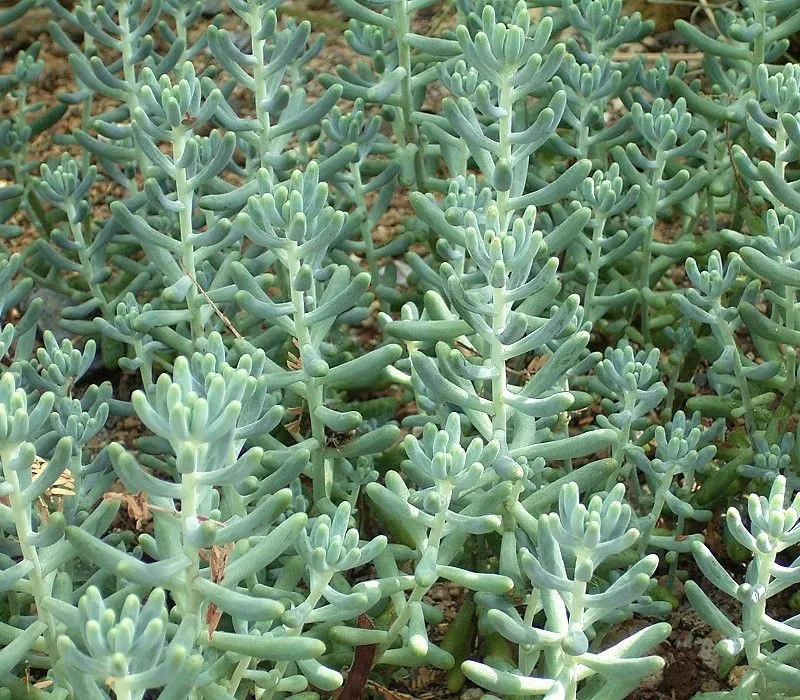
Sedum pachyphyllum Rose, one of the two plants that travels under the trade name "jelly bean plant", was described by Joseph Nelson Rose in 1911 from Mexican material. It is a stem-forming, sparsely branching succulent of 15 cm to 30 cm with stubby, club-shaped leaves whose tips redden in strong light.
The species is native to the Mexican states of Oaxaca and Puebla, where it grows on rocky, well-drained slopes between 1,500 m and 2,500 m. That habitat is dry, exposed, and seasonally cold at altitude, which is why mature plants in cultivation tolerate a wider band of conditions than their soft, plump leaves suggest.
Part of the Complete Sedum Guide.
Identification
The plant builds short, semi-erect stems that lean and branch with age, forming loose mounds rather than a defined rosette. Identification rests on the leaves.
- Leaf shape. Cylindrical to club-shaped, 2 cm to 4 cm long, widest near the rounded apex and tapering to a narrow base. The cross-section is round, not flattened. This shape is what gave the plant its common name; an unstressed leaf, lying loose on a bench, looks like a pale green jelly bean.
- Leaf colour. Blue-green to mint-green over most of the leaf, with a thin waxy bloom that rubs off if handled. The apical 2 mm to 5 mm flush red to magenta under sun stress, low night temperatures, or summer drought. Plants kept in shade carry no red at all and read uniformly mint.
- Inflorescence. Branched, lateral cymes 5 cm to 10 cm tall, carrying small yellow star-shaped flowers in early to mid spring. Pollination by small bees and flies is normal in cultivation but seed is rarely set on isolated clones.
- Habit. Slow lateral spread by leaning stems that root where they touch substrate. Old specimens in shallow pans become bonsai-like, with thick woody bases and clouds of glaucous leaves at the tips.
The species is genuinely difficult to confuse with anything once the leaf shape is in your hand, but the name is shared with several near-relatives sold under the same English label. The three lookalikes worth knowing:
- S. rubrotinctum ('Pork and Beans', also marketed as 'Jelly Bean Plant'). Leaves are shorter, more strictly bean-shaped, less elongated, and turn deep saturated red across the entire leaf surface, not only at the tip. The bloom is thinner; the green base colour is darker. If a "jelly bean plant" reads tomato-red over most of the leaf, it is S. rubrotinctum (or its 'Aurora' variegate).
- S. nussbaumerianum ('Coppertone'). Leaves are broader, distinctly flatter in cross-section, and stained copper-orange across the whole blade. Mature plants reach 40 cm to 60 cm in height with longer internodes than S. pachyphyllum.
- S. clavatum. Forms tighter rosettes at the stem tips with fewer, larger blue-grey leaves and a more compact habit. Where S. pachyphyllum leans and branches, S. clavatum sits up in clusters of small dome-rosettes.
Cultivation
Light is the main lever. Outdoors in Mediterranean conditions a half-day of direct sun produces the desirable red leaf tips and keeps internodes short; full midday sun in inland summer (35 °C plus) burns the bloom off and leaves dull tan scars on the apical leaves. Indoors, a south or unobstructed west window will hold leaf colour reasonably well, but expect the red blush to fade within a couple of weeks of moving the plant away from direct light. Acclimate gradually when shifting between sun regimes.
Water on the standard lean-Sedum schedule. In active growth (spring and autumn in temperate climates), water thoroughly when the leaves at the base of the stem feel slightly soft to firm pressure between thumb and forefinger; the plump, healthy leaves should resist a light squeeze. In summer dormancy under heat, drop to one watering every three to four weeks; in winter, dry stop entirely if temperatures fall below 5 °C.
Substrate should be 60 to 70 percent mineral. A working mix is two parts pumice or 3 mm to 6 mm scoria, one part coarse perlite, one part sieved coir or low-peat potting soil. Avoid water-retentive composts; the species rots fast at the leaning stems if the substrate stays wet for more than four or five days at a stretch.
Temperature tolerance is wider than the soft leaves suggest. Brief dry exposure to about −3 °C causes only tip damage on the apical leaves; the woody stems and root crown survive. Wet cold is the killer. Below 5 °C the plant must be bone-dry, or rot will appear at the substrate line within days of a thaw.
Pots should be wide and shallow rather than deep. Terracotta in 12 cm to 18 cm pans suits a mature plant; the broad surface area helps the substrate dry between waterings, and the leaning habit looks correct in a low pot. Repot every two to three years, in spring, into fresh dry mix.
Most other care defaults map directly onto the genus, so pair this profile with A Beginner's Guide to Succulents if you are new to the family.
Propagation
Propagation is the species' party trick. Leaves abscise from the stem at the lightest touch, often falling off during transport from the nursery, and almost every fallen leaf will root.
The reliable method is dry leaf propagation. Lay detached leaves on the surface of a tray of dry pumice, or fine grit, in bright indirect light at 18 °C to 25 °C. Do not water. Roots emerge from the basal scar within 7 to 14 days, and a tiny plantlet appears at the same point within a further two to four weeks. Begin light misting only once the plantlet shows green leaves; before that, the propagule lives off the parent leaf and resents standing moisture. Success rates of 80 to 95 percent are normal across a tray of intact leaves. Damaged or torn leaves usually fail.
Stem cuttings work equally well. Take a 5 cm to 10 cm tip cutting in spring, let the cut callus for three or four days in shade, then push it into dry pumice and water lightly after a fortnight. Cuttings root in three to four weeks and grow on without check.
Seed is rarely worth pursuing. The species is largely self-incompatible, isolated cultivated plants set little seed, and seedlings grow no truer than vegetative offsets while taking two seasons to reach a usable size.
Notes
The plant is mildly toxic to cats and dogs in moderate quantities. The genus Sedum contains a class of piperidine alkaloids; ingestion of a few leaves typically produces drooling, mild gastric upset, and lethargy rather than serious illness, but the leaves detach so easily that an inquisitive pet can dismantle a plant in minutes. Keep specimens out of reach of cats in particular.
The shared "jelly bean plant" label is the most persistent source of confusion in trade. Many nurseries apply it interchangeably to S. pachyphyllum, S. rubrotinctum, and various rubrotinctum hybrids; the only reliable disambiguation is to look at leaf length, cross-section, and the distribution of red colour, as set out in the identification section above. If a label is the only evidence available, treat it as a starting hypothesis, not a verdict.
In long cultivation the plant becomes characterful. Old leaning stems shed their lower leaves, develop a corky base, and end in clusters of glaucous, red-tipped tips that catch low winter light. It is one of the better hardy Sedum species for an unheated porch or a sheltered patio in zone 9b conditions.
See also
- The Complete Sedum Guide for genus-wide cultivation defaults and the full satellite map, including profiles of S. rubrotinctum, S. nussbaumerianum, and S. clavatum as they ship.
- A Beginner's Guide to Succulents if this is one of your first plants in the family.
- Sedum rubrotinctum — the other plant sold as jelly bean plant, with whole-leaf red colour rather than tip-only red.
Frequently Asked Questions
Why are only the tips red on Sedum pachyphyllum?
Tip-only red colour is normal for the species. Strong light, low night temperatures, and summer drought concentrate the red flush in the apical 2–5 mm.
How cold can Sedum pachyphyllum tolerate?
Brief dry exposure to about −3 °C causes only tip damage. Below 5 °C the substrate should stay dry because wet cold rots the stem base.
How do you propagate Sedum pachyphyllum?
Lay intact fallen leaves on dry pumice or fine grit in bright indirect light. Roots appear in 7–14 days and plantlets follow within two to four weeks.
Is Sedum pachyphyllum the same as jelly bean plant?
It is one plant sold under that common name. The same label is also used for S. rubrotinctum, so identify by leaf length, cross-section, and where the red colour appears.