| Question | Short Answer |
|---|---|
| Is Sedum rubrotinctum found in the wild? | No confirmed wild population is known. |
| Why are my jellybean plant leaves green? | Insufficient light. |
| How do you propagate Sedum rubrotinctum? | Detached leaves root easily on moist substrate and produce plantlets in 3–4 weeks. |
| Is Sedum rubrotinctum toxic to pets? | Yes. |
Sedum rubrotinctum R.T.Clausen (jellybean plant, pork-and-beans, Christmas cheer) is a stem-succulent stonecrop grown for its short bead-like leaves that blush red in strong sun. It was described by Robert T. Clausen in 1948, and although long treated as a Mexican native, it has never been confirmed in the wild and is generally accepted as a garden hybrid, most plausibly Sedum pachyphyllum × S. stahlii.
Part of the Complete Sedum Guide.
Identification
- Short sprawling stems 15 to 25 cm long, eventually pendant in a pot.
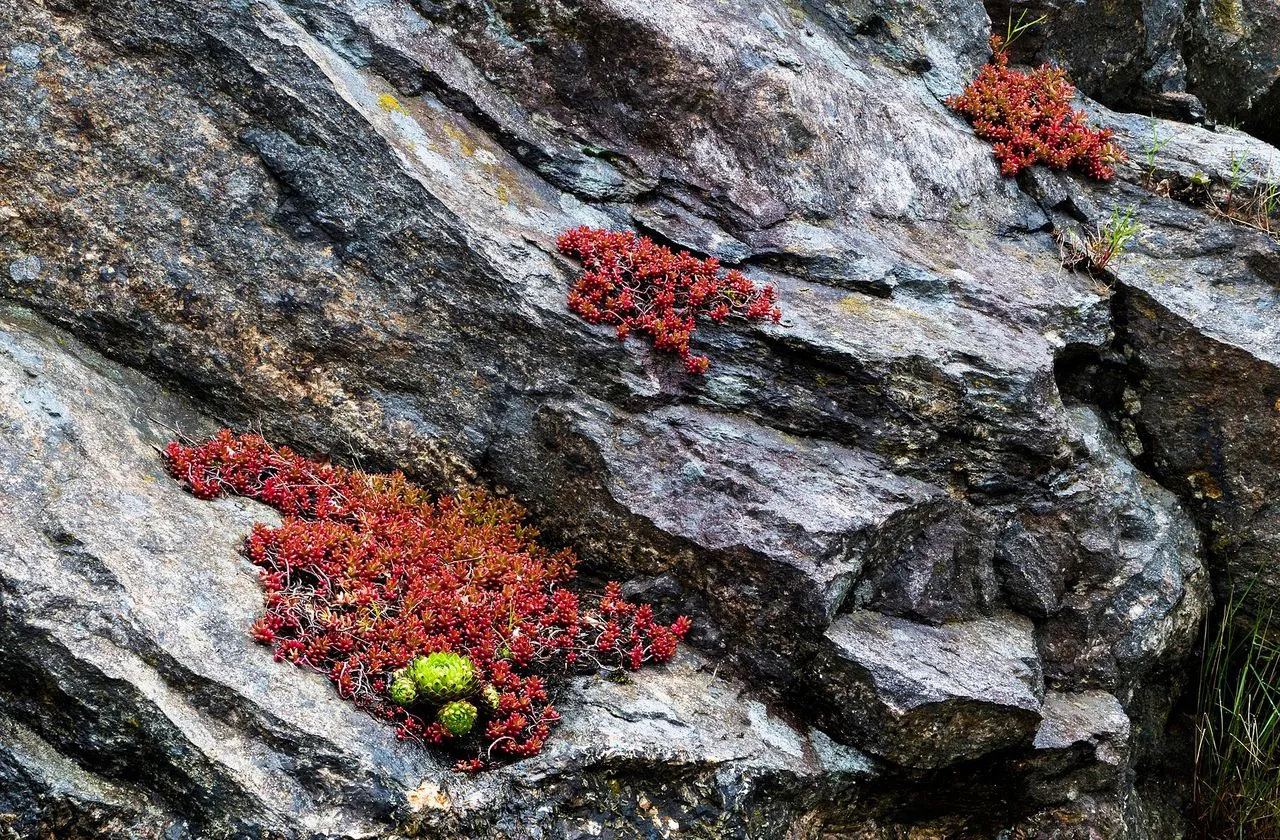
- Leaves terete, 1 to 2 cm long, held in loose spirals along the stem, bright green in shade, turning scarlet to bronze in full sun.
- Detaching leaves is easy; they drop at the slightest bump, which is how the plant colonises adjacent pots.
- Inflorescence a small terminal cyme of yellow five-petalled flowers in late winter and early spring. Flowering is sparse in cultivation.
A variegated form sold as 'Aurora' has pale pink and cream leaves and is slower-growing.
Cultivation
Standard for the tender stem-succulent group in the pillar guide. Specific to this species:
- Hardy to about USDA zone 9b. Tender; any sustained frost destroys the plant.
- Wants full sun for leaf colour. Shaded plants stay uniformly green and sprawl open.
- Tolerates neglect well. Container specimens can go a month without water in winter and suffer no setback.
- Brittle. Pots need to sit somewhere leaves and stems will not be brushed against, or the plant will steadily dismantle itself.
Substrate is a standard mineral succulent mix, 60 per cent pumice or perlite, 40 per cent loam-based compost. Shallow pots suit the root habit.
Propagation
The easiest sedum to propagate. Drop a detached leaf onto moist substrate; within 3 to 4 weeks a plantlet emerges at the base. Stem cuttings root almost as fast: take a 5 cm fragment, let the cut callus for two days, push it into substrate. Success rates approach 100 per cent. You will accidentally propagate this plant by moving it from one shelf to another.
Notes
Mildly toxic. The sap contains irritant compounds and ingestion causes gastric upset in cats, dogs, and children; the ASPCA lists S. rubrotinctum specifically as toxic to pets, which is unusual for Sedum. Handle with care, wash hands after repotting, and keep pots out of reach of animals that chew plants.
The common name "pork-and-beans" refers to the red-and-green colour contrast when some leaves have coloured up and others have not. "Jellybean plant" is more often used in North America. "Christmas cheer" is a nurseryman's marketing name, not a cultivar.
A frequent point of confusion: S. rubrotinctum looks superficially like S. stahlii (coral bells), which has smaller redder leaves in pairs rather than spirals, and genuine provenance as a Mexican species.
See also
Frequently Asked Questions
Is Sedum rubrotinctum found in the wild?
No confirmed wild population is known. It is generally accepted as a garden hybrid, probably involving S. pachyphyllum and S. stahlii.
Why are my jellybean plant leaves green?
Insufficient light. In shade the leaves stay bright green and the stems sprawl open; full sun produces the scarlet to bronze colour.
How do you propagate Sedum rubrotinctum?
Detached leaves root easily on moist substrate and produce plantlets in 3–4 weeks. Stem cuttings also root quickly after a short callus period.
Is Sedum rubrotinctum toxic to pets?
Yes. The post notes irritant sap and gastric upset in cats, dogs, and children, and the ASPCA lists this species specifically as toxic to pets.