| Question | Short Answer |
|---|---|
| When does Sedum palmeri flower? | It flowers in late winter and very early spring, often February in a mild Mediterranean winter. |
| How cold-hardy is Sedum palmeri? | It is marginally hardy: zone 8b with protection and zone 9 reliably. |
| How do you propagate Sedum palmeri? | Stem cuttings root in 10–14 days after a 2–3 day callus. |
| How is Sedum palmeri different from Sedum confusum? | S. |
Sedum palmeri S.Watson is a rosette-stemmed creeper native to cliffs and canyon walls in northeastern Mexico, principally in the states of Nuevo León, Coahuila, and Tamaulipas. It was described by the American botanist Sereno Watson in 1889 from material collected by Edward Palmer. The species sits at the borderline of the hardy and tender sedum groups, and in mild-winter regions it has become a reliable outdoor plant despite its Mexican origin.
Part of the Complete Sedum Guide.
Identification
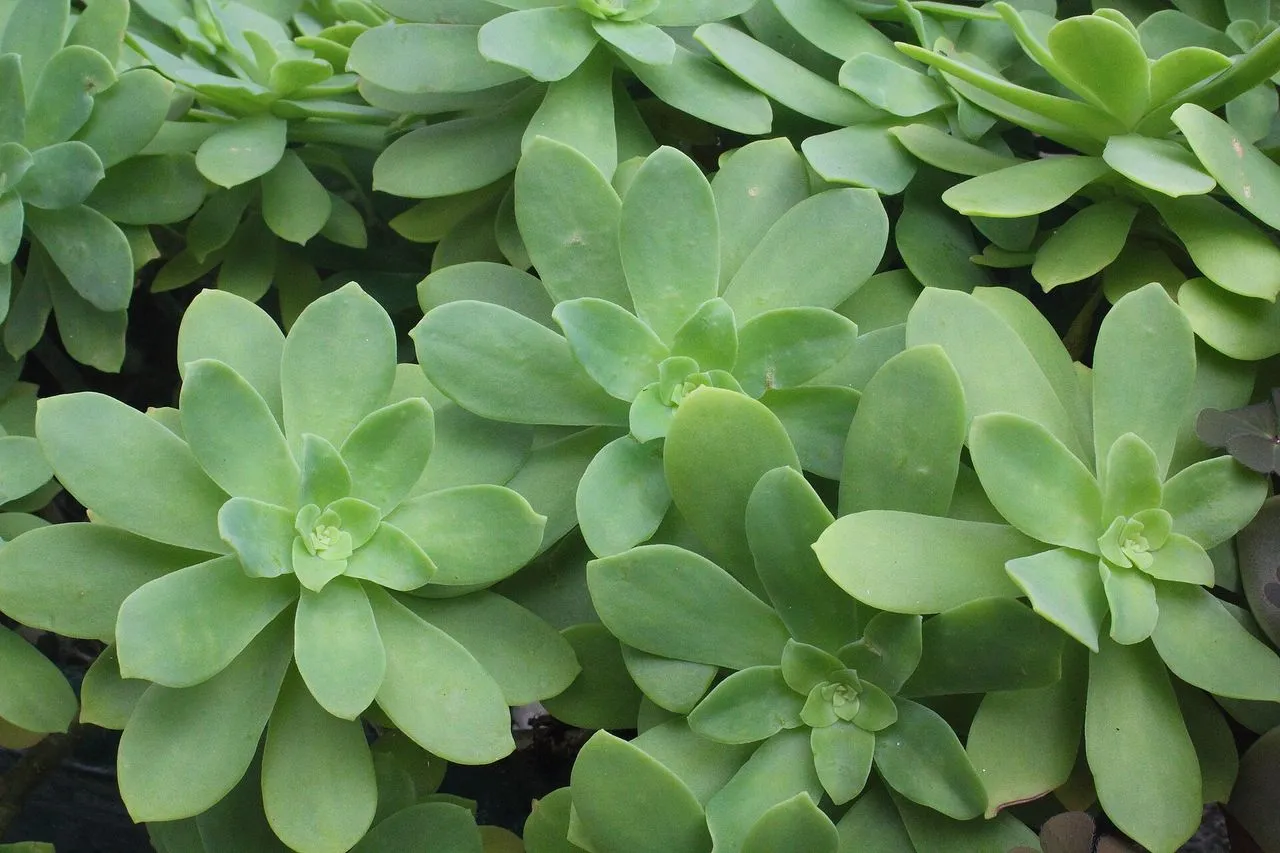
- Sprawling stem-succulent with short prostrate stems, each tipped with a loose rosette of 20 to 30 leaves.
- Leaves spathulate to obovate, 2 to 3 cm long, flat with a rounded tip, grey-green with a pale bloom, reddening at the margins in full sun.
- Inflorescence a terminal cyme of bright yellow to orange-yellow five-petalled stars in late winter and very early spring, often opening in February in a mild Mediterranean winter.
- Flowering time is diagnostic: few sedums bloom in the depths of winter.
Easy to confuse with S. confusum (paler leaves, smaller rosettes, summer-flowering) and with S. compressum (tighter rosettes, more grey-blue foliage). The winter-flowering habit settles it.
Cultivation
Marginally hardy. USDA zone 8b with protection, zone 9 reliably. Tolerates brief frost to around −4 degrees Celsius when dry. Specific to this species:
- Full sun to light shade. Accepts more shade than most tender sedums.
- Free-draining mineral substrate. Standard succulent mix is fine.
- Drought-tolerant. Water monthly in winter, every 10 to 14 days in summer in a container.
- Good for dry walls, north-facing rockeries in warm regions, and as a container subject in colder areas.
In cold-winter climates (zone 8 and colder) grow in a pot and bring into an unheated greenhouse or porch before first frost. The foliage tolerates dry cold better than wet cold.
Propagation
Stem cuttings root easily. Take a 5 to 8 cm shoot, strip the lower rosette leaves, allow the cut to callus for 2 to 3 days, then pot up in mineral mix. Roots within 10 to 14 days. Leaf propagation is less reliable than with the true rosette species; the flat leaves are more prone to drying out before a plantlet forms. Division of established clumps works when a mat has spread enough to lift in pieces.
Notes
The winter flowering is the reason to grow this species. In a Mediterranean garden, S. palmeri in full bloom in February, alongside late Galanthus and early Crocus, gives a week of saturated yellow when nothing else in the succulent collection is moving. Expect bumblebees on the flowers at 10 degrees Celsius on a sunny morning in late winter.
Wild populations are scattered across a narrow range and are not under significant pressure; the species is stable in cultivation and propagates readily from cuttings. No conservation restrictions apply.
Not to be confused with S. palmeri as occasionally misapplied in old garden literature to any yellow-flowered Mexican sedum. The true species has the combination of flat spathulate leaves, loose rosettes, and winter flowering.
See also
- Sedum nussbaumerianum
- Sedum adolphi
- Sedum rubrotinctum
- Sedum confusum — the closely related Mexican mat-former historically confused with S. palmeri in 19th-century herbaria.
Frequently Asked Questions
When does Sedum palmeri flower?
It flowers in late winter and very early spring, often February in a mild Mediterranean winter. That timing is diagnostic among yellow-flowered Mexican sedums.
How cold-hardy is Sedum palmeri?
It is marginally hardy: zone 8b with protection and zone 9 reliably. Dry plants tolerate brief frost to about −4 °C.
How do you propagate Sedum palmeri?
Stem cuttings root in 10–14 days after a 2–3 day callus. Leaf propagation is less reliable because the flat leaves dry before plantlets form.
How is Sedum palmeri different from Sedum confusum?
S. palmeri has flat spathulate leaves in loose rosettes and winter flowers. S. confusum is glossier, usually taller, and flowers later with denser heads.