| Question | Short Answer |
|---|---|
| How do you get Sedum nussbaumerianum orange? | Strong sun drives the copper-orange colour. |
| Is Sedum nussbaumerianum hardy? | It is hardy only around USDA zone 9b, roughly −3 °C for brief exposures. |
| How is Sedum nussbaumerianum different from Sedum adolphi? | Nussbaumerianum has broader, flatter, more spaced leaves and turns more saturated orange. |
| How do you propagate Sedum nussbaumerianum? | Stem cuttings root within about two weeks after 3–5 days of callus. |
Sedum nussbaumerianum Bitter, known as coppertone stonecrop or coppertone sedum, is a tender stem-succulent native to Veracruz in eastern Mexico. It was described in 1913 and named for the Swiss botanist Friedrich Nussbaumer. Among the cluster of closely related Mexican sedums used in mixed-succulent design, it is the one most reliably valued for sun-stressed orange foliage.
The species sits in the dwarf-rosette and stem-succulent group of the genus, alongside S. adolphi, S. palmeri, and S. pachyphyllum. These are the frost-sensitive end of the genus and behave in cultivation more like the Mexican Echeveria than like the hardy creeping sedums.
Part of the Complete Sedum Guide.
Identification
A low stem-succulent, 15 to 25 cm tall, forming loose open rosettes of finger-shaped leaves at the stem tips and branching from the base as it ages.
- Leaves. Lanceolate, thick and slightly flattened, 3 to 4 cm long and 1 cm wide, with a pointed tip. Surface matte, not waxy. Colour is the diagnostic feature: pale yellow-green in shade, flushing through yellow to copper-orange and burnt-tangerine when grown in strong sun.
- Stems. Prostrate at the base, then lifting at the tip; older plants sprawl and root where stems touch substrate.
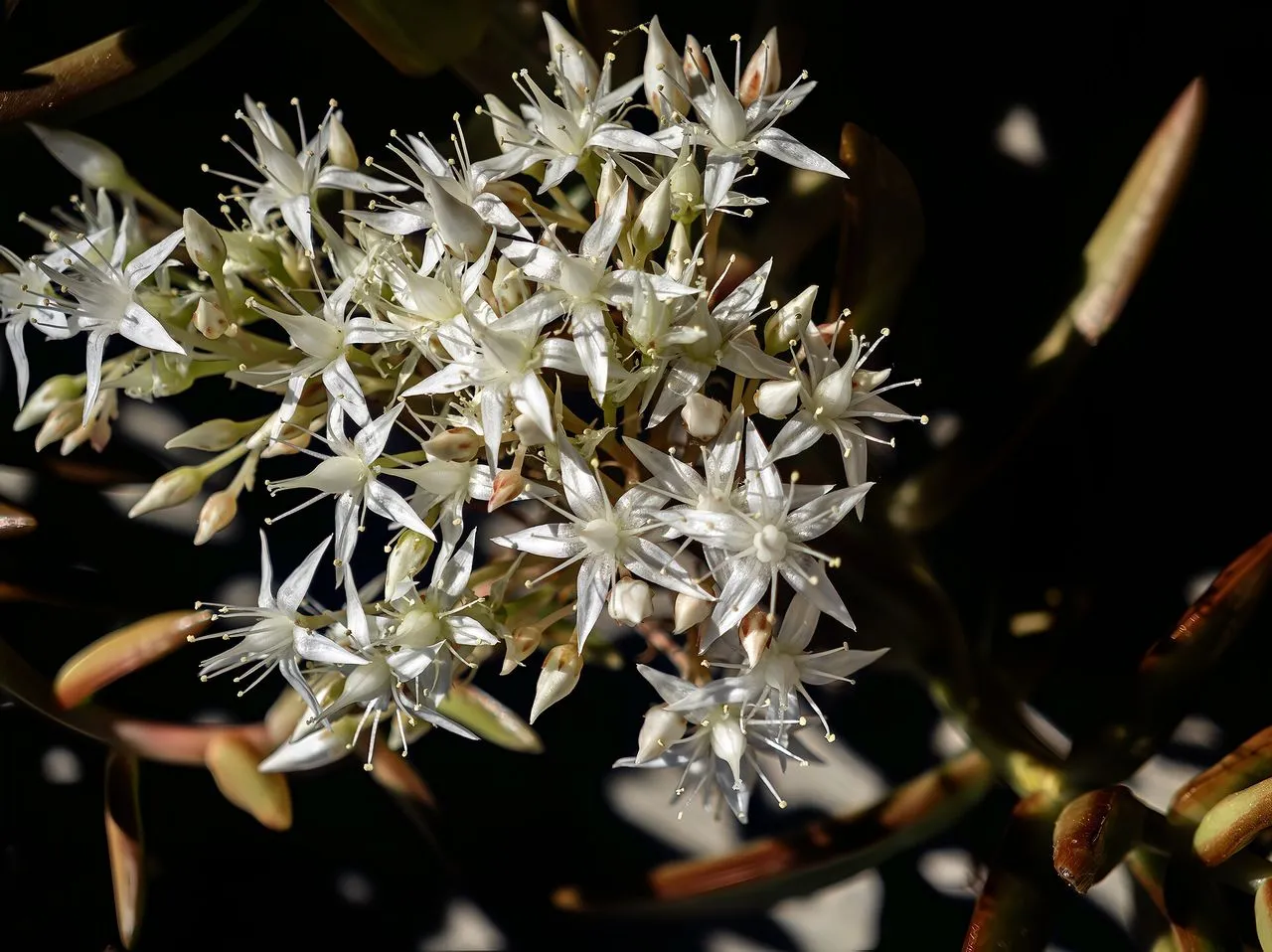
- Inflorescence. Terminal cymes of small cream-white star-shaped flowers in spring. Honey-scented at close range.
S. nussbaumerianum is frequently confused with S. adolphi (golden sedum). The reliable distinction: S. adolphi leaves are narrower and held more tightly along the stem, with a green edge even in full sun; S. nussbaumerianum leaves are broader, more spaced, and turn a more saturated orange when sun-stressed. The two are thought to be closely related and possibly synonymous; some recent treatments sink nussbaumerianum into adolphi but the horticultural trade treats them separately.
Cultivation
This is where S. nussbaumerianum diverges most sharply from the hardy sedum pillar. Treat it like a tender Mexican succulent, not a stonecrop.
- Light. Full sun for the coppertone colour. In low light leaves revert to plain green and internodes stretch.
- Temperature. Hardy to USDA zone 9b, roughly −3 °C for brief exposures. Sustained frost destroys the above-ground tissue. In temperate climates grow in a pot and move indoors before first frost.
- Substrate. A mineral-heavy succulent mix. My standard is 60 per cent pumice or perlite, 40 per cent loam-based compost.
- Water. More sparing than for the hardy creepers. Water when the top third of the substrate is dry through the growing season; reduce to monthly or less in winter.
Outdoors in Mediterranean climates the plant thrives year-round in a raised gravel bed with no cover. In continental winters it is strictly a container plant.
Propagation
Both leaf and stem propagation work.
Stem cuttings: take a 5 to 10 cm terminal cutting, strip the bottom few leaves, callus the cut end for 3 to 5 days in shade, then push into gritty substrate. Roots within 2 weeks, visible growth within a month.
Leaf propagation: detach a whole mature leaf with a clean twist so the base is intact. Lay it on moist substrate, keep in bright indirect light, do not bury. A small pink-tipped rosette emerges at the base in 4 to 6 weeks. Success rate is high, above 70 per cent.
Division: not applicable to this single-stemmed species.
Notes
The coppertone colour is light-dependent and reversible. A specimen moved from full sun to shade will fade to green over several weeks; moved back, it re-colours. This is not a pigment change in existing leaves only; new growth produced under sun stress carries more anthocyanin and more carotenoid content. Use this to your advantage in arrangement design: plant in a portable pot and rotate into sun when you want the warm tone to peak.
The honey-scented flowers are a minor surprise for a plant typically valued for foliage. Bloom occurs on mature terminal rosettes in spring, and the flowering rosette does not die afterwards, unlike some of the closely related Graptopetalum hybrids. The plant simply resumes vegetative growth below the old bloom spike.
Mealybug in leaf axils is the main pest under indoor or greenhouse culture. Check new stock before adding it to a mixed-succulent pot.
See also: Sedum adolphi, Sedum rubrotinctum, Sedum morganianum.
Frequently Asked Questions
How do you get Sedum nussbaumerianum orange?
Strong sun drives the copper-orange colour. A plant moved into shade fades green over several weeks, and new sun-grown leaves recolour when the pot returns to bright light.
Is Sedum nussbaumerianum hardy?
It is hardy only around USDA zone 9b, roughly −3 °C for brief exposures. Sustained frost destroys above-ground tissue.
How is Sedum nussbaumerianum different from Sedum adolphi?
Nussbaumerianum has broader, flatter, more spaced leaves and turns more saturated orange. Adolphi leaves are narrower, tighter, and retain a green edge.
How do you propagate Sedum nussbaumerianum?
Stem cuttings root within about two weeks after 3–5 days of callus. Whole leaves also work, producing rosettes in 4–6 weeks with success above 70%.