| Question | Short Answer |
|---|---|
| How long do Sedum morganianum stems get? | Mature stems commonly hang 60–90 cm, and related measurements in the guide allow up to about 100 cm in baskets. |
| Does burro’s tail want full sun? | No hard afternoon sun. |
| Why does Sedum morganianum drop leaves? | The wax-coated leaves are heavy and attached at narrow bases, so they dislodge from slight contact. |
| How do you propagate burro’s tail? | Stem cuttings root in about two weeks after 3–5 days of callus. |
Sedum morganianum E.Walther (burro's tail, donkey tail, horse's tail) is a tender pendant stem-succulent first described in 1938 from garden-cultivated material. Its wild origin was unknown for decades; it is now documented from a single small locality in Veracruz, Mexico, where it grows hanging from cliff faces in humid semi-shade, and its wild range is listed as critically endangered on the IUCN Red List. The plants in ordinary cultivation are all descended from that small founding population.
The species is the signature representative of the pendant-trailer growth form in the genus.
Part of the Complete Sedum Guide.
Identification
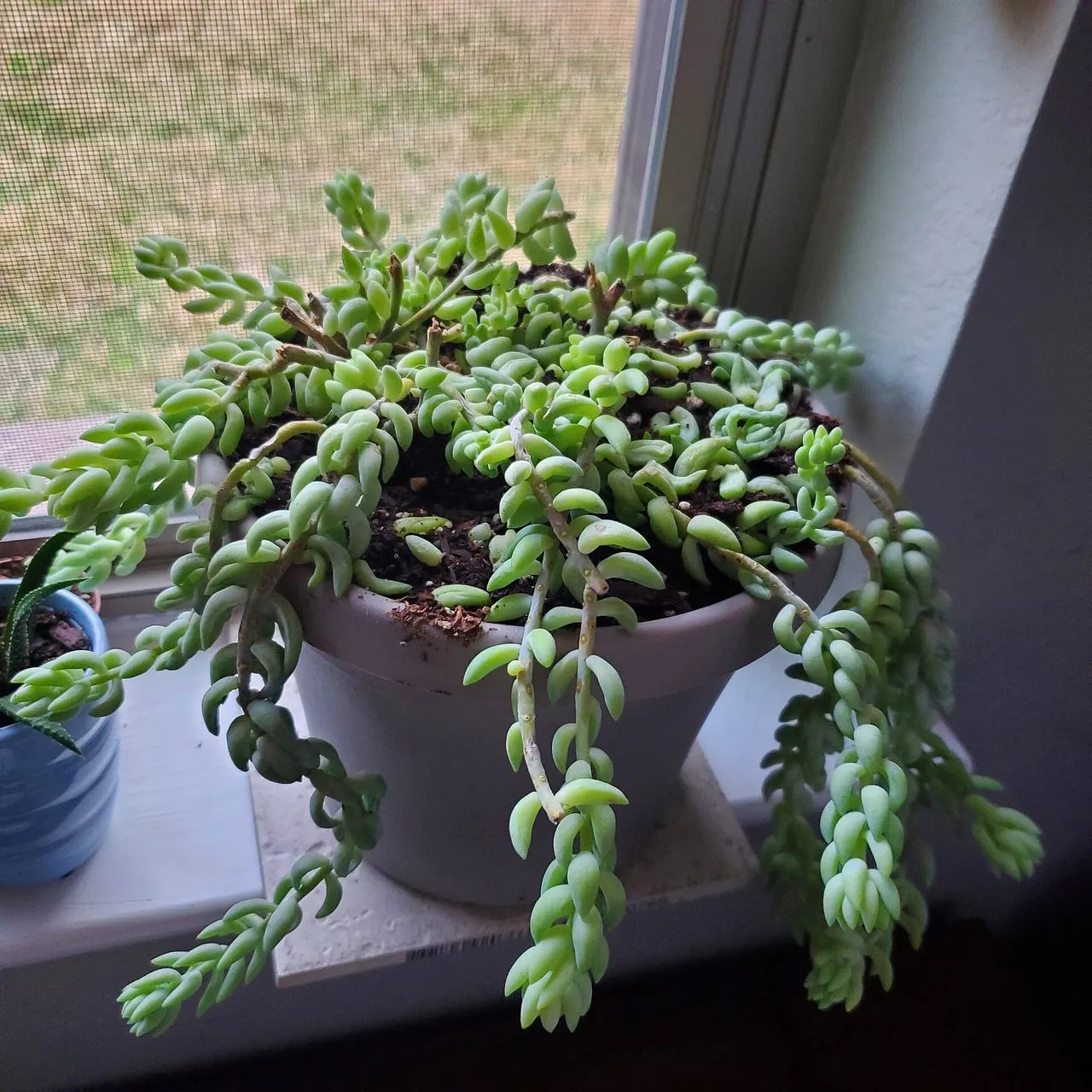
A pendant stem-succulent with hanging stems reaching 60 to 90 cm in mature specimens.
- Leaves. Lanceolate to fusiform, terete, 1.5 to 2.5 cm long, covered in a heavy pale blue-grey farinose wax that gives the overall plant a frosted look. Densely overlapping along the stem like braided rope.
- Stems. Pendant, hanging downward from the pot, not branching readily. Mature plants produce single long stems rather than many short ones.
- Inflorescence. Small nodding clusters of deep pink to wine-red bell-shaped flowers at the stem tips, appearing in summer on mature specimens. Flowering is a minor event compared to the foliage display.
The closely related S. burrito Moran (baby burro's tail) has shorter, rounder, tighter leaves and is sometimes sold under the same common name. The distinction: morganianum leaves are pointed and spaced along the stem; burrito leaves are blunt, nearly spherical, and packed tightly against each other.
Cultivation
Treat as a tender Mexican succulent with some specific quirks for the pendant habit.
- Light. Bright indirect light or gentle morning sun. Unlike most tender Mexican sedums, S. morganianum does not want hard direct afternoon sun, which bleaches and sunburns the wax-coated leaves. Its wild habitat is a shaded cliff face.
- Temperature. Hardy to roughly −2 °C for brief exposures; USDA zone 9b. In temperate climates grow in a hanging basket and bring indoors or into a cool conservatory before first frost.
- Substrate. Mineral-heavy succulent mix, but slightly more organic than for the desert species: 50 per cent pumice or perlite, 30 per cent loam-based compost, 20 per cent peat-free cocoa fibre or similar.
- Water. Water thoroughly when the top half of the substrate is dry, then let drain fully. In winter reduce to monthly or less. The mass of leaves holds significant water reserve.
The critical divergence from the pillar: this is a plant you do not move. Every time a stem brushes a surface, leaves dislodge. Hang the basket in its final position, keep it out of traffic paths, do not shift it for watering, do not rotate it.
Propagation
Both stem and leaf propagation work, and both are often forced on you by accidental leaf drop.
Stem cuttings: take 10 to 15 cm terminal cuttings, strip the lower third of leaves, callus the cut for 3 to 5 days, pot up in gritty substrate. Roots within 2 weeks. The detached leaves from the stripped section can be used for leaf propagation.
Leaf propagation: lay whole undamaged leaves on moist substrate, keep in bright indirect light. Small new rosettes emerge at the leaf base in 4 to 6 weeks. Success rate is high, above 70 per cent. Seedling plants from leaf propagation take 2 to 3 years to produce trailing stems of any length, so this is a long-term bulk increase rather than a quick win.
Notes
The fragile leaves are the single most-discussed feature of the species. Wax-coated, attached at a narrow base, and heavy for their size, they drop at the slightest disturbance. Shipped plants often arrive with a layer of detached leaves in the packaging. Hanging baskets in nurseries are usually priced based on how well the stems have held their leaves during transport.
Two practical mitigations. First, once the plant is in position do not move it. Water in place from a long-spouted can. Second, collect and use the dropped leaves for propagation; every leaf is a potential new plant.
The flowers, when they appear on mature specimens, are often hidden in the middle of the stems and are easy to miss. A specimen displayed from below, rather than at eye level, shows the bell-shaped pink flowers to better advantage.
Mealybug and aphids are the main pests in indoor cultivation; the dense leaf packing makes them hard to treat with cotton swabs. Preventive checks are more useful than late intervention.
The care rhythm — fragile leaf attachment, mineral substrate, and sparse winter watering — is broadly shared with Sedum pachyphyllum, another tender Mexican stem-succulent that roots easily from detached leaves.
See also: Sedum adolphi, Sedum nussbaumerianum, Sedum rubrotinctum.
Frequently Asked Questions
How long do Sedum morganianum stems get?
Mature stems commonly hang 60–90 cm, and related measurements in the guide allow up to about 100 cm in baskets.
Does burro’s tail want full sun?
No hard afternoon sun. It prefers bright indirect light or gentle morning sun, reflecting its shaded cliff-face habitat.
Why does Sedum morganianum drop leaves?
The wax-coated leaves are heavy and attached at narrow bases, so they dislodge from slight contact. Keep the basket out of traffic and do not move it for watering.
How do you propagate burro’s tail?
Stem cuttings root in about two weeks after 3–5 days of callus. Dropped whole leaves can also produce new rosettes in 4–6 weeks.