| Question | Short Answer |
|---|---|
| How do you tell Sedum adolphi from Sedum nussbaumerianum? | Adolphi leaves are narrower, more pointed, and held more tightly; they retain a green margin in sun. |
| Is Sedum adolphi hardy? | It is hardy only to roughly −2 °C for brief exposures and needs USDA zone 9b or warmer for permanent outdoor planting. |
| How fast does Sedum adolphi grow? | It is one of the faster tender sedums, producing display-ready plants from cuttings within a single season. |
| How do you propagate Sedum adolphi? | Stem cuttings root within about two weeks after 3–5 days of callus. |
Sedum adolphi Hamet (golden sedum, golden glow) is a tender stem-succulent native to the Mexican state of Veracruz, described in 1912 by the French botanist Raymond Hamet and named for the Swiss horticulturist Adolph Engler. It sits in the tender rosette and stem-succulent group of the genus, the Mexican clade that includes S. nussbaumerianum, S. palmeri, and S. pachyphyllum.
S. adolphi is frequently confused with S. nussbaumerianum (coppertone stonecrop), and recent taxonomic work has suggested the two may be conspecific. In the horticultural trade they are treated as distinct cultivars or clones, and there are reliable visual differences that justify keeping them separate in practice.
Part of the Complete Sedum Guide.
Identification
A low stem-succulent forming loose open rosettes at the tips of branching stems, 15 to 20 cm tall.
- Leaves. Lanceolate, thick, 2 to 3 cm long and up to 1 cm wide, pointed at the tip, tapering at the base. Narrower and more tightly held along the stem than those of S. nussbaumerianum. Colour is pale yellow-green in shade, flushing to warm gold and amber-orange at the tips under full sun.
- Stems. Prostrate to decumbent, branching from the base, usually 10 to 20 cm long, becoming woody at the base with age.
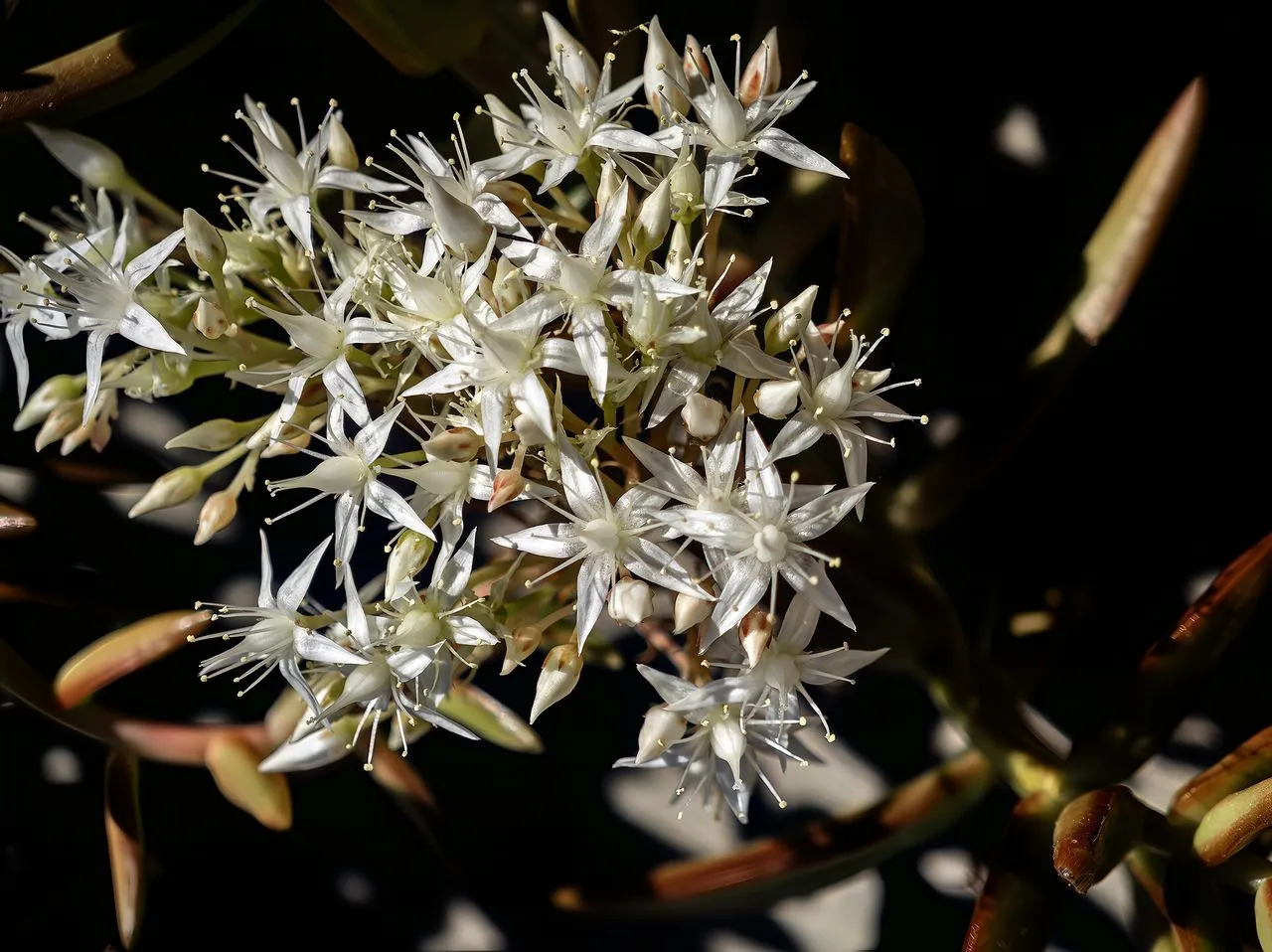
- Inflorescence. Short terminal cymes of small white star-shaped flowers in spring, lightly honey-scented.
The named selection 'Firestorm' (sometimes marketed as 'Gold Mound') emphasises the sun-flushed gold colour with orange leaf margins. 'Golden Glow' is another similar selection; both are vegetatively propagated clones of the species.
Tell S. adolphi from S. nussbaumerianum by leaf shape: adolphi leaves are narrower, more pointed, and held more tightly along the stem; nussbaumerianum leaves are broader, flatter, and more spaced. S. adolphi retains a green leaf margin even in full sun; S. nussbaumerianum turns fully orange.
Cultivation
Treat as a tender Mexican succulent, not a hardy stonecrop. This is the standard divergence from the pillar for the Mexican group.
- Light. Full sun for colour. In low light leaves stay green and the rosettes stretch.
- Temperature. Hardy to roughly −2 °C for brief exposures; sustained frost destroys above-ground tissue. USDA zone 9b or warmer for permanent outdoor planting. In temperate climates grow in pots and bring indoors before first frost.
- Substrate. Mineral-heavy succulent mix: 60 per cent pumice or perlite, 40 per cent loam-based compost.
- Water. When the top third of the substrate is dry through the growing season; monthly or less in winter.
Can be grown outdoors year-round in Mediterranean and subtropical climates; in continental winters it is a house or conservatory plant.
Propagation
Stem cuttings are fast and reliable. Take a 5 to 10 cm terminal cutting, strip the bottom leaves, callus the cut for 3 to 5 days in shade, pot up in gritty substrate. Roots within two weeks.
Leaf propagation works but is less reliable than for the bead-leaved species such as S. rubrotinctum. Success rate around 40 to 60 per cent; detach whole undamaged leaves, lay them on moist substrate, wait 4 to 6 weeks. New rosettes emerge at the base of the leaf.
Division is not applicable to this branching stem-succulent.
Notes
S. adolphi is one of the faster-growing tender sedums and produces display-ready plants from cuttings within a single season, which is why it turns up regularly in mixed-succulent arrangements from commercial nurseries.
The gold colour is light-dependent and reversible, like that of S. nussbaumerianum. A specimen kept indoors on a windowsill will revert toward green; moved to a south-facing patio in summer, it re-colours within a month. Plan pot-rotation to coincide with the times of year you want the warm colour most visible.
A well-branched specimen in a shallow clay pot reads as a miniature sculptural landscape, particularly when combined with Echeveria rosettes and a creeping sedum filler. It holds its shape for years with occasional renewal cuttings.
Mealybug and aphids are the main pests under glasshouse culture. Check new stock before incorporating it into mixed-succulent pots.
See also: Sedum nussbaumerianum, Sedum rubrotinctum, Sedum morganianum.
Frequently Asked Questions
How do you tell Sedum adolphi from Sedum nussbaumerianum?
Adolphi leaves are narrower, more pointed, and held more tightly; they retain a green margin in sun. Nussbaumerianum leaves are broader and turn fully orange.
Is Sedum adolphi hardy?
It is hardy only to roughly −2 °C for brief exposures and needs USDA zone 9b or warmer for permanent outdoor planting.
How fast does Sedum adolphi grow?
It is one of the faster tender sedums, producing display-ready plants from cuttings within a single season.
How do you propagate Sedum adolphi?
Stem cuttings root within about two weeks after 3–5 days of callus. Leaf propagation works at roughly 40–60% from whole undamaged leaves.