| Question | Short Answer |
|---|---|
| What does creeping sedum mean? | It is a horticultural grouping for low-growing stonecrops that root at stem nodes and form ground-covering mats. |
| Which species are creeping sedums? | Common examples include S. |
| How do you propagate creeping sedum? | Pull up a section of mat, fragment it, and press the pieces onto moist gritty substrate. |
| Are creeping sedums invasive? | Some can be. |
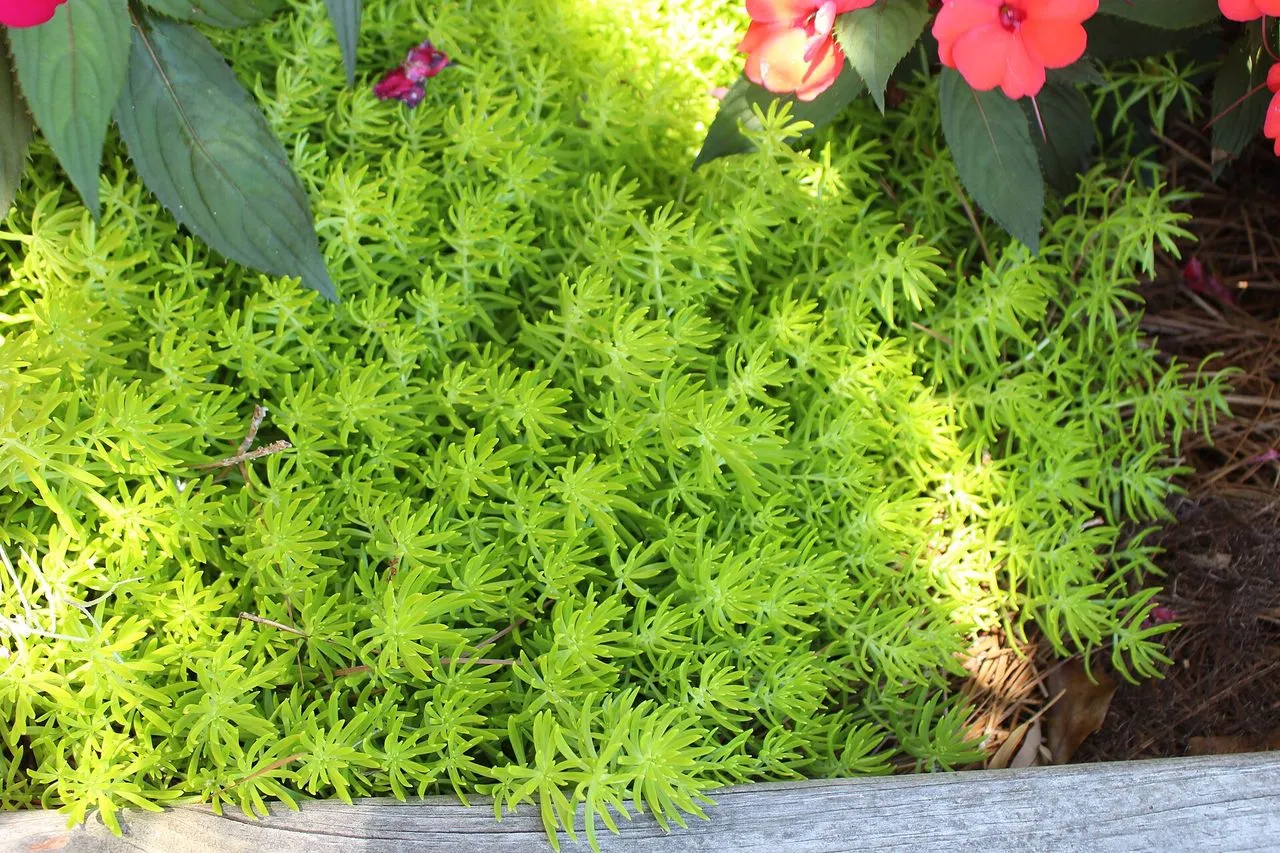
"Creeping sedum" is a horticultural grouping, not a species. It covers all the low-growing stonecrops whose stems root at the nodes and form dense ground-covering mats. The group spans several dozen species across Sedum proper and the segregate genus Phedimus, and it accounts for most of the sedums sold in nurseries, garden centres, and green-roof specifications.
Part of the Complete Sedum Guide.
Which species count as creeping sedum
The species most commonly sold under this label:
- Sedum acre (biting stonecrop) — tiny pointed green leaves, yellow flowers
- Sedum album (white stonecrop) — cylindrical bronze-tinted leaves, white flowers
- Sedum spurium / Phedimus spurius (two-row stonecrop) and its cultivars — flat obovate leaves, pink or red flowers
- Sedum rupestre 'Angelina' — chartreuse needle leaves, orange winter colour
- Sedum reflexum 'Blue Spruce' — blue-grey needle leaves
- Sedum sexangulare — tiny green terete leaves in six spiralled ranks
- Sedum dasyphyllum — blue bead-shaped leaves, white flowers
- Sedum lineare — needle-leaved, often variegated
- Sedum kamtschaticum / Phedimus kamtschaticus — slightly taller, orange-yellow flowers
- Sedum sarmentosum — stringy fast-spreading yellow-flowered species
- Sedum mexicanum 'Lemon Coral' — chartreuse leaves, bedded as an annual in cold zones
- Sedum ternatum — the North American woodland native, the shade-tolerant exception
All share the creeping habit; they differ sharply in hardiness, leaf form, and flower colour.
Why they work as groundcover
Creeping sedums root at every stem node that touches soil. That means a single broken fragment becomes a colony, and an established planting heals itself quickly after foot traffic, snow damage, or rabbit browsing. They tolerate thin soil, poor nutrition, drought, and direct sun, and they shade out most annual weed seedlings once the mat closes. On a 5 cm substrate depth with full sun, creeping sedums will outperform almost any other perennial groundcover.
Cultivation
Standard for the hardy mat-forming group in the pillar guide. The essentials:
- Full sun. Most species stretch and flop in shade.
- Free-draining substrate. Sharp grit and thin soil beat rich compost.
- Minimal water once established.
- No feeding.
- Hardy to USDA zones 3 to 5 for most species; check individual species pages.
The main pitfall is placing them where something else wants to compete. A creeping sedum mat outmatches thin grass and most small wildflowers, but any tall herbaceous neighbour (hostas, daylilies, grasses) will shade and smother it within a season. Plant them at the edges of beds, on slopes, in paving, on retaining walls, and on roofs, where they have the run of the sun.
Propagation
Trivial across the group. Pull up a section of mat, fragment it, press the pieces onto moist gritty substrate. Roots within a week. Commercial green-roof plug production uses shredded stem material scattered over hydroponic felt; the same principle works in a domestic tray. Stem cuttings, division, and layering all work and take less care than most perennials.
Notes
The risk with creeping sedums is choosing the wrong species for the climate. Tender Mexican species like S. morganianum are sometimes listed as "creeping" and sold alongside the hardy Europeans; they will die in a hard winter. If the label reads USDA zone 9 or warmer, it is not a hardy creeping sedum regardless of the growth habit.
The ecological risk is the flipside. S. acre, S. album, and S. sarmentosum have naturalised outside cultivation in many regions; in the US Mid-Atlantic, S. sarmentosum is listed as invasive. Check your local list before planting in sensitive areas.
See also
- Sedum acre
- Sedum Angelina
- Dragon's Blood Sedum
- Sedum album — white stonecrop; compact European mat-former for green roofs and thin substrates.
Frequently Asked Questions
What does creeping sedum mean?
It is a horticultural grouping for low-growing stonecrops that root at stem nodes and form ground-covering mats.
Which species are creeping sedums?
Common examples include S. acre, S. album, S. spurium, Angelina, Blue Spruce, S. dasyphyllum, S. lineare, S. kamtschaticum, S. sarmentosum, Lemon Coral, and S. ternatum.
How do you propagate creeping sedum?
Pull up a section of mat, fragment it, and press the pieces onto moist gritty substrate. Roots form within about a week.
Are creeping sedums invasive?
Some can be. S. acre, S. album, and S. sarmentosum naturalise readily, and S. sarmentosum is invasive in parts of the US Mid-Atlantic and Southeast.