| Question | Short Answer |
|---|---|
| Is Angelina sedum hardy? | Yes. |
| How is Angelina different from Lemon Coral? | Angelina is a cold-hardy S. |
| Why is my Angelina sedum turning green? | Partial shade or rich soil weakens the chartreuse colour. |
| How do you propagate Angelina sedum? | Break off 3–5 cm stem fragments and lay them on gritty substrate. |
'Angelina' is a cultivar of Sedum rupestre L. (reflexed stonecrop; sometimes still listed under the older name S. reflexum). You will see the plant labelled Sedum 'Angelina' at garden centres and S. rupestre 'Angelina' in more careful references; both refer to the same clone. Despite the confusion, the cultivar is emphatically rupestre, not a species in its own right.
The species is a European native, widespread from the Pyrenees through central Europe and into Scandinavia, growing on dry walls, rocky slopes, and acid grassland. 'Angelina' is a chartreuse-foliaged sport selected from this wild stock and has become one of the most widely planted groundcover sedums in temperate gardens.
Part of the Complete Sedum Guide.
Identification
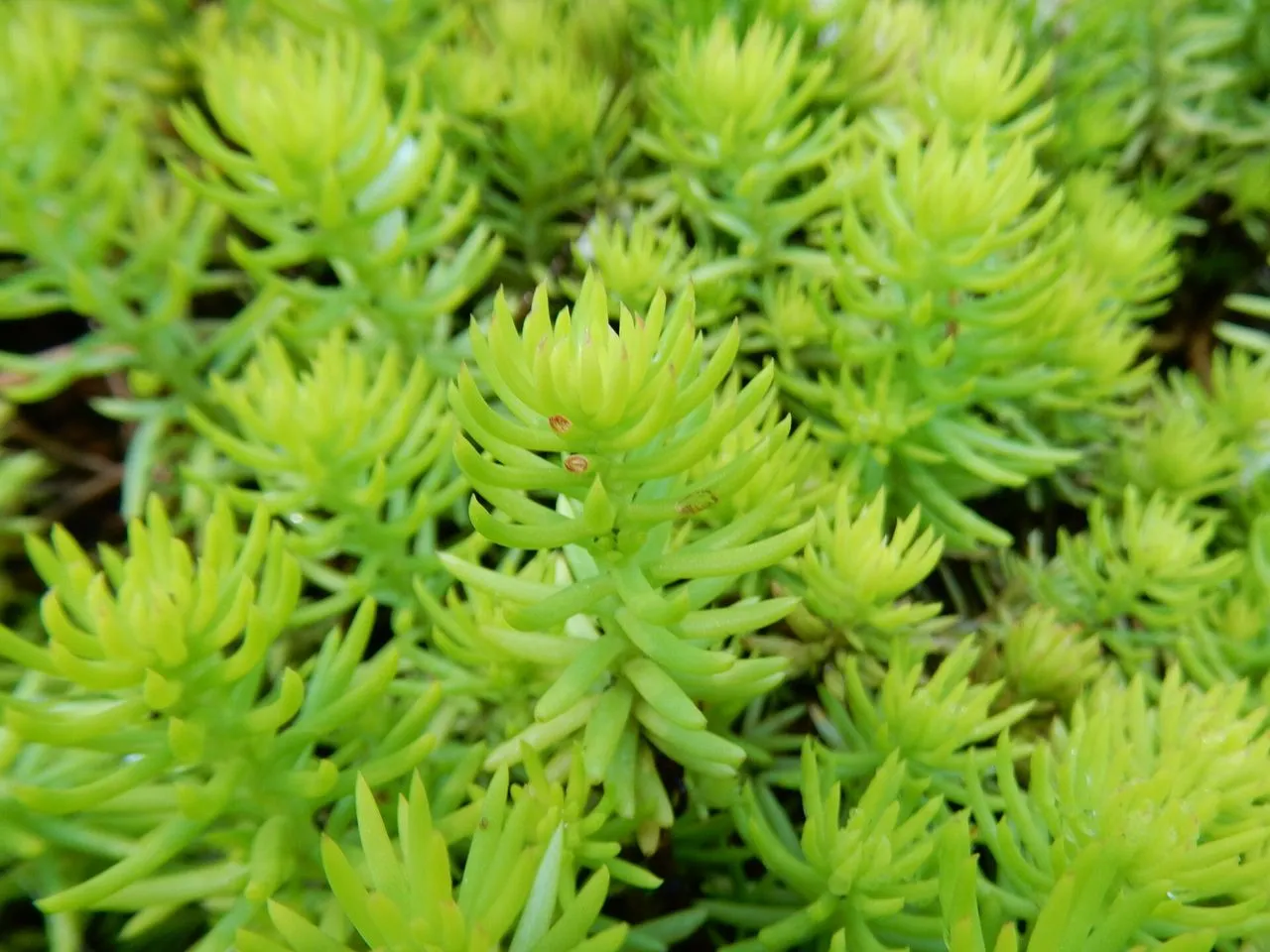
A mat-forming evergreen creeper reaching 10 to 15 cm tall and spreading indefinitely at the margins.
- Leaves. Needle-like, terete, 1 to 2 cm long, densely spirally arranged along the stem, giving a feathery cypress-like appearance. Colour is the distinguishing feature: bright chartreuse to acid yellow in summer, turning warm orange to coral-red at the tips in autumn and through winter cold.
- Stems. Creeping and rooting at every node. Non-flowering shoots are crowded with leaves; flowering shoots lift 15 cm upright.
- Inflorescence. Terminal cymes of small bright yellow five-petalled stars in early to mid summer. Flowering is modest compared to S. acre.
Confused most often with S. reflexum 'Blue Spruce' (grey-blue, same growth form) and Lemon Coral Sedum (similar chartreuse colour, tender). 'Angelina' is cold-hardy; 'Lemon Coral' is not.
Cultivation
Grow as for the rest of the hardy creeping group: full sun, gritty drainage, USDA zones 3 to 9. 'Angelina' tolerates poor, shallow, and alkaline soil, which is why it is specified for extensive green roofs and dry-gravel plantings at near-zero substrate depth.
Light is the main point of divergence from generic sedum advice. In partial shade the foliage reverts to a muddy green and the orange winter colour fails to develop. For the cultivar's named colour, give it six or more hours of direct sun daily, year-round.
Drought tolerance is exceptional once established. Overhead irrigation in summer is unnecessary and encourages aphids on the flowering shoots. The plant does not tolerate sustained wet feet, particularly in winter; on heavy clay raise the planting or amend with coarse grit to at least 30 per cent by volume.
No fertiliser. Feeding washes out the gold colour and promotes soft, stretched growth that flops under its own weight.
Propagation
Trivially easy. Break off any 3 to 5 cm stem fragment between late spring and early autumn, lay it on gritty substrate, and water once. Roots appear at every node within a week to ten days. The plant's native survival strategy is exactly this: stem fragments dislodged by grazing animals or water wash into new ground and re-establish.
For larger areas, lift a chunk of mat with a trowel and split it into plugs, spacing them 15 to 20 cm apart. The mat will close within a season.
Leaf propagation is not reliable for the mat-forming rupestre types; use stem fragments.
Notes
'Angelina' was introduced from a Dutch selection in the late 1990s and has since become one of the five most-sold groundcover sedums worldwide. Its combination of evergreen habit, bright year-round colour, drought tolerance, and ease of propagation puts it at the top of most extensive green-roof species lists.
Two quirks worth knowing. First, the foliage is brightest in late spring before flowering; after flowering the colour can look slightly tired until the autumn flush. Second, on very rich soil or in deep shade the plant produces elongated non-colouring stems that root aggressively into lawns and adjacent beds. This is usually presented as invasiveness; it is in fact a response to being planted in conditions the cultivar does not want. Move it to a gravel bed in full sun and the problem disappears.
Deer and rabbit resistant. Mildly toxic if ingested in quantity, consistent with the rest of the genus.
See also: Sedum Blue Spruce, Lemon Coral Sedum, Creeping Sedum.
Frequently Asked Questions
Is Angelina sedum hardy?
Yes. The post gives USDA zones 3–9, and the cultivar is widely used in green roofs and gravel plantings.
How is Angelina different from Lemon Coral?
Angelina is a cold-hardy S. rupestre cultivar with dense spiral needle leaves and orange winter colour. Lemon Coral is tender and grown as summer bedding in cold climates.
Why is my Angelina sedum turning green?
Partial shade or rich soil weakens the chartreuse colour. Full sun and lean substrate are needed for the named acid-yellow effect.
How do you propagate Angelina sedum?
Break off 3–5 cm stem fragments and lay them on gritty substrate. Roots appear at every node within a week to ten days.