| Question | Short Answer |
|---|---|
| Is Blue Spruce sedum S. reflexum or S. rupestre? | Both names are used for the same clone. |
| How do you keep Blue Spruce sedum blue? | Grow it in full sun. |
| Can Blue Spruce sedum be eaten? | The species has historical pot-herb use, but the post does not recommend eating garden plants because cultivation chemicals are unknown. |
| How do you propagate Blue Spruce sedum? | Use 3–5 cm stem fragments, which root at every node within a week to ten days. |
'Blue Spruce' is a cultivar of Sedum reflexum L. (reflexed stonecrop, prick-madam), which is treated by many modern authorities as a synonym of S. rupestre L. You will see the plant labelled as either S. reflexum 'Blue Spruce' or S. rupestre 'Blue Spruce' and both refer to the same clone, selected for blue-grey foliage that evokes the colour of the ornamental blue spruce conifer (Picea pungens 'Glauca').
The species is European in origin, native from the Pyrenees across central Europe to western Russia, where it grows on dry walls, stony slopes, and short grassland. It sits in the hardy mat-forming creeper group of the genus.
Part of the Complete Sedum Guide.
Identification
A creeping evergreen mat, 15 to 20 cm tall when flowering, spreading to 40 cm or more.
- Leaves. Terete, needle-like, 1.5 to 2.5 cm long, densely spirally arranged along the stem in a conifer-like pattern. Colour is the diagnostic feature: a cool silvery blue-grey coated with a fine waxy bloom (farina). Colour intensifies in full sun and cold weather.
- Stems. Creeping, rooting at the nodes, rising to 15 cm when flowering. Older non-flowering stems carry dense leaves along their entire length.
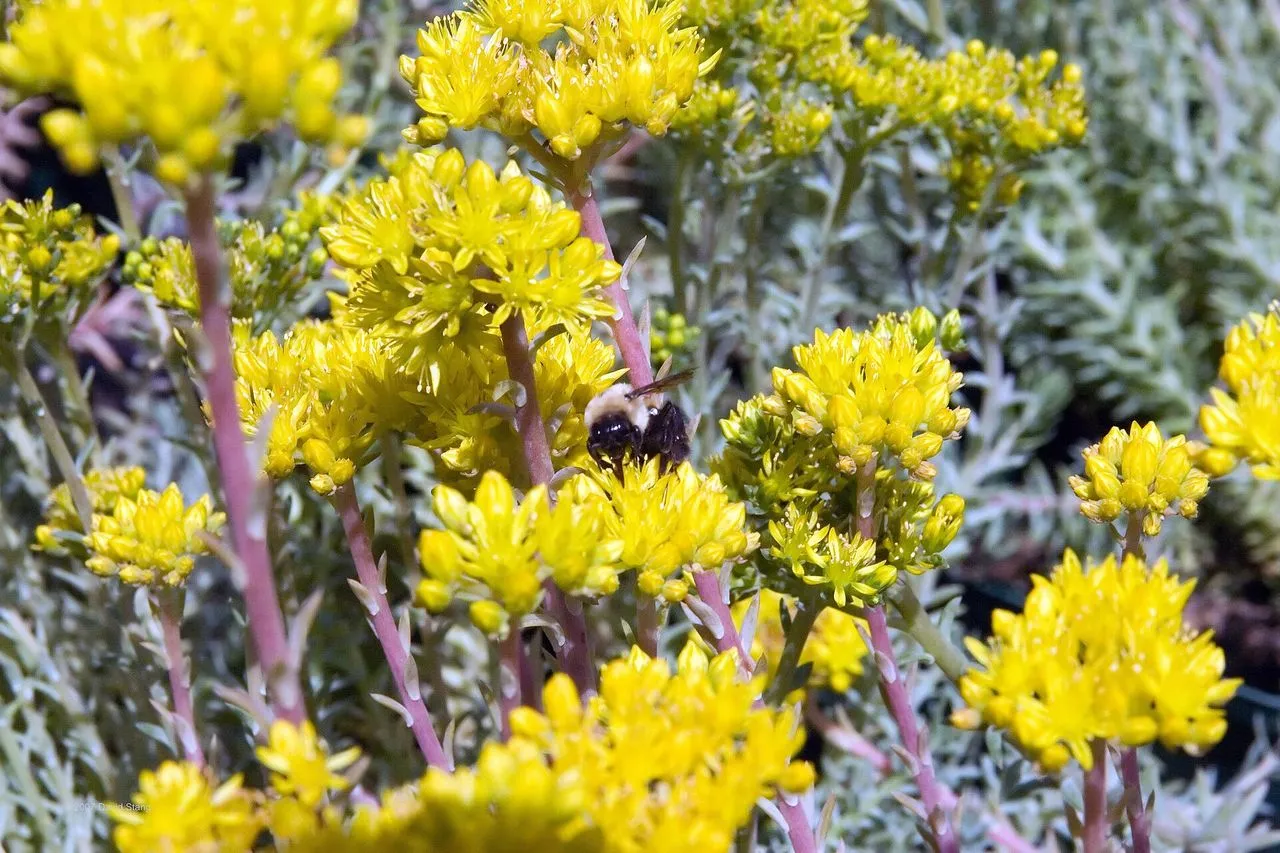
- Inflorescence. Terminal cymes of small bright yellow star-shaped flowers in summer, lifted on upright shoots 20 cm tall. Flowers open from nodding buds, the reflexed bud stage giving the species its epithet.
Confused most often with S. rupestre 'Angelina' (same growth form, chartreuse instead of blue) and with the tender Lemon Coral Sedum. 'Blue Spruce' is the blue one; the confusion is usually about colour, not species.
Cultivation
Standard hardy creeping sedum culture: full sun, sharp drainage, USDA zones 3 to 9. Tolerates poor, shallow, stony, and alkaline soils. Exceptional drought tolerance.
Light is the main lever for the blue colour. In full sun the farinose wax coating is thickest and the leaves read as clear silver-blue. In part shade the wax coating thins and the underlying green shows through, making the foliage read as muddy blue-green. For the named colour give the cultivar six or more hours of direct sun daily.
A practical note about the waxy bloom: the farina does not regenerate on leaves that have been handled. Avoid rubbing the foliage during planting and weeding. In a heavily trafficked area the blue colour will degrade over time from mechanical wear.
Do not fertilise. Rich soil produces lax green growth and the blue colour fades.
Propagation
Stem fragments root readily. A 3 to 5 cm piece laid on moist gritty substrate will produce roots at every node within a week to ten days. Take cuttings from terminal shoots that carry the best blue colour; plants raised from poorly coloured shoots tend to produce more of the same.
Leaf propagation is not reliable for this cultivar. Use stem fragments.
Division of an established mat with a trowel works at any time from spring through early autumn.
Notes
'Blue Spruce' is one of the most cold-hardy and drought-tolerant blue-foliaged groundcovers available to temperate gardeners, and a reliable alternative where Festuca glauca (blue fescue) or Elymus magellanicus would be too demanding. It is specified regularly for extensive green-roof plantings, gravel gardens, and the tops of dry stone walls.
One minor quirk. The species is the traditional European pot-herb sometimes called "prick-madam" or "stone-orpine", recorded in medieval English herbals as a salad ingredient. 'Blue Spruce' inherits that edible status. The leaves have an acrid-piquant taste and were used sparingly as a condiment rather than as a salad base. In modern cultivation I would not recommend eating it; the wild-collected traditional use does not translate well to garden plants carrying unknown cultivation chemicals.
Deer and rabbit resistant. Pollinators, particularly solitary bees and hoverflies, work the yellow flowers heavily in mid-summer.
See also: Sedum Angelina, Lemon Coral Sedum, Sedum dasyphyllum.
Frequently Asked Questions
Is Blue Spruce sedum S. reflexum or S. rupestre?
Both names are used for the same clone. Many authorities treat S. reflexum as a synonym of S. rupestre.
How do you keep Blue Spruce sedum blue?
Grow it in full sun. The farinose wax coating is thickest with six or more hours of direct light, while part shade reveals more green.
Can Blue Spruce sedum be eaten?
The species has historical pot-herb use, but the post does not recommend eating garden plants because cultivation chemicals are unknown.
How do you propagate Blue Spruce sedum?
Use 3–5 cm stem fragments, which root at every node within a week to ten days. Leaf propagation is not reliable.