| Question | Short Answer |
|---|---|
| How do you identify Sedum dasyphyllum? | Look for tiny almost spherical 3–5 mm leaves with blue-grey farina and a pink sun-flush. |
| Is Sedum dasyphyllum good for foot traffic? | No. |
| How hardy is Sedum dasyphyllum? | The post gives USDA zones 5–10, with reliable winter performance needing dry cover in zones 5 and 6. |
| Can Sedum dasyphyllum be leaf-propagated? | Yes. |
Sedum dasyphyllum L. (Corsican stonecrop, thick-leaf stonecrop) is a compact mat-forming perennial native to rocky sites across southern Europe, North Africa, and the Mediterranean islands. It was described by Linnaeus in Species Plantarum (1753). The specific epithet dasyphyllum means "thick-leaved" in Greek, referring to the distinctive almost spherical leaves.
Among all the hardy creeping sedums it is one of the smaller and more refined, forming neat low mats suitable for trough gardens, miniature plantings, and the tight paving joints where larger species would be too rampant.
Part of the Complete Sedum Guide.
Identification
A low creeping mat, 3 to 8 cm tall, spreading slowly to 20 or 25 cm.
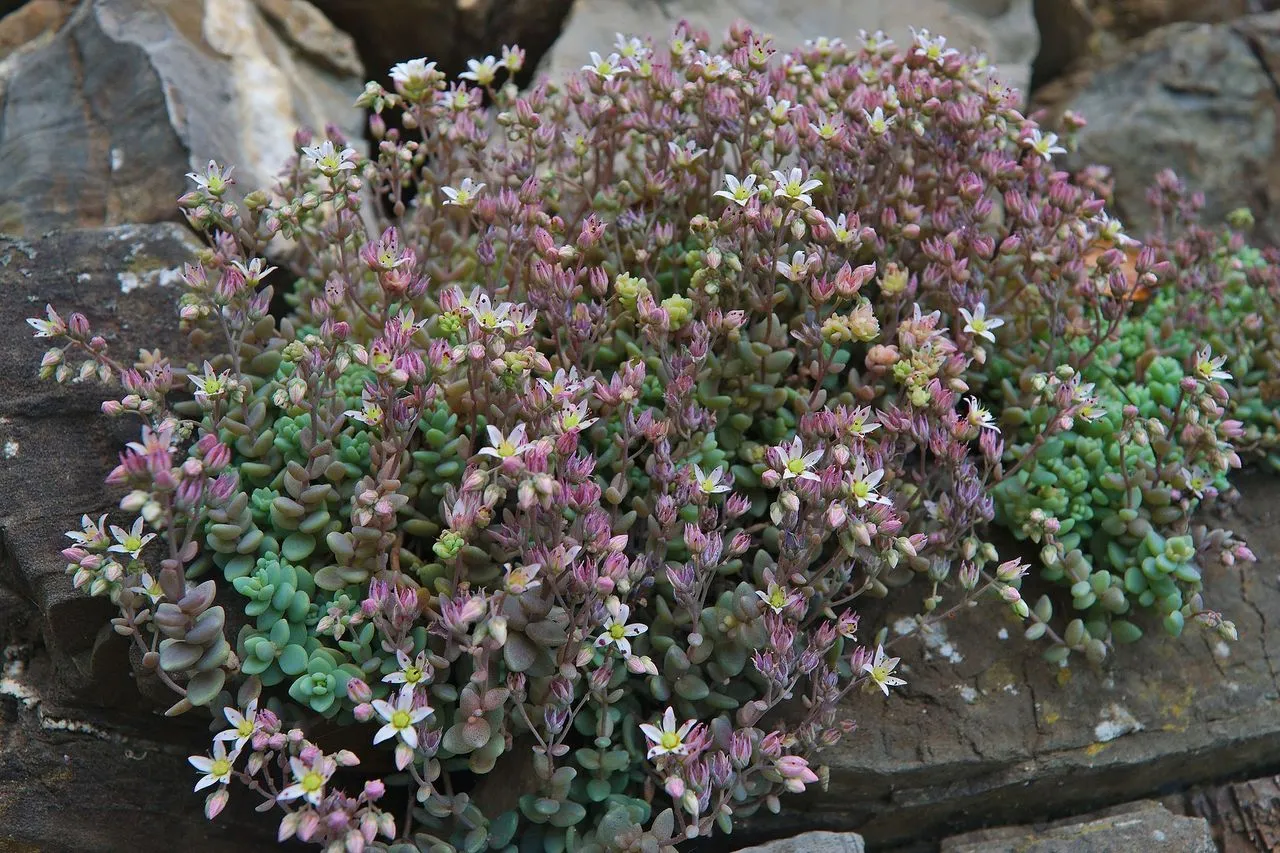
- Leaves. Tiny, almost spherical to broadly ellipsoid, 3 to 5 mm long, densely packed along the stem. A fine farinose wax gives them a powder-blue to lavender-grey colour, often flushing distinctly pink on the sun-exposed side.
- Stems. Short, fragile, branching, rooting at the nodes. The whole plant has a distinctly delicate feel compared to the more robust S. album or S. acre.
- Inflorescence. Short cymes of small white to very pale pink five-petalled flowers in late spring to early summer. Flowers are subtle and not the primary ornamental feature.
Several varieties are in cultivation. var. macrophyllum has larger leaves (to 7 mm), var. glanduliferum has glandular-hairy leaves and stems, and the selection 'Lilac Mound' emphasises the pink-purple flush. All share the bead-leaf habit.
Confused most often with S. hispanicum (similar size, greyer, less spherical leaves) and with very young S. album (which will grow larger and more robust within a season). The tiny bead leaves with a distinct pink sun-flush are diagnostic.
Cultivation
Standard creeping sedum culture with one important divergence. S. dasyphyllum is more fragile than most mat-formers and dislikes heavy foot traffic, aggressive hoeing, or being overrun by vigorous neighbours. Plant it where it will not be disturbed.
Full sun gives the best blue-grey colour and pink flush. Light afternoon shade is tolerated and may actually help in hot Mediterranean summers where direct sun can bleach the farinose wax.
Drainage must be sharp. This species drops out of wet positions faster than most hardy sedums; winter wet combined with cold is the usual killer. Plant into pure gravel beds, stone troughs, tufa rock, or rock-garden crevices where drainage is guaranteed.
USDA zones 5 to 10, though reliable winter performance needs dry cover in zones 5 and 6. No fertiliser.
Propagation
The fragile stems shed fragments easily and each fragment roots readily. Break off a small portion, lay it on gritty substrate, and keep barely moist. Roots form within a week.
Leaf propagation is unusually successful for this species. Detach a whole bead-leaf with a gentle pinch at the base and press it half-submerged into gritty substrate; success rate is above 60 per cent with adequate light and very light watering. This is one of the few mat-forming hardy sedums where leaf propagation is genuinely worth the effort.
Division is straightforward but the small mat size rarely requires it.
Notes
S. dasyphyllum is the sedum I recommend most often for trough gardens, alpine houses, and any collector planting where scale matters. Its fine texture combines particularly well with small Sempervivum, dwarf Saxifraga, and small bulb plantings.
The pink flush on sun-exposed leaves is not a permanent colour change: new growth in shade will be clear blue-grey, and the pink develops only on the upper side of sun-exposed rosettes. Gardeners sometimes mistake this asymmetric colouring for pest damage; it is not.
One structural quirk: old stems become bare at the base as the creeping mat spreads forward. In a mature planting this can leave a ragged rear edge. Trim off the bare stems with fine scissors after flowering and the mat fills in from re-rooted fragments.
Deer and rabbit resistant. Mildly toxic if ingested in quantity, consistent with the genus.
See also: Sedum acre, Sedum album, Sedum Blue Spruce.
Frequently Asked Questions
How do you identify Sedum dasyphyllum?
Look for tiny almost spherical 3–5 mm leaves with blue-grey farina and a pink sun-flush. The bead-leaf texture is diagnostic.
Is Sedum dasyphyllum good for foot traffic?
No. It is more fragile than most mat-formers and should be placed where it will not be stepped on, hoed, or smothered.
How hardy is Sedum dasyphyllum?
The post gives USDA zones 5–10, with reliable winter performance needing dry cover in zones 5 and 6.
Can Sedum dasyphyllum be leaf-propagated?
Yes. It is one of the few hardy mat-formers where leaf propagation is worthwhile, with success above 60% from whole bead leaves.