| Question | Short Answer |
|---|---|
| How do you identify Sedum album? | Look for a low evergreen mat with round 4–12 mm leaves and white star flowers in June and July. |
| Is Sedum album hardy? | Yes. |
| Why does Sedum album turn red? | Prolonged drought triggers anthocyanin accumulation, shifting leaves from green to red or near-purple. |
| How is Sedum album propagated? | Stem fragments root within a week on moist gritty substrate. |
Sedum album L. (white stonecrop) is an evergreen creeping perennial native across Europe, North Africa, and western Asia, extending into parts of the British Isles where it naturalises on old walls, dunes, and roadside gravel. Linnaeus described it in Species Plantarum (1753). It is one of the most widely used sedums in modern green-roof construction, usually combined in a mix with S. acre, S. album, S. reflexum, and Sedum spurium to produce the extensive sedum mats sold for shallow-substrate roofs.
Part of the Complete Sedum Guide.
Identification
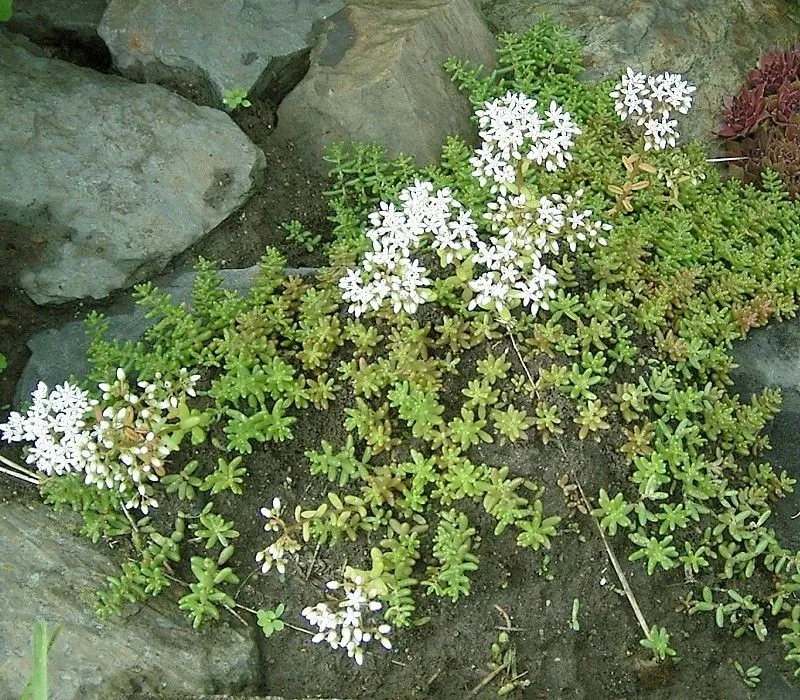
- Low evergreen mat, 5 to 10 cm tall in flower, about half that in vegetative form.
- Leaves cylindrical or obovoid, 4 to 12 mm long, alternate along creeping stems; colour mid-green to bronze-red depending on sun exposure.
- Leaves are fully terete (round in cross-section), which separates S. album from the superficially similar S. acre (leaves more flattened, pointed) and S. dasyphyllum (leaves shorter, rounder, often blue).
- Inflorescence a flat-topped cyme of white five-petalled stars on a 10 to 20 cm scape in June and July.
- Flowers are genuinely white, with red anthers that give the head a dusky pink cast at close range.
Several cultivars are widely grown: 'Coral Carpet' with pink-orange new growth, 'Faro Form' with smaller tighter leaves, 'Murale' with burgundy foliage in sun, 'Athoum' with compact habit.
Cultivation
Standard for the hardy mat-forming group in the pillar guide. Specific to this species:
- USDA zones 3 to 9. One of the hardier European sedums.
- Tolerates full sun to light shade; colour deepens in full sun.
- Exceptional on thin, poor, alkaline substrates. Performs on as little as 5 cm of substrate depth, which is why it dominates extensive green-roof specifications.
- Evergreen in mild climates; in zone 5 and colder the mat may die back partially in hard winters and regrow from the creeping stems in spring.
- Drought-tolerant to the point of being drought-preferring. Waters itself from atmospheric humidity and occasional rain.
Spreads steadily but not aggressively. Walkable for limited foot traffic.
Propagation
Trivial. A handful of broken stems scattered on moist gritty substrate will root within a week. Commercial green-roof plug production uses shredded plant material over hydroponic felt. For home propagation, lift a section of mat, pull it apart, replant fragments. Division, cuttings, and seed all work; vegetative methods are faster.
Notes
S. album is a CAM-cycling species with strong drought metabolism. Leaves in prolonged dry weather turn from green to red to near-purple as anthocyanins accumulate as a photoprotective response. The colour shift is reversible when water returns, which is why the same mat can look green in spring and burgundy in August.
Historically eaten in small quantities as a salad herb in parts of southern Europe. Lightly acrid, similar to watercress. Do not confuse with S. acre, which contains piperidine alkaloids and is not edible.
Listed as invasive in parts of North America where it has escaped cultivation. It spreads by stem fragments rather than seed or rhizome, so it remains controllable in a bed but will colonise neighbouring gravel.
See also
- Sedum acre
- Sedum dasyphyllum
- Creeping Sedum — the mat-forming group that S. album belongs to, with green-roof and groundcover uses.
Frequently Asked Questions
How do you identify Sedum album?
Look for a low evergreen mat with round 4–12 mm leaves and white star flowers in June and July. The fully terete leaf separates it from S. acre and S. dasyphyllum.
Is Sedum album hardy?
Yes. It is one of the hardier European sedums, generally suitable for USDA zones 3–9 and evergreen in mild climates.
Why does Sedum album turn red?
Prolonged drought triggers anthocyanin accumulation, shifting leaves from green to red or near-purple. The colour is reversible when water returns.
How is Sedum album propagated?
Stem fragments root within a week on moist gritty substrate. For home propagation, lift a section of mat, pull it apart, and replant the fragments.