| Question | Short Answer |
|---|---|
| Is Sedum spurium still a Sedum? | Botanically it is now Phedimus spurius, but the trade still sells it as Sedum spurium. |
| How do you identify Sedum spurium? | Look for opposite pairs of flat broadly obovate leaves with coarsely toothed upper margins. |
| Which cultivars come from Sedum spurium? | Common cultivars include Dragon’s Blood, Fuldaglut, Voodoo, John Creech, Tricolor, Album Superbum, and Pink Jewel. |
| How do you propagate Sedum spurium? | Lay 3–5 cm stem fragments on moist substrate; they root at every node within a week. |
Sedum spurium M.Bieb. (two-row stonecrop, Caucasian stonecrop) is a hardy herbaceous perennial native to the Caucasus mountains, northern Iran, and parts of northern Turkey, where it grows on rocky meadows and forest edges up to around 2,500 m elevation. It was described in 1808 by the German-Russian botanist Friedrich August Marschall von Bieberstein.
Under current taxonomy the species is correctly placed in the segregate genus Phedimus as P. spurius (M.Bieb.) 't Hart, but the horticultural trade almost universally retains Sedum spurium on labels and in general use. Both names refer to the same plant.
Part of the Complete Sedum Guide.
Identification
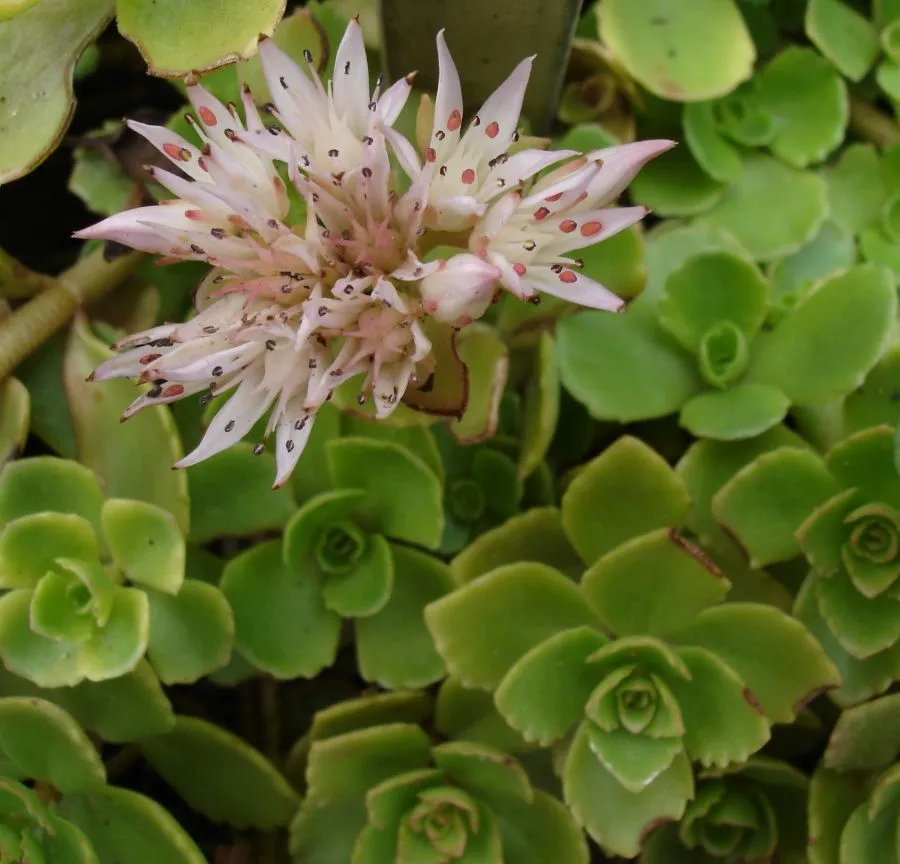
A dense creeping mat, 10 to 15 cm tall, spreading to 45 cm or more.
- Leaves. Flat, broadly obovate, 1.5 to 2.5 cm long, with coarsely toothed upper margins. Arranged in opposite pairs along the stem, giving the "two-row" common name.
- Stems. Creeping, rooting at the nodes; flowering stems rise briefly to 15 cm.
- Inflorescence. Flat terminal cymes of five-petalled star-shaped flowers in mid to late summer. Flower colour varies by cultivar from white through pale pink to deep rose-red.
The wild green-leaved species is not especially common in cultivation. Most gardeners meet S. spurium in one of its named cultivars:
- 'Dragon's Blood' (also 'Schorbuser Blut') — deep burgundy foliage, red flowers
- 'Fuldaglut' — compact, bright red flowers, bronze-red leaves
- 'Voodoo' — larger dark-leaved selection
- 'John Creech' — green-leaved, compact, late-flowering
- 'Tricolor' (also 'Variegatum') — pink, white, and green variegation
- 'Album Superbum' — green foliage, pure white flowers
- 'Pink Jewel' — green foliage, clear pink flowers
Cultivation
A standard hardy creeping sedum. USDA zones 3 to 9. Full sun to light part shade; the shade tolerance (about half a day) is better than in most mat-forming sedums and makes S. spurium useful at the edge of borders where full sun is not available.
Drainage must be free. The species tolerates poor, thin, alkaline, and rocky soil, and is specified routinely for extensive green-roof plantings in temperate climates. Does not tolerate sustained waterlogging. No fertiliser; rich soil produces lax green growth and reduced flowering.
Drought-tolerant once established. An exceptional species for dry gravel slopes, paving joints, rock gardens, and the tops of dry stone walls.
Propagation
Stem fragments root trivially. A 3 to 5 cm stem piece laid on moist substrate produces roots at every node within a week. Take cuttings any time from late spring through early autumn.
For large areas, divide an established mat with a trowel and replant sections 15 to 20 cm apart. The mat closes within a season.
Named cultivars must be propagated vegetatively; seed-raised plants will segregate. The species is not patent-protected in most jurisdictions; propagation is generally unrestricted.
Notes
S. spurium is arguably the most commercially important species in the creeping sedum trade. Its cold hardiness, ease of propagation, variety of cultivar colour, and tolerance of part shade put it ahead of S. acre and S. album in most landscape uses where foliage colour and flower colour matter.
The 'Tricolor' cultivar has a known stability problem. Its pink-white-green variegation is unstable and will revert to plain green over time if the green reverted shoots are not removed. Cut them out at the base as soon as they appear; a plain-green spurium mat will out-compete the variegated mat within a few seasons and the cultivar will be lost.
All cultivars bloom on flowering shoots that arise on the current season's growth, so a hard cutback in early spring will delay but not prevent flowering. In a messy mat, shearing the whole planting with hedge shears in March restores a tidy low profile and stimulates denser re-growth.
Deer and rabbit resistant. Pollinators, particularly bees and hoverflies, work the flowers in July and August. Mildly toxic if eaten in quantity, consistent with the genus.
See also: Dragon's Blood Sedum, John Creech Sedum, Sedum kamtschaticum.
Frequently Asked Questions
Is Sedum spurium still a Sedum?
Botanically it is now Phedimus spurius, but the trade still sells it as Sedum spurium. Both names refer to the same garden plant.
How do you identify Sedum spurium?
Look for opposite pairs of flat broadly obovate leaves with coarsely toothed upper margins. The paired leaves explain the common name two-row stonecrop.
Which cultivars come from Sedum spurium?
Common cultivars include Dragon’s Blood, Fuldaglut, Voodoo, John Creech, Tricolor, Album Superbum, and Pink Jewel.
How do you propagate Sedum spurium?
Lay 3–5 cm stem fragments on moist substrate; they root at every node within a week. For large areas, divide mats and replant pieces 15–20 cm apart.