| Question | Short Answer |
|---|---|
| Is Dragon’s Blood sedum hardy? | Yes. |
| Why is Dragon’s Blood sedum not red? | Part shade, rich soil, or very dry mid-summer stress can reduce colour. |
| How tall does Dragon’s Blood sedum get? | It forms a dense creeping mat 10–15 cm tall and spreads to about 45 cm. |
| How do you propagate Dragon’s Blood sedum? | Press 3–5 cm stem pieces onto gritty substrate and water once. |
'Dragon's Blood' is a cultivar of Sedum spurium M.Bieb. (two-row stonecrop, Caucasian stonecrop). Under the current taxonomy the species is formally placed in Phedimus as P. spurius (M.Bieb.) 't Hart, but the horticultural trade and garden-centre labelling universally still use Sedum, so that is the name you will encounter on the tag. The cultivar name is spelled variously as 'Dragon's Blood', 'Schorbuser Blut', or translated into other languages; all refer to the same clone selected in Germany in the 1950s.
The species is native to the Caucasus and northern Turkey, growing on rocky grassland and dry forest edge. It sits in the mat-forming creeper group of the genus.
Part of the Complete Sedum Guide.
Identification
A dense creeping mat, 10 to 15 cm tall, spreading to 45 cm.
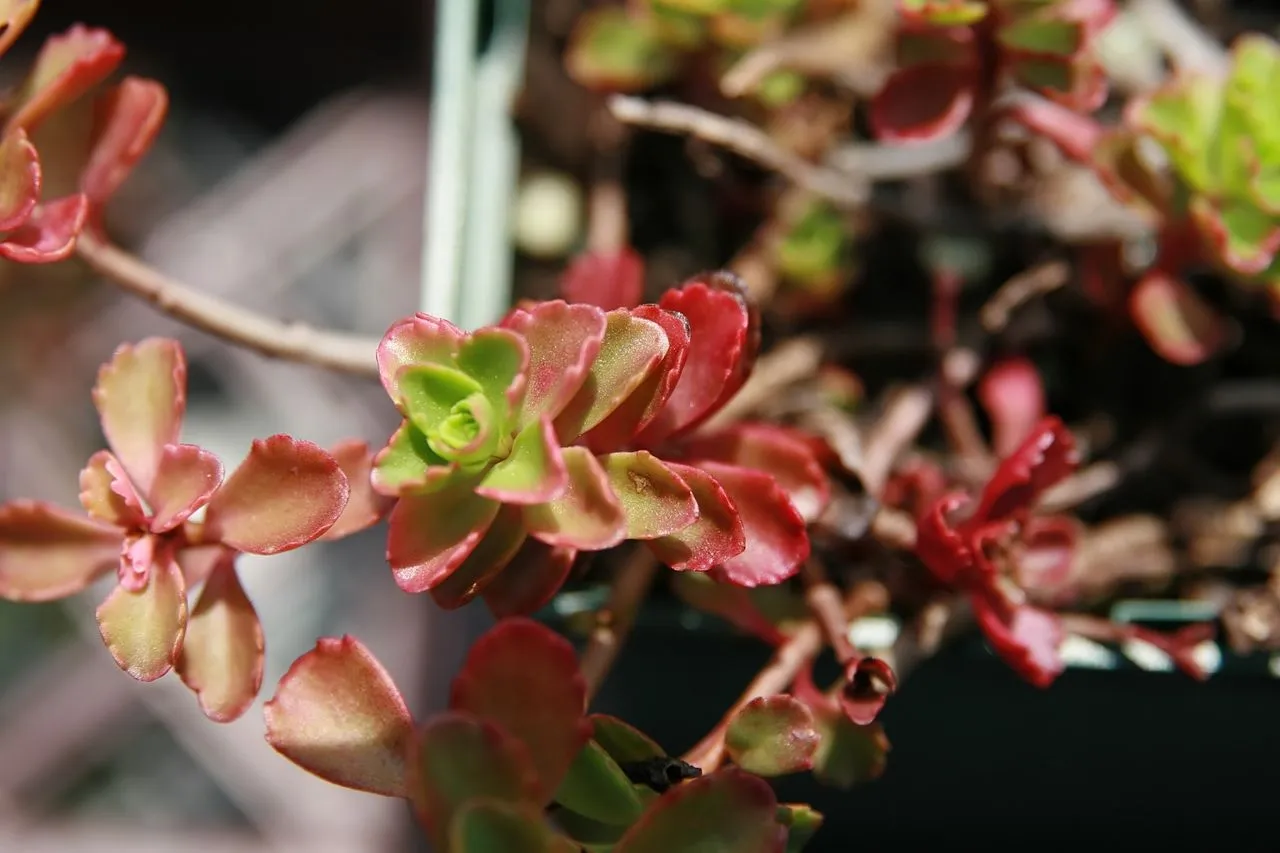
- Leaves. Broad, flat, obovate, 1.5 to 2.5 cm long, with coarsely toothed upper margins. Arranged in opposite pairs along the stem (the "two-row" epithet). Colour is the diagnostic feature of this cultivar: green with a strong burgundy flush in spring, deepening to rich dark red through summer heat, and intensifying almost black-purple after autumn cold.
- Stems. Creeping, rooting at nodes; flowering stems rise briefly to 15 cm.
- Inflorescence. Flat terminal cymes of deep pink to red five-petalled stars in mid to late summer, well matched to the foliage colour.
'Dragon's Blood' is frequently confused with S. spurium 'Voodoo' (similar but with larger, slightly darker leaves) and with 'Fuldaglut' (more compact, brighter red flowers). All three are selections of the same species and behave identically in cultivation; the visual differences are subtle.
Cultivation
Typical creeping sedum care: full sun, sharp drainage, USDA zones 3 to 9. 'Dragon's Blood' is one of the most cold-hardy cultivars in the trade, reliably surviving Siberian winters in planted rock gardens.
Light is the main lever for colour. In full sun the leaves develop their deepest burgundy; in part shade the colour fades toward bronze-green and the mat grows more loosely. For the named colour, give it six or more hours of direct sun daily.
Drought tolerant once established. Tolerates poor soil, thin substrate, and a wide pH range. Does not tolerate standing water; on heavy clay raise the planting or plant into grit.
Does not need fertiliser. Rich soil produces lax green growth at the expense of the red pigmentation.
Propagation
Stem fragments root at every node within days of contact with moist soil. Break off a 3 to 5 cm piece of stem any time from late spring through early autumn, press it lightly onto gritty substrate, water once. Roots within a week.
For larger plantings lift a section of established mat with a trowel and split it into plugs 15 to 20 cm apart. The mat closes within one season.
'Dragon's Blood' is not patent-protected; propagation for personal and commercial use is unrestricted.
Notes
'Dragon's Blood' is arguably the single most widely planted red-foliaged sedum worldwide. It appears on extensive green-roof species lists, in mixed-succulent bowls, as edging for gravel paths, and as a permanent groundcover on dry slopes. Its combination of cold hardiness, drought tolerance, reliable colour, and ease of propagation is unmatched in the genus.
Two quirks. First, the foliage loses colour temporarily in mid-summer heat on very dry soil; a brief soak and the new growth that follows carry strong colour again. Second, in deep winter cold the mat can look dead; the above-ground leaves may brown completely in zone 3 while the plant remains alive at the crown, re-flushing from the base in spring. Do not replace plants that appear dead in February; wait for March.
The flowers draw bees, hoverflies, and small butterflies in July and August. Deer and rabbit resistant. Mildly toxic if consumed in quantity.
See also: Sedum spurium, John Creech Sedum, Sedum Angelina.
Frequently Asked Questions
Is Dragon’s Blood sedum hardy?
Yes. It is a hardy creeping cultivar for USDA zones 3–9 and survives very cold winters when established.
Why is Dragon’s Blood sedum not red?
Part shade, rich soil, or very dry mid-summer stress can reduce colour. Full sun and lean soil produce the strongest burgundy.
How tall does Dragon’s Blood sedum get?
It forms a dense creeping mat 10–15 cm tall and spreads to about 45 cm.
How do you propagate Dragon’s Blood sedum?
Press 3–5 cm stem pieces onto gritty substrate and water once. Roots form at the nodes within about a week.