| Question | Short Answer |
|---|---|
| Who was John Creech sedum named for? | It is named for John L. |
| When does John Creech sedum flower? | It flowers in September and October, later than most Phedimus spurius cultivars. |
| How tall is John Creech sedum? | The mat is 5–8 cm tall and spreads 30–45 cm from a single plant. |
| How do you propagate John Creech sedum? | Lift a rooted section of mat or use rootless stem fragments. |
'John Creech' is a selection of Sedum spurium M.Bieb., now formally Phedimus spurius ('t Hart, but almost always sold under the old Sedum name. It is named for John L. Creech, a former director of the US National Arboretum, who collected the original plant on a Soviet-era plant expedition to the Caucasus. Creech introduced it to the Arboretum's collection in 1971 and it has been in the nursery trade since the 1980s.
Part of the Complete Sedum Guide.
Identification
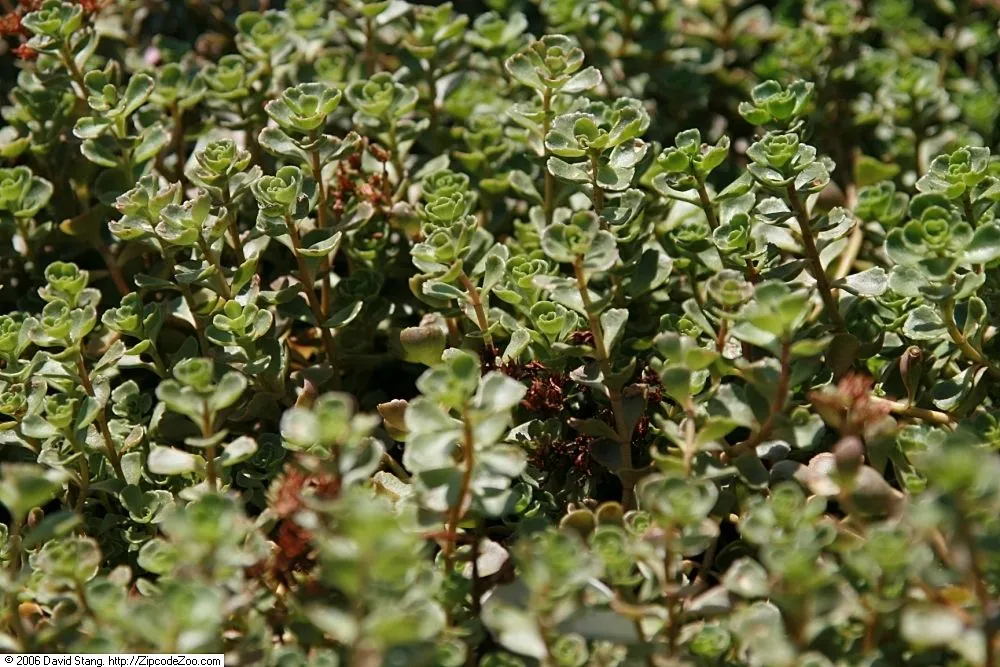
- Flat mat 5 to 8 cm tall, spreading to 30 to 45 cm from a single plant.
- Leaves obovate, 1 to 2 cm long, crenate at the tip (the small scalloped margin is diagnostic), glossy mid-green turning bronze-red in autumn.
- Leaves in dense rosette-like whorls along creeping stems that root at every node.
- Inflorescence a low cyme of pale pink five-petalled stars in September and October, later than most Phedimus spurius cultivars.
- Evergreen in mild winters; semi-deciduous and tucked close to the ground in hard winters.
The late flowering and the crenate leaf edge separate 'John Creech' from 'Dragon's Blood' (serrate leaves, red flowers in midsummer) and from the type species, which flowers in July with larger looser leaves.
Cultivation
Standard for the hardy mat-forming group in the pillar guide. Specific to this cultivar:
- USDA zones 3 to 9. One of the most cold-hardy ground-cover sedums.
- Tolerates more shade than most mat-formers; accepts half a day of direct sun.
- Drought-tolerant once established. A single watering in mid-summer during prolonged dry spells is the most it needs.
- Foot-traffic tolerant in moderation. Will regrow from broken stems, which makes it useful in paving crevices and stepping-stone gardens.
The late flowering window is the practical reason to choose 'John Creech' over other Phedimus spurius cultivars. It extends sedum colour in the garden into October.
Propagation
Stem cuttings are trivial. Lift a section of mat with roots attached and lay it on moist substrate; new roots issue within a week. Rootless stem fragments root at the first node within 10 days. Division of established mats in spring produces reliable transplants. Seed-grown plants do not reliably come true.
Notes
The plant was patented originally but the patent has long expired; it is freely propagated. Its late bloom makes it a useful pollinator resource in autumn when most groundcover sedums are finished. It works well threaded through gravel gardens, on green roofs in shallow soil, and as a filler in troughs and shallow bowls where it will spill over the rim without becoming invasive.
Not to be confused with Sedum 'John Creech' as sometimes sold in the US trade, which is the same plant but occasionally mislabelled with slightly different parentage claims. It is Phedimus spurius and only Phedimus spurius.
See also
- Sedum spurium
- Dragon's Blood Sedum
- Creeping Sedum
- Sedum kamtschaticum — another late-flowering stonecrop suited to rock gardens and troughs.
Frequently Asked Questions
Who was John Creech sedum named for?
It is named for John L. Creech, former director of the US National Arboretum, who collected the original plant on a Soviet-era Caucasus expedition.
When does John Creech sedum flower?
It flowers in September and October, later than most Phedimus spurius cultivars.
How tall is John Creech sedum?
The mat is 5–8 cm tall and spreads 30–45 cm from a single plant.
How do you propagate John Creech sedum?
Lift a rooted section of mat or use rootless stem fragments. New roots form within a week to ten days on moist substrate.