| Question | Short Answer |
|---|---|
| Is Sedum kamtschaticum cold-hardy? | Yes. |
| Does Sedum kamtschaticum tolerate shade? | It tolerates half a day of shade without losing flower count or form. |
| How does Sedum kamtschaticum spread? | It grows from a short branching rhizome into a dense rounded clump, not by long creeping stolons like many mat sedums. |
| How do you propagate Sedum kamtschaticum? | Divide the clump in spring as new shoots emerge, or root 5 cm non-flowering stem fragments in late spring. |
Sedum kamtschaticum Fisch. & C.A.Mey. (Russian stonecrop, orange stonecrop, Kamchatka stonecrop) is a hardy herbaceous perennial native to the Russian Far East, including the Kamchatka Peninsula, Japan, Korea, and northern China. It was described in 1841 from collections made during the early 19th-century Russian scientific expeditions to the Pacific coast.
Under the current taxonomy the species has been transferred to the segregate genus Phedimus as P. kamtschaticus ('t Hart), though the horticultural trade continues to use the name Sedum kamtschaticum on most labels. Both refer to the same plant.
Part of the Complete Sedum Guide.
Identification
A semi-woody subshrub, 10 to 20 cm tall, forming a dense rounded clump 25 to 30 cm wide, growing from a short branching rhizome rather than by creeping stolons.
- Leaves. Obovate to spathulate, flat, 2 to 4 cm long, with coarsely toothed distal margins. Mid to dark green through summer, turning bronze-orange to red in autumn before senescing back in hard winters.
- Stems. Stiffly ascending from the rhizome base, not creeping like most mat-formers. The clumping habit is diagnostic.
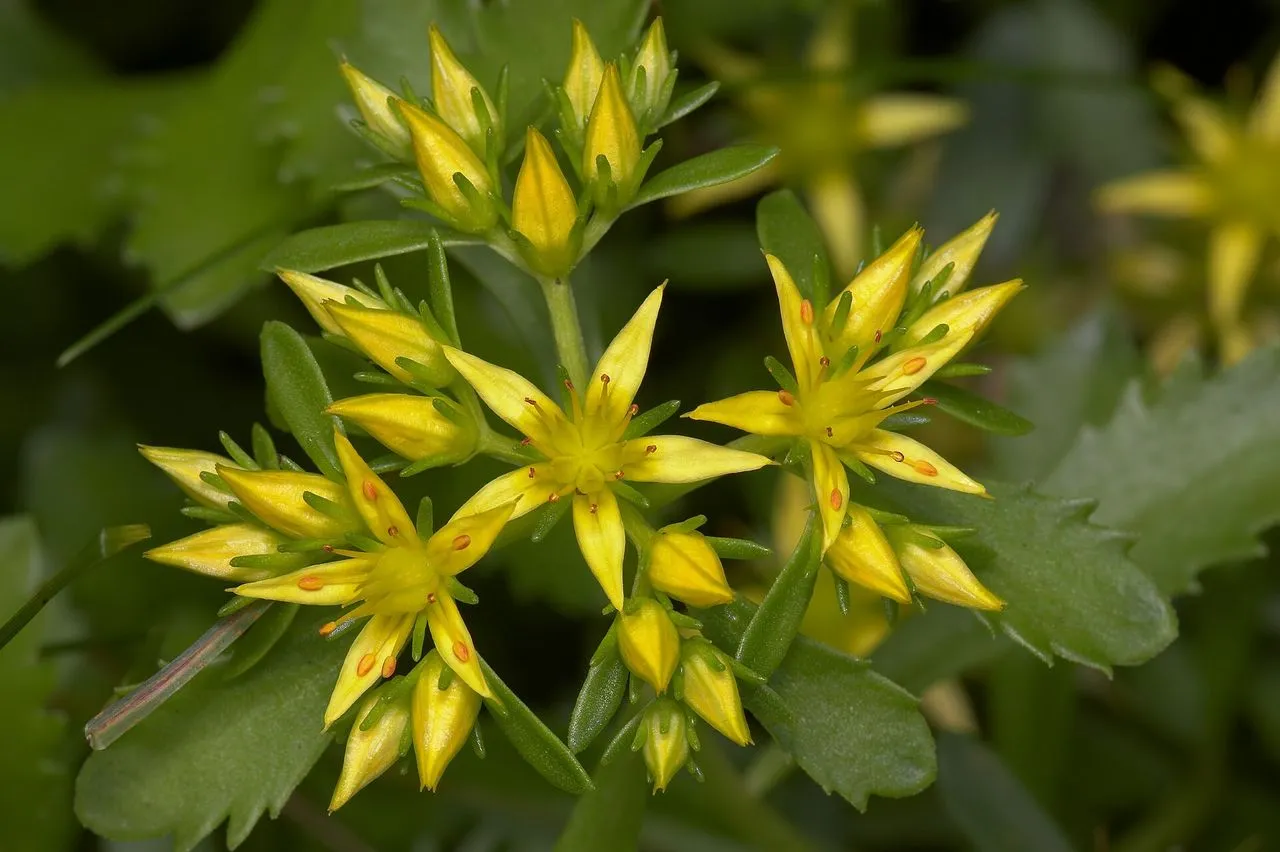
- Inflorescence. Flat terminal cymes of deep yellow to orange-yellow five-petalled stars in late spring to early summer, followed by decorative red seed heads that persist into autumn.
Two named forms are common in the trade. 'Variegatum' has a clean white to cream leaf edge that pinks up in cool weather; var. floriferum (S. floriferum 'Weihenstephaner Gold' is essentially the same plant) is smaller, more floriferous, and blooms longer.
Cultivation
Hardy to USDA zone 3, arguably zone 2 with snow cover. The species is among the toughest in the genus.
The point of divergence from the pillar's generic sun requirement: S. kamtschaticum tolerates half a day of shade without losing flower count or form, making it useful for the partly shaded edge of a border where most sedums decline. Full sun gives the best autumn colour and most compact habit; part shade is acceptable.
Substrate and water are standard for the hardy group. Free-draining loam, no fertiliser, water only during extended summer drought in the first establishment year. The clump habit means it does not spread into neighbouring plants, which is useful in formal plantings where the running S. acre and S. spurium would misbehave.
Cold-hardy, drought-tolerant, deer-resistant. One of the species I recommend most often for gardeners in zones 3 to 5 looking for a well-behaved front-of-border sedum.
Propagation
Stem cuttings root readily but the species is equally easy from division. Lift the clump in spring as new shoots emerge, split the rhizome with a clean blade into sections each carrying several buds, replant at the original depth. Establishes within the same season.
Seed propagation works for the green-leaved species type but not for the named variegated cultivar, which will segregate in the offspring. Surface-sow fresh seed on moist substrate in early spring with bottom heat; expect germination within three weeks.
Stem fragments 5 cm long root within a fortnight if taken from non-flowering shoots in late spring.
Notes
The autumn colour is underrated. While Sedum Angelina and 'Dragon's Blood' get attention for foliage interest, S. kamtschaticum offers a bronze-orange autumn flush that combines well with ornamental grasses and late-flowering asters. The red seed heads are persistent enough to carry visual interest into late November in temperate climates.
'Weihenstephaner Gold' (listed by some growers as S. floriferum, by others as a variety of kamtschaticum, and by modern taxonomy as Phedimus kamtschaticus var. floriferus) is particularly worth tracking down for smaller gardens. Its flowering period extends two to three weeks longer than the straight species, and the plant tops out at 10 cm rather than 20 cm.
Deer and rabbit resistant. Mildly toxic if ingested in quantity. Occasional aphid colonies on flowering stems in June but never severe enough to require treatment.
See also: Sedum spurium, Sedum ternatum, Sedum acre.
Frequently Asked Questions
Is Sedum kamtschaticum cold-hardy?
Yes. It is hardy to USDA zone 3 and arguably zone 2 with snow cover, making it one of the toughest stonecrops.
Does Sedum kamtschaticum tolerate shade?
It tolerates half a day of shade without losing flower count or form. Full sun still gives the best autumn colour and compact habit.
How does Sedum kamtschaticum spread?
It grows from a short branching rhizome into a dense rounded clump, not by long creeping stolons like many mat sedums.
How do you propagate Sedum kamtschaticum?
Divide the clump in spring as new shoots emerge, or root 5 cm non-flowering stem fragments in late spring. Species seed also works, but cultivars segregate.