| Question | Short Answer |
|---|---|
| Does Sedum ternatum grow in shade? | Yes. |
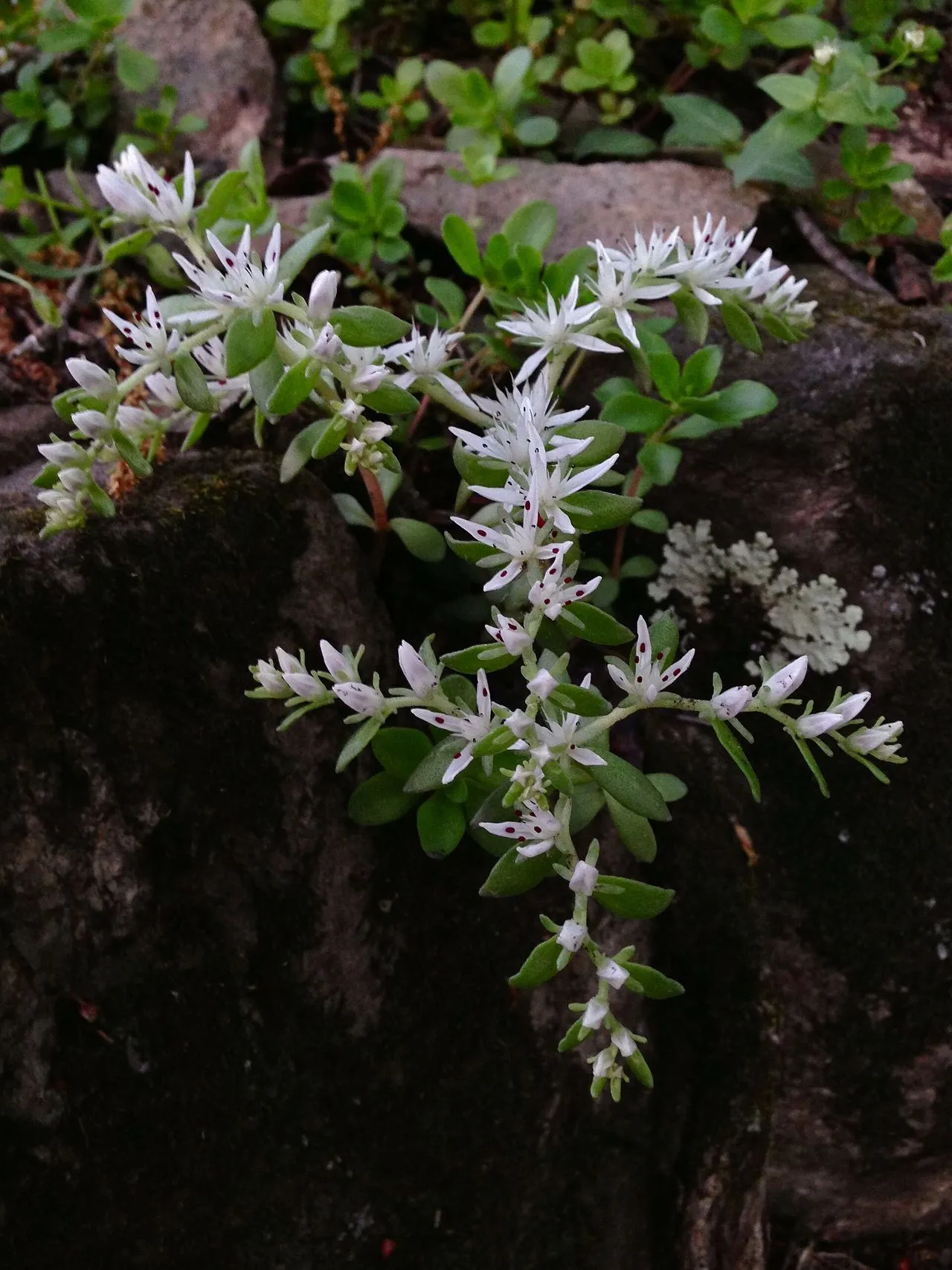
| How do you identify Sedum ternatum? | Look for flat bright-green leaves in whorls of three and white four-petalled flowers in late spring. |
| Is Sedum ternatum native to North America? | Yes. |
| How do you propagate Sedum ternatum? | Use 5 cm stem fragments or division. |
Sedum ternatum Michx. (wild stonecrop, three-leaved stonecrop) is a mat-forming perennial native to rocky woodland across eastern North America, from southern Ontario and Michigan down through the Appalachians to Georgia, west to Missouri and Arkansas. It was described by the French botanist André Michaux in 1803 from specimens collected in the Carolinas. Among all sedums in common cultivation it is the one true outlier on light preference: this is the stonecrop for shade.
The species grows naturally on damp, mossy rock shelves and on leaf litter over outcrops in deciduous forest, in conditions that would kill most Mediterranean and Mexican sedums within a season.
Part of the Complete Sedum Guide.
Identification
A low mat-former, 5 to 10 cm tall, spreading by prostrate stems that root at the nodes.
- Leaves. Obovate to spathulate, flat, 1 to 2 cm long, bright green and slightly fleshy. Arranged in whorls of three along non-flowering shoots, giving the species its name and a distinctive look among sedums.
- Stems. Prostrate creeping stems with upright flowering shoots to 15 cm.
- Inflorescence. An open cyme of pure white four-petalled flowers (four rather than five, another unusual feature for the genus) with dark anthers, blooming in late spring (April to June depending on latitude). The white flower is distinctive; most eastern creeping sedums are yellow.
Tell S. ternatum from S. nevii (a smaller Appalachian endemic) by size and habitat: ternatum forms broader mats at lower elevations; nevii is a dolomite specialist.
Cultivation
This is the species that breaks the pillar's "most sedums want full sun" rule. S. ternatum prefers dappled woodland shade and evenly moist, humus-rich soil. Grown in full sun on dry substrate it sulks, burns, and often dies within a season.
- Light. Part to full shade. Morning sun is tolerated; afternoon sun in summer is not.
- Substrate. Moist but well-drained humus-rich soil. Unlike most sedums it prefers organic matter over pure grit. Ordinary woodland-garden soil with a generous leaf-mould content is ideal. Slightly acid to neutral pH (5.5 to 7.0).
- Water. Consistent moisture, especially through the first season. Established plants tolerate brief summer drought but do not thrive on it.
- Temperature. USDA zones 4 to 8. Fully hardy across its native range.
If you have a shaded foundation planting, a north-facing rock garden, or a mossy log in a woodland edge, this is the sedum for it.
Propagation
Stem cuttings or division. Take 5 cm stem fragments in spring or early autumn, lay on moist humus-rich substrate, keep shaded and evenly moist; roots within two weeks. Division of an established mat is straightforward and carries an established root system directly into the new position.
Seed propagation is possible from wild-type plants. Surface-sow fresh seed on moist substrate in autumn, keep outdoors through winter, expect germination in spring after cold stratification. For a garden planting vegetative methods are faster.
Notes
S. ternatum is the only North American sedum routinely recommended for native-plant woodland gardens, and increasingly for ecological restoration projects on shaded rocky sites. The Xerces Society rates it as a moderate value for native pollinators in spring, particularly for mining bees and small solitary species.
It is not the showiest sedum, and in a sunny border it will be outperformed by almost any other species. Its niche is narrow and specific: a damp shaded rocky spot where most sedums fail and most woodland groundcovers overgrow. Planted there it is long-lived, spreading slowly rather than aggressively, and coexists well with ferns, wood anemone, and small spring ephemerals.
Deer browse it occasionally, unlike most sedums. In high-pressure deer areas some protection in the first season may help establishment.
See also: Sedum spurium, Sedum acre, Sedum kamtschaticum, Sedum sarmentosum — the other notably shade-tolerant species in the genus, though invasive in parts of the US.
Frequently Asked Questions
Does Sedum ternatum grow in shade?
Yes. It is the one commonly cultivated sedum that genuinely prefers dappled woodland shade, and it can fail in hot dry full sun.
How do you identify Sedum ternatum?
Look for flat bright-green leaves in whorls of three and white four-petalled flowers in late spring. That combination is unusual in the genus.
Is Sedum ternatum native to North America?
Yes. It is native to rocky woodland across eastern North America, from southern Ontario and Michigan through the Appalachians and west to Missouri and Arkansas.
How do you propagate Sedum ternatum?
Use 5 cm stem fragments or division. Lay fragments on moist humus-rich substrate in shade and keep them evenly moist until they root within about two weeks.