| Question | Short Answer |
|---|---|
| Why is Sedum sarmentosum called stringy stonecrop? | Its stems trail 20 cm or more before rooting, giving a loose stringy habit unlike compact mat-forming sedums. |
| Is Sedum sarmentosum invasive? | It is listed as invasive in Virginia, the Carolinas, Tennessee, and several other southeastern US states. |
| Does Sedum sarmentosum grow in shade? | Yes. |
| How do you propagate Sedum sarmentosum? | Stem fragments as short as 3 cm root within a week on moist substrate. |
Sedum sarmentosum Bunge (stringy stonecrop, graveyard moss, gold moss sedum) is an East Asian mat-forming perennial native to China, Korea, and Japan, where it grows on rocky slopes, stream banks, and disturbed ground. It was described in 1835 by the Russian botanist Alexander von Bunge. In its native range it is a traditional leaf vegetable, briefly blanched and eaten in spring salads under the Korean name dol-namul.
The species sits in the mat-forming creeper group of the genus, and is the fastest-growing species in common cultivation.
Part of the Complete Sedum Guide.
Identification
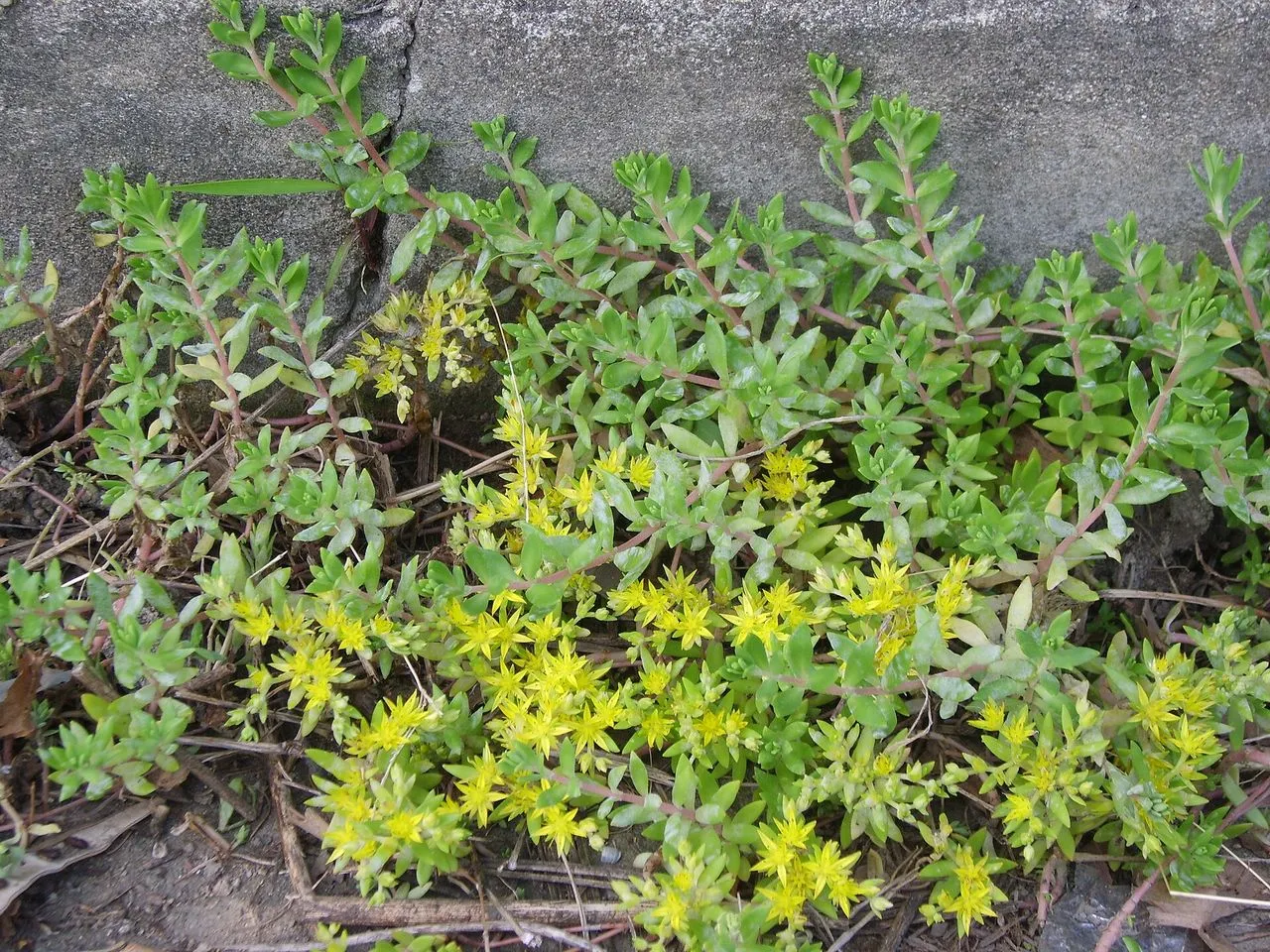
A low mat, 5 to 15 cm tall, spreading indefinitely.
- Leaves. Lanceolate to narrowly oblanceolate, flat to slightly fleshy, 1.5 to 2.5 cm long, in whorls of three. Bright yellow-green, not variegated, not flushing with age.
- Stems. Notably long and lax, often trailing 20 cm or more before rooting; the "stringy" habit distinguishes the species from more compact mat-formers.
- Inflorescence. Terminal cymes of bright yellow star-shaped flowers in late spring to early summer. A prolific bloomer.
Confused most often with S. lineare (narrower leaves, tighter habit) and with S. kamtschaticum (clump-forming, not running). The long trailing habit and yellow-green leaf colour identify sarmentosum quickly once seen.
Cultivation
The most forgiving sedum in cultivation on almost every axis: light, soil, water, cold.
- Light. Full sun to full shade. Will grow in conditions that no other sedum tolerates. Colour and flowering are best in full sun; in shade the habit is looser and blooms reduced.
- Soil. Any free-draining substrate including poor, shallow, alkaline, and disturbed ground. Grows on gravestone surfaces, stone walls, and thin gravel where no other sedum establishes.
- Water. Drought-tolerant once established. Also tolerates briefly damp conditions better than most hardy sedums, though not standing water.
- Temperature. Hardy to USDA zone 4. Heat-tolerant through zone 9. Evergreen to semi-evergreen depending on climate.
The species divergence from the generic sedum pillar: it is much more shade-tolerant, much faster-spreading, and much less fussy about soil than the typical hardy creeper. That combination makes it either an ideal problem-solver or a menace, depending on where you plant it.
Propagation
Trivial, arguably too easy. A single stem fragment 3 cm long will root and establish within a week on moist substrate. Broken pieces from weeding trays will root if left. Lawnmower clippings have been reported to re-root in mulch piles.
Division by digging a trowel-sized clump and replanting is the fastest way to colonise a large area. Leaf propagation is not reliable and not needed; stem fragments are the efficient route.
Notes
This is the point where I need to flag the invasive issue. S. sarmentosum is listed as invasive in Virginia, the Carolinas, Tennessee, and several other southeastern US states, where it escapes gardens and colonises forest floors, displacing native woodland groundcover. It is on the watch list in several other jurisdictions. Before planting, check your state or county's invasive species list. In the Pacific Northwest, across Europe, and in zone 4 through 6 in general it is well-behaved and not on invasive lists, but use judgement in areas where it has escaped cultivation.
In suitable sites it is the sedum to choose for difficult conditions: deep dry shade under trees, stone wall tops, disturbed thin substrate on green roofs, and erosion-control plantings on steep slopes. Nothing else in the genus will establish and hold those niches as reliably.
The species is edible and is still eaten in Korean cuisine; the young leaves are crunchy and mildly tart. Eating is not recommended outside culturally informed preparation because the species carries the same low-grade piperidine alkaloid background as the rest of the genus at levels tolerable in moderation but not for daily volume consumption.
See also: Sedum lineare, Sedum kamtschaticum, Sedum acre.
Frequently Asked Questions
Why is Sedum sarmentosum called stringy stonecrop?
Its stems trail 20 cm or more before rooting, giving a loose stringy habit unlike compact mat-forming sedums.
Is Sedum sarmentosum invasive?
It is listed as invasive in Virginia, the Carolinas, Tennessee, and several other southeastern US states. Check local rules before planting.
Does Sedum sarmentosum grow in shade?
Yes. It tolerates full sun to full shade, though colour and flowering are best in full sun.
How do you propagate Sedum sarmentosum?
Stem fragments as short as 3 cm root within a week on moist substrate. That ease of propagation is also why discarded fragments must be handled carefully.