| Question | Short Answer |
|---|---|
| How do you identify Sedum lineare? | Look for narrow flat 1.5–2.5 cm leaves in whorls of three. |
| Is Sedum lineare variegatum stable? | It is one of the more stable variegated sedums, but fully green shoots can appear. |
| How hardy is Sedum lineare? | The post gives USDA zones 5–10. |
| How do you propagate Sedum lineare? | Use 3–5 cm stem fragments from cleanly variegated shoots. |
Sedum lineare Thunb. (needle stonecrop) is an East Asian mat-forming species native to Japan, Korea, and parts of eastern China, where it grows on rocky slopes, stone walls, and disturbed ground up to 1,500 m elevation. It was described by Carl Peter Thunberg in the late 18th century from Japanese material. The green type is uncommon in Western gardens; the white-margined cultivar 'Variegatum' is what most gardeners recognise under the name.
The species sits in the hardy mat-forming creeper group of the genus, alongside S. acre, Sedum album, and S. sarmentosum. In climate terms it behaves as a typical cold-temperate Asian sedum.
Part of the Complete Sedum Guide.
Identification
A creeping evergreen mat 10 to 15 cm tall, spreading to 40 cm or more.
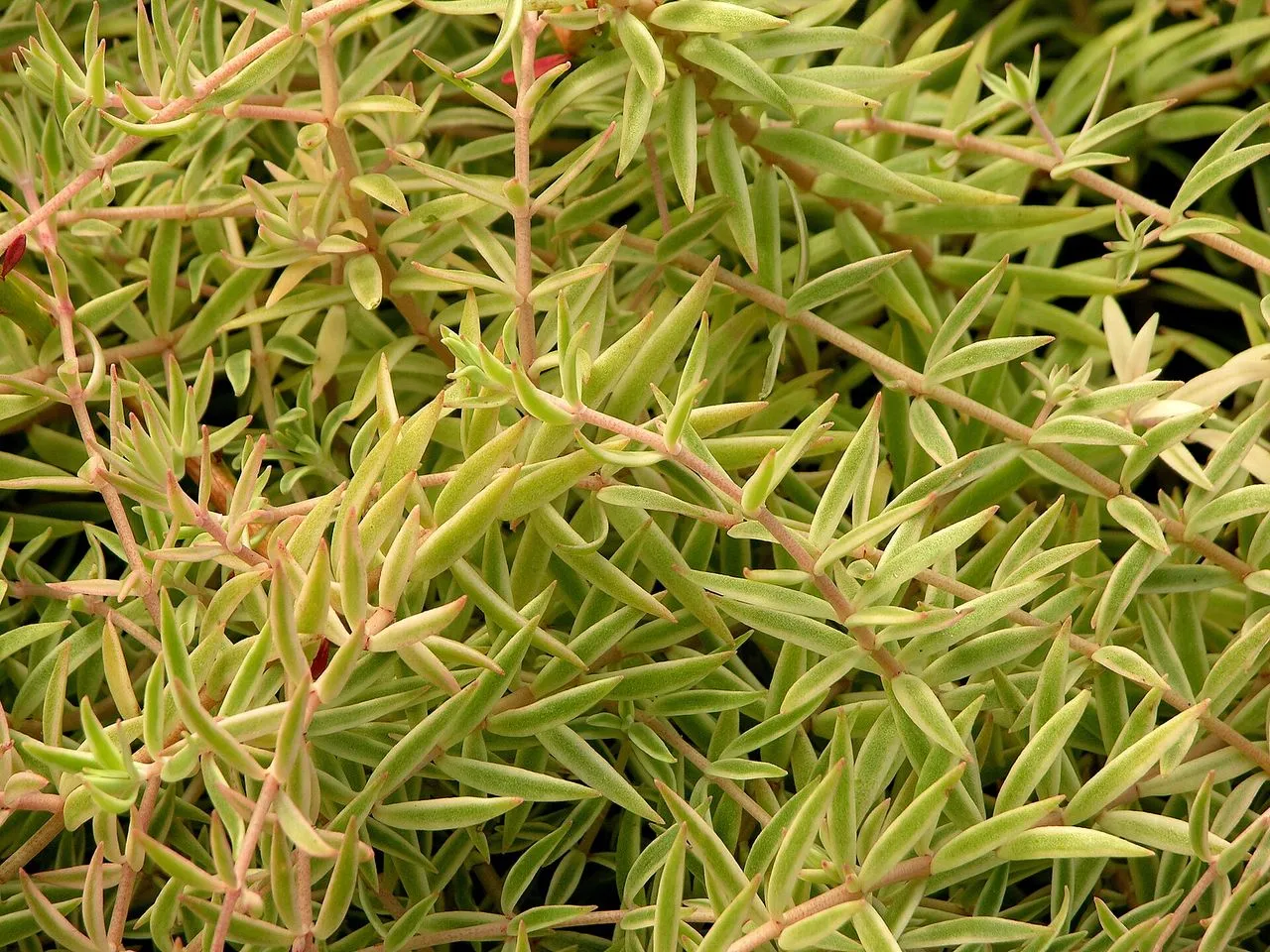
- Leaves. Narrow, linear to needle-shaped, 1.5 to 2.5 cm long and 2 to 3 mm wide, in whorls of three along the stem. Flat rather than terete, distinguishing the species from the true needle-leaved S. rupestre and S. reflexum forms.
- Stems. Creeping, rooting freely at nodes. Sterile shoots are leafy through; flowering shoots arise as short upright branches.
- Inflorescence. Flat terminal cymes of small bright yellow five-petalled flowers in late spring to early summer. A reliable bloomer.
'Variegatum' has a clean white edge to each leaf; under strong sun the white flushes pink. Occasional fully green shoots appear in the variegated form and should be cut out at the base to prevent the plant reverting to plain green over several seasons.
Confused most often with S. sarmentosum (slightly flatter, wider leaves, distinctly stringy habit) and with S. rupestre 'Angelina' (terete needle leaves, chartreuse colour). The whorls-of-three leaf arrangement and narrow flat shape distinguish S. lineare on close inspection.
Cultivation
Standard for the hardy creeping group. USDA zones 5 to 10. Tolerates full sun to light part shade; colour and flowering are best in full sun. 'Variegatum' holds its white edge well in sun and fades to cream in deep shade.
Drought tolerant once established. Not fussy about soil pH or fertility; grows on thin, stony, and slightly alkaline substrates where many groundcovers fail. Does not tolerate prolonged waterlogging. On heavy clay plant into a raised grit pocket.
No fertiliser. The variegated form in particular produces fewer green reversions on lean soil than on rich.
Propagation
Trivial. Stem fragments of 3 to 5 cm laid on moist substrate root at every node within a week. For 'Variegatum' take cuttings from shoots that carry the white margin cleanly; fragments from partially reverted shoots will segregate in the offspring. Leaf propagation is not reliable for this species; use stem cuttings.
Division of an established mat with a trowel works at any time from spring through early autumn and is the fastest way to colonise a new area.
Notes
S. lineare is the sedum most commonly sold under the Japanese name marumanneng (in Korean: dolnamul- variants are different species), and it turns up as ground-garnish in East Asian restaurant plating. The green form is edible in small quantities; the variegated cultivar carries the same low-grade piperidine alkaloid background as the rest of the genus, so treat it as not-for-salad.
The 'Variegatum' form is one of the few reliably variegated sedums that does not lose stability in full sun. Where 'Tricolor' (S. spurium 'Tricolor') fades and sometimes reverts, S. lineare 'Variegatum' holds its pattern through years of exposure.
A useful species for green roofs where you want a white-and-yellow late-spring display alongside the more common chartreuse and red cultivars. Combines well with Sempervivum, small Saxifraga, and dwarf grasses on thin substrates.
Deer and rabbit resistant. Hardy, evergreen, low-maintenance; the only routine task is cutting out the occasional green reverted shoot in the variegated form.
See also: Sedum sarmentosum, Sedum Angelina, Sedum kamtschaticum.
Frequently Asked Questions
How do you identify Sedum lineare?
Look for narrow flat 1.5–2.5 cm leaves in whorls of three. It is not terete like Angelina or Blue Spruce.
Is Sedum lineare variegatum stable?
It is one of the more stable variegated sedums, but fully green shoots can appear. Cut those out at the base before they outgrow the variegated mat.
How hardy is Sedum lineare?
The post gives USDA zones 5–10. It is a hardy mat-forming East Asian sedum for thin, stony, free-draining substrates.
How do you propagate Sedum lineare?
Use 3–5 cm stem fragments from cleanly variegated shoots. They root at every node within a week on moist substrate.