| Question | Short Answer |
|---|---|
| Why is Sedum acre called biting stonecrop? | The leaves taste sharp and acrid because of piperidine alkaloids. |
| Is Sedum acre invasive in gardens? | It can be aggressive on fertile, evenly watered soil, smothering small neighbours within a few seasons. |
| How hardy is Sedum acre? | It is a standard hardy creeping sedum for USDA zones 3–8 and tolerates cold continental winters without protection. |
| How do you propagate Sedum acre? | Any stem fragment roots within days on moist substrate. |
Sedum acre L. (biting stonecrop, goldmoss, wallpepper) is the type species of the genus, described by Linnaeus in Species Plantarum (1753). It is native across Europe, North Africa, and western Asia, growing on dry walls, sand dunes, dry grassland, railway ballast, and any other thin mineral substrate that drains freely. Having been introduced as a garden plant, it is now naturalised across North America from coast to coast.
The specific epithet acre means "sharp" or "acrid" in Latin, referring to the peppery taste of the leaves. The common name "biting stonecrop" refers to the same property: chewing a leaf produces an immediate acrid heat.
Part of the Complete Sedum Guide.
Identification
A very low creeping evergreen mat, 2 to 10 cm tall, spreading indefinitely.
- Leaves. Tiny, triangular-ovate, fleshy, 3 to 6 mm long, densely packed along the stem in a spiral arrangement. Bright green through most of the year, sometimes tinted bronze under drought stress.
- Stems. Short, densely branching, rooting at every node. Creates a moss-like green carpet over stones and thin soil.
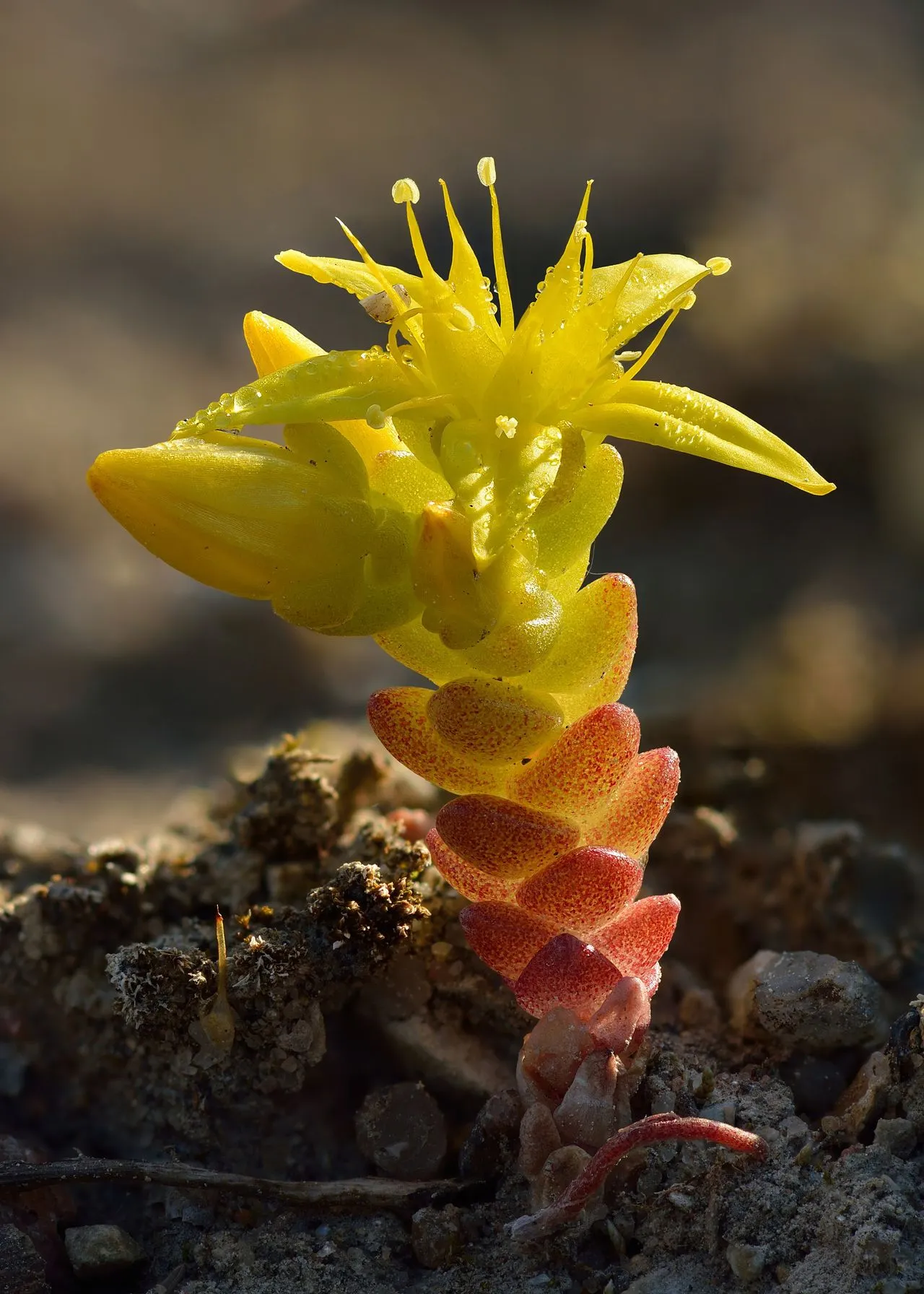
- Inflorescence. Bright yellow five-petalled stars in terminal cymes, appearing in early to mid summer. The flowers are proportionally large compared to the tiny leaves, and the effect on a mature mat in full bloom is striking: a sheet of yellow over a low green substrate.
Several cultivars are in trade:
- 'Aureum' — young growth bright yellow-green, fading through the season
- 'Elegans' — pale yellow-green tips year-round
- 'Minus' — dwarf form, tighter mat
Tell S. acre from S. album (similar habit, white flowers, slightly larger leaves) by flower colour and by the peppery taste. Tell it from S. sexangulare (similar yellow flowers, similar mat habit, six-ranked leaf arrangement) by the triangular leaf shape and by taste: S. sexangulare is not acrid.
Cultivation
Standard creeping sedum culture: full sun, sharp drainage, USDA zones 3 to 8. Exceptionally drought-tolerant and cold-hardy; tolerates Scottish highland, Scandinavian, and continental winters without protection.
This is one of the most aggressive creepers in the genus. On fertile, evenly watered soil it will run through flower borders, smother small neighbouring plants, and re-seed freely. On thin rocky substrates it forms a tight, slow-expanding mat. Match the site to the habit: use S. acre on green roofs, paving joints, gravel garden edges, dry stone walls, and poor soils where its vigour is an asset, not a problem.
Does not tolerate deep shade. Prefers alkaline to neutral pH. No fertiliser.
Propagation
Trivial. Any stem fragment, even one dropped during weeding, will root within days of contact with moist substrate. For planned propagation scatter stem fragments over a prepared gritty bed and water them in lightly. The fastest way to establish a S. acre mat on a new green roof is exactly this: break handfuls of stem, distribute, water once.
Seed propagation also works but is unnecessary given the speed of vegetative increase. The species self-seeds readily in suitable sites.
Notes
Two quirks matter for a gardener planning to use S. acre.
Toxicity. This is the sedum with the most significant alkaloid load in common cultivation. It contains piperidine alkaloids including sedridine, sedamine, and nicotinoid-related compounds. Livestock poisoning is documented where animals have been forced onto pure S. acre stands during drought. Human ingestion of significant quantity causes gastric upset and skin irritation in sensitive individuals. The traditional medieval culinary use ("wallpepper" as a condiment) used tiny amounts. Do not eat it in quantity; do not encourage children to taste-test it; keep mats out of reach of grazing pets.
Aggression. In a rock garden of mixed small plants, S. acre will out-compete most things within three or four seasons. Plant it where its spread is either welcome or physically bounded. It does not spread by rhizome; pulling up stems removes the plant cleanly, but small fragments left behind will re-root.
Pollinators work the yellow flowers heavily in June and July. The species is an important nectar source for small solitary bees in dry-habitat restoration plantings. Deer and rabbit resistant; the acrid taste is a deterrent to browsers.
See also: Sedum album, Sedum spurium, Sedum sarmentosum.
Frequently Asked Questions
Why is Sedum acre called biting stonecrop?
The leaves taste sharp and acrid because of piperidine alkaloids. The Latin epithet acre also means sharp or acrid.
Is Sedum acre invasive in gardens?
It can be aggressive on fertile, evenly watered soil, smothering small neighbours within a few seasons. On thin rocky substrate it forms a tighter mat.
How hardy is Sedum acre?
It is a standard hardy creeping sedum for USDA zones 3–8 and tolerates cold continental winters without protection.
How do you propagate Sedum acre?
Any stem fragment roots within days on moist substrate. Scatter fragments over a prepared gritty bed and water once to establish a new mat.