| Question | Short Answer |
|---|---|
| How large does Sedum confusum get? | Mature plants form low mats 15–25 cm tall and 30–50 cm across after several years. |
| How do you tell Sedum confusum from Sedum palmeri? | S. |
| Is Sedum confusum cold-hardy? | A mature dry plant tolerates brief exposure to about −5 °C with some tip scarring. |
| How do you propagate Sedum confusum? | Stem cuttings are fastest: take 5–10 cm tips, callus three or four days, then root in dry pumice. |
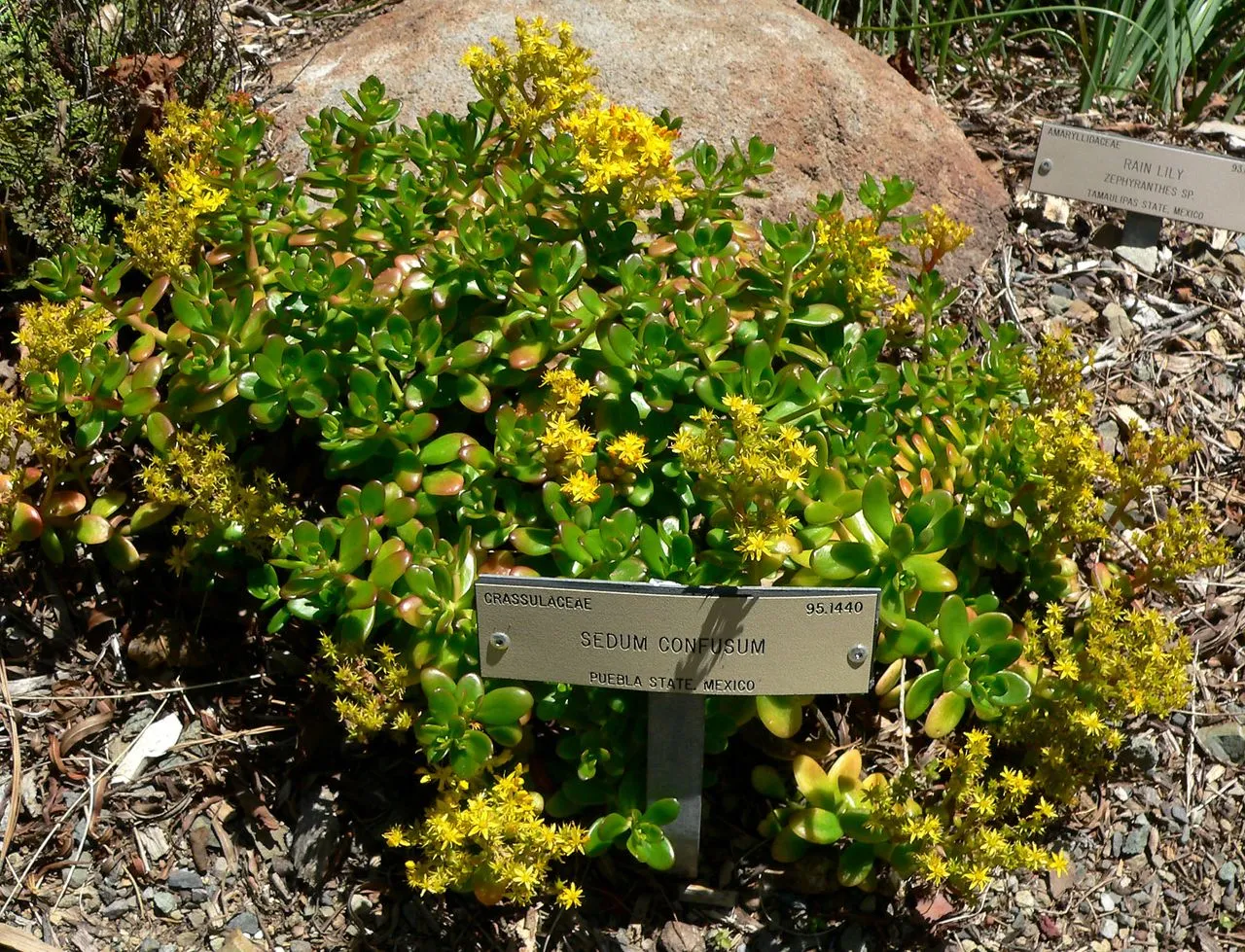
Sedum confusum Hemsl., described by William Botting Hemsley in 1893 from Mexican collections, is a spreading stonecrop of rocky highland slopes. Mature plants form low mats 15 cm to 25 cm tall, with branching stems that lean and root, and glossy bright green leaves clustered into loose rosette-like whorls at every growing tip.
The species is native to the central and eastern uplands of Mexico, with most documented populations in the states of Hidalgo and Veracruz. It grows on exposed rocky outcrops between roughly 1,000 m and 2,500 m elevation, often on shallow soil pockets lodged in cracks. The habitat is seasonally cool and well-drained; nights drop close to freezing for stretches in winter, and summer rain runs off the rock fast. That ecology explains both the species' compact mat habit and its surprising tolerance of brief subzero exposure when its substrate is dry.
Part of the Complete Sedum Guide.
Identification
A mature plant builds a rambling, leaning skeleton of stems that branch from the base and root where they touch substrate. The result is a loose mat 30 cm to 50 cm across on a five-year-old specimen, with leaves carried only at the tips and woody, leafless stem segments behind. The defining traits live in the leaves and the inflorescence.
- Leaf shape and finish. Leaves are obovate-spathulate, 1 cm to 2.5 cm long, broadest toward the rounded apex and tapering to a narrow base. Cross-section is somewhat flattened rather than cylindrical. The surface is glossy bright green, almost lacquered, without a heavy waxy bloom; that gloss is the cleanest field separator from the blue-grey, glaucous leaves of S. clavatum.
- Rosette arrangement. Leaves cluster into loose, open rosette-like whorls at the end of each branch. A terminal cluster usually carries 15 to 25 leaves spaced loosely enough that the central growing point is visible, not wedged into a tight head.
- Inflorescence. Bright yellow, star-shaped flowers in dense, much-branched terminal cymes 4 cm to 8 cm wide, produced in spring. The species is very floriferous; an established mat in flower can carry several dozen cymes simultaneously and read solidly yellow from a few metres away.
- Habit. Stem-forming and spreading rather than rosette-forming. Old plants drop their lower leaves and develop a low woody framework that holds the leafy tips off the substrate.
The specific epithet records the species' history. Hemsley described it because earlier collections had been confused with the closely related S. palmeri, and the two were repeatedly muddled in nineteenth-century herbaria. Modern accounts separate them on stature and inflorescence density: S. palmeri sits lower, branches less, and carries looser, less compact flowering heads. Three lookalikes are worth knowing in trade:
- S. palmeri. The historic confusion partner. Smaller in overall stature, with shorter and more sparsely branched stems, and noticeably less compact terminal flowering. Leaves are similar in shape but tend to flush copper or red at the margins on cold-stressed plants, where S. confusum stays solidly green or develops only a thin red rim. If a plant reads like S. confusum but smaller, sparser, and more colour-stressed, it is probably S. palmeri.
- S. nussbaumerianum. Broader leaves, distinctly stained copper-orange across the whole blade, and taller stems with longer internodes. Mature S. nussbaumerianum reaches 40 cm to 60 cm where S. confusum tops out at 25 cm; the leaf colour alone is usually enough to settle it.
- S. clavatum. Forms tighter, more compact rosettes at the stem tips, with fewer, blue-grey leaves under a heavy waxy bloom. Where S. confusum is glossy and open, S. clavatum is glaucous and snug.
Cultivation
Light is the first lever. Outdoors in Mediterranean conditions the species takes a half-day of direct sun without complaint, and full sun in cooler maritime climates suits it well. Inland summer sun above 35 °C scorches the apical leaves and dulls the gloss; in those climates, light afternoon shade through the hottest two months keeps the plant looking presentable. Indoors, a south-facing or unobstructed west window holds growth tight, but a north-facing room produces stretched internodes and pale, lax rosettes within a single season.
Water on the standard lean-Sedum schedule. In active growth (spring and autumn in temperate climates) water thoroughly when the leaves at the base of a tip cluster feel slightly soft to firm pressure between thumb and forefinger; healthy turgid leaves resist a light squeeze, while drought-stressed leaves flex. Drop frequency by half in midsummer if the plant slows in heat, and stop watering entirely in winter once night temperatures fall below 5 °C.
Substrate should run 60 to 70 percent mineral. A working mix is two parts pumice or 3 mm to 6 mm scoria, one part coarse perlite, one part sieved coir or low-peat potting soil. Avoid water-retentive composts; the species rots fast at the leaning stem joints if substrate stays saturated for more than four or five days at a stretch.
Temperature tolerance is wider than the soft, glossy leaves suggest. A mature plant, kept dry, takes brief exposure to about −5 °C without lasting damage; the apical leaves may show tip scarring, but the woody stem framework and root crown survive and reflush in spring. Wet cold is the critical failure mode. Below 5 °C the substrate must be bone-dry, or rot will appear at stem nodes within days of a thaw. In zone 9b winter conditions on a sheltered patio the species behaves as a tough mat groundcover.
Pots should be wide and shallow rather than deep. Terracotta in 15 cm to 20 cm pans suits the spreading habit, and the broad evaporative surface helps the mineral mix dry out between waterings. Repot every two or three years in spring into fresh dry mix; leaning stems can be cut back at this point to refresh the silhouette without setback.
Most other care defaults map onto the genus, so pair this profile with A Beginner's Guide to Succulents if the family is new to you.
Propagation
Both leaf and stem cuttings work, and both work well. Stem cuttings are the faster route in practice; leaf propagation is the more entertaining one.
For stem cuttings, take a 5 cm to 10 cm tip cutting in spring with a clean blade, strip the lower leaves off the bottom 2 cm of stem, and let the cut callus for three or four days in shade. Push the calloused stub into dry pumice or fine grit and water lightly only after a fortnight. Roots emerge in three to four weeks, and the cutting grows on without check. Success rates above 90 percent are routine in a single batch.
Leaf propagation suits gardeners who want to bulk up a row of pots. Detach intact leaves with a small twist (a clean basal scar is the key; torn leaves rarely root) and lay them on the surface of a tray of dry pumice or grit, in bright indirect light at 18 °C to 25 °C. Do not water. Roots show at the basal scar within 10 to 21 days, and a tiny plantlet appears in another two to four weeks. Begin light misting only once the plantlet shows green leaves; before that the propagule lives off the parent leaf and resents standing moisture. Across a tray of clean leaves, expect 70 to 90 percent strike rates.
Seed is occasionally offered by specialist suppliers and germinates readily in spring at 20 °C on a sterile mineral mix, but seedlings take two seasons to reach a usable size and offer no advantage over vegetative offsets unless you are working on hybridisation.
Notes
The shared horticultural history with S. palmeri still leaks into trade. Plants labelled "S. confusum" in non-specialist nurseries are sometimes S. palmeri, sometimes hybrids, and sometimes vigorous seedlings of unclear parentage; if a specimen reads smaller and more red-stressed than the description here, treat the label as a hypothesis rather than a verdict and use leaf gloss, stature, and flowering density to settle it.
Pest pressure is low compared with sister species. Mealybug occasionally settles between leaning stems where airflow is poor, and aphids can appear on flowering shoots in spring; both respond to a single drench with a 1 percent neem solution if caught early. Slugs ignore the species in the field but will graze new propagules on a humid bench.
Toxicity is mild. Like other Sedum species, S. confusum contains piperidine alkaloids; ingestion of a few leaves typically produces drooling and mild gastric upset in cats and dogs rather than serious illness. The leaves are firm enough that casual chewing is uncommon, but new pet owners should still place specimens out of easy reach.
In long cultivation the plant becomes characterful. A five-year-old mat in a wide terracotta pan reads as a low cushion of lacquered green tips floating above a tracery of woody, leaning stems; in spring it disappears under solid yellow flower heads for two or three weeks. It is one of the easier Mexican mat-forming sedums for an unheated porch in zone 9b conditions, and the cold tolerance is reliable enough that year-round container culture outdoors is realistic across much of southern Europe and the western Mediterranean coast.
See also
- The Complete Sedum Guide for genus-wide cultivation defaults and the full satellite map, including profiles of S. palmeri and S. nussbaumerianum as they ship.
- A Beginner's Guide to Succulents if this is one of your early plants in the family.
- Sedum palmeri — the closely related Mexican species historically confused with S. confusum in 19th-century herbaria.
Frequently Asked Questions
How large does Sedum confusum get?
Mature plants form low mats 15–25 cm tall and 30–50 cm across after several years. Older stems become woody and carry glossy leafy tips above the substrate.
How do you tell Sedum confusum from Sedum palmeri?
S. confusum is taller, glossier, and carries denser yellow flower heads. S. palmeri stays smaller, colours more readily at the margins, and is notable for winter flowering.
Is Sedum confusum cold-hardy?
A mature dry plant tolerates brief exposure to about −5 °C with some tip scarring. Wet cold is the failure mode, so keep the substrate bone-dry below 5 °C.
How do you propagate Sedum confusum?
Stem cuttings are fastest: take 5–10 cm tips, callus three or four days, then root in dry pumice. Leaf propagation also works at roughly 70–90% from intact leaves.