| Question | Short Answer |
|---|---|
| Is sedum invasive? | Several mat-forming sedum are considered garden-invasive in the sense that they spread aggressively and require active management to contain. |
| How do I stop sedum from spreading into my lawn? | Install a physical barrier: metal or plastic edging buried 12–15 cm deep, set flush with the lawn surface. |
| Will sedum take over other plants? | Mat-forming sedum can physically smother lower-growing perennials, alpines, and bulbs by overgrowing and shading them out. |
| How do I get rid of established sedum in a border? | Hand-pull in dry conditions, removing every fragment. |
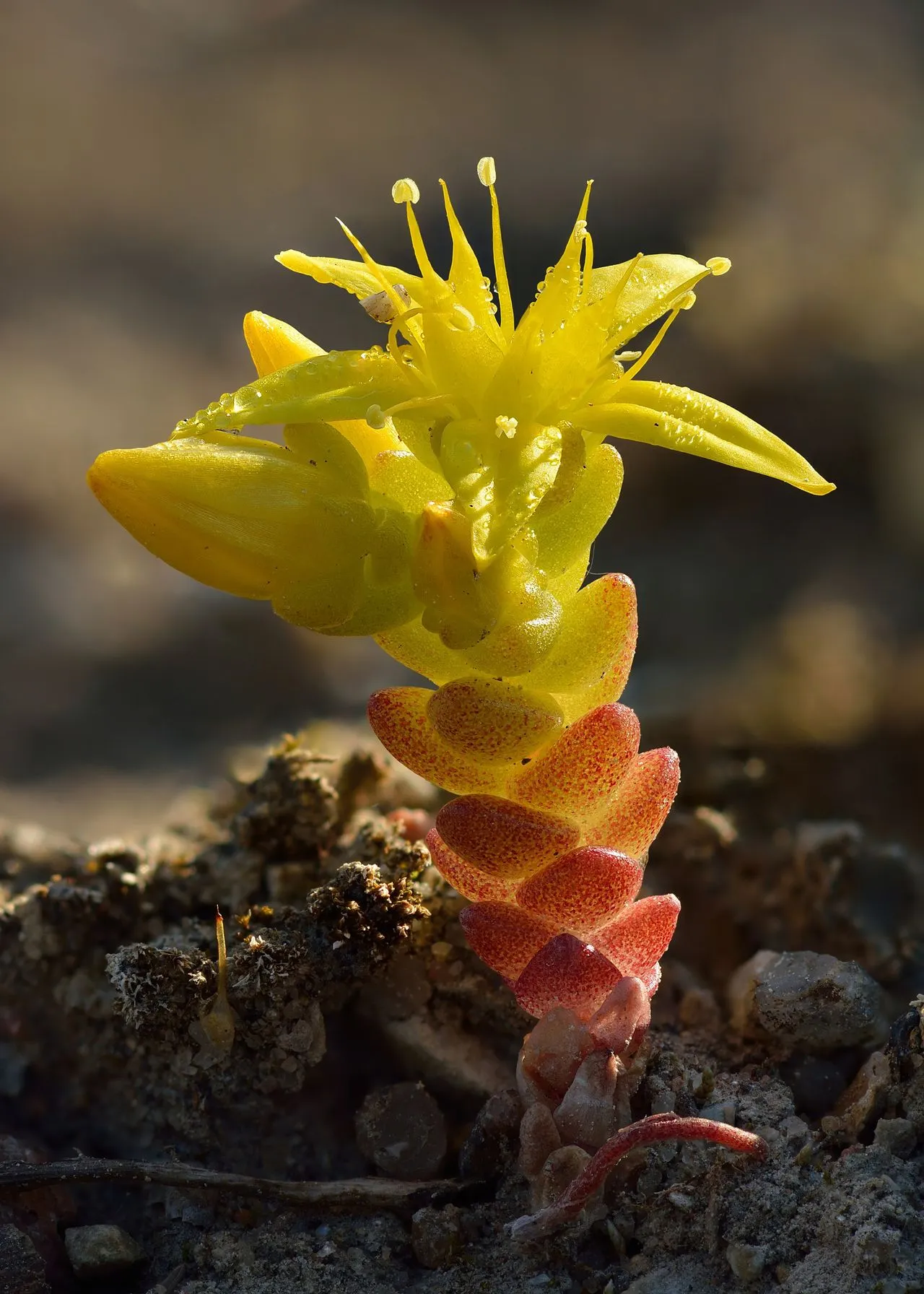
Mat-forming Sedum are among the fastest-spreading ground-cover plants in temperate gardens. Sedum acre, S. album, S. spurium, and S. sarmentosum root at every node where a stem contacts soil, survive fragmentation, and colonise paths, gravel, adjacent beds, and paving gaps with the same enthusiasm as their intended planting area. The quality that makes them excellent for dry banks, green roofs, and rock gardens — the ability to establish almost anywhere with minimal input — becomes a maintenance problem when they spread beyond their allocated space. Controlling spreading sedum is straightforward in the early stages and significantly more effort once a mat becomes deep, dense, and fragmented across a large area.
Part of the Complete Sedum Guide.
Why sedum spreads so fast
Mat-forming Sedum spread by two mechanisms that operate simultaneously: active creeping and passive fragmentation.
Active creeping: stems of S. acre, S. album, S. spurium, and related species grow outward from the plant's centre, lying flat on or just below the soil surface. At every node — every point where a leaf attaches to the stem — adventitious roots are produced when the node is in contact with moist substrate. In summer conditions, rooted new nodes appear within 7–10 days of a stem section touching bare soil or gravel. The plant does not spread by rhizome or stolon; it walks across the surface by continuously extending stems and rooting them down.
Passive fragmentation: sedum stems are brittle. A hoe pass, a rake, a boot, or brushing equipment breaks them into sections, and each fragment with at least one node and one leaf can root independently if it comes to rest on any surface with enough moisture. This is precisely why attempting to control sedum by mechanical cutting or raking without collecting the fragments is counterproductive — a single hoe pass across an established mat can create dozens of viable propagules and distribute them across the bed.
Birds, water movement, and wind can carry stem fragments or fine seed short distances. Sedum seed is dust-fine and easily transported. This explains why sedum patches sometimes appear at a distance from the parent planting with no obvious mechanical cause — seed or fragments moved by rain splash or foot traffic.
Which species spread most aggressively
Spreading behaviour varies substantially across the mat-forming group. Knowing the species determines the urgency of containment.
High spreading rate: Sedum acre (biting stonecrop) and S. album (white stonecrop) are the most aggressive spreaders in European and North American gardens. Both self-seed freely as well as spreading vegetatively, which makes them the most difficult to fully eradicate once established. S. acre specifically has a tolerance for wall mortar, roof tiles, and alkaline rubble — it colonises surfaces that most plants cannot. S. sarmentosum (stringy stonecrop) is listed as invasive in parts of the southeastern United States and several Asian regions; it spreads rapidly in moist, mild conditions and is less drought-tolerant than S. acre but faster in suitable climates.
Moderate spreading rate: Sedum spurium and its cultivars ('Dragon's Blood', 'John Creech', 'Tricolor') spread actively but more slowly than S. acre. They do not self-seed as freely, which makes them somewhat more manageable. S. kamtschaticum and S. sexangulare are vigorous but grow in compact mats that are easier to cut back and contain with physical barriers.
Low spreading rate: Sedum cauticola, S. dasyphyllum, and S. ternatum are compact or clumping plants that spread gradually but are not aggressive in most garden situations. S. dasyphyllum is tiny-leaved and slow; S. ternatum spreads by runners at a moderate pace but is a woodland species and does not thrive in the full-sun open-bed conditions where the aggressive spreaders cause problems. The Hylotelephium upright border types do not spread vegetatively — they are clump-forming and stay in place.
Tender trailing and rosette types — S. morganianum, S. nussbaumerianum, S. rubrotinctum, S. adolphi — do not spread in garden beds in temperate climates. They are not cold-hardy enough for outdoor ground planting in most regions and are not part of the spreading problem. See sedum creeping for the full care guide for the spreading forms, including appropriate planting density and appropriate sites.
Where the spread goes and what it affects
The typical spread pattern: the original planting expands outward in all directions at approximately 10–30 cm per season depending on species and conditions. Stems reach the edge of a defined bed and continue across path gravel, into lawn turf, between paving slabs, over retaining-wall edges, and into adjacent beds. Sedum acre finds wall crevices and grows out of them — it is a natural wall coloniser and will establish in pointing mortar, which can eventually cause damage to old stone or brick walls.
In a mixed border, a vigorous mat-forming sedum can overgrow and physically smother lower-growing neighbours — small alpines, low-growing herbs, spring bulbs. The mechanism is purely physical: the dense mat eliminates light to plants beneath it and prevents stem emergence. This is rarely a rapid collapse; it typically develops over one to three seasons as the sedum mat expands to cover the neighbours' crowns.
Sedum sarmentosum is a particular concern in mild, moist climates. See sedum sarmentosum for species-specific information and regional restriction status. Sedum acre is detailed in sedum acre including the containment strategies that are most effective for this species specifically.
Risk and severity
In a contained garden setting, spreading sedum is a maintenance problem, not an ecological emergency. It does not have aggressive rhizomes or suckering root systems; pulling it up removes it. A well-established mat in a large area does take sustained effort to eliminate, but the mechanism is straightforward.
Risk escalates with: the size of the established mat, the proximity to areas where eradication would be very difficult (established perennial roots, old stone walls, densely planted borders), the species involved (S. acre and S. sarmentosum are harder to eliminate than S. spurium), and the question of whether the planting is near areas of ecological sensitivity. In most urban and suburban garden contexts the risk is limited to aesthetic and horticultural — the sedum taking up space that other plants should occupy.
Solutions
Physical removal
The most reliable method and the appropriate first response for most garden situations. Pull the mat by hand rather than cutting or hoeing. Work in dry conditions when the substrate is not sticky — dry sedum stems release more cleanly from the soil and the fragments are less likely to root where they fall. Work backward across the mat so that you are always pulling up material you have not yet walked over.
Collect all fragments immediately. Place them in sealed bags for general waste — do not compost sedum, which is vigorous enough to root in active compost heaps. Do not leave fragments on bare soil or gravel.
One pass is rarely sufficient for an established mat. Return after 3–4 weeks and remove all regrowth from missed nodes, which will be small new shoots 2–5 cm tall at this point. Continue for a full growing season. S. acre in particular often requires three to four rounds of removal before the established seed bank and root fragments are exhausted.
Physical edging and barriers
Metal edging (aluminium or stainless steel) or heavy-duty plastic landscape edging buried to a depth of 12–15 cm provides a reliable barrier against stem creep into adjacent areas. Set the top of the edging flush with the lawn surface or path level so that stems cannot arch over it. Check twice yearly — spring and autumn — and trim any stems that have overtopped the barrier before they root on the other side.
Root-barrier fabric installed vertically along bed margins works similarly, though over time (5+ years) determined species such as S. acre can find gaps at joins. Concrete mowing edges around beds also work and are more permanent.
For sedum that has established in gravel paths or between paving: remove the stones, pull the sedum by hand, and relay a weed-suppressing membrane beneath fresh gravel. This delays recolonisation by several seasons but is not permanent.
Reducing the planted area
If the planted mat has spread to an unmanageable size, reduce the overall cultivated area first — pull back the perimeter — before focusing on quality improvement within the remaining planting. Once the area is manageable, introduce vertical edging to hold the boundary, then work on interior density and health.
Consider replacing the aggressive species with a slower-spreading alternative that provides the same ground-cover function with less maintenance: S. cauticola for a blue-leaved mat, S. dasyphyllum for a tiny-leaved rock-garden carpet, or S. kamtschaticum for a compact but less invasive spreading type.
Herbicide
Glyphosate at 1–2% solution applied to actively growing foliage in dry conditions in the main growing season (May to September) is effective on sedum but requires multiple applications — typically two to three, spaced 3–4 weeks apart — because sedum's waxy leaf cuticle reduces initial absorption. Add a surfactant or spreader-sticker to the spray mix to improve uptake. Allow 2–3 weeks between applications to assess the full effect of the previous treatment before re-spraying. Protect adjacent desirable plants from spray drift with cardboard shields; glyphosate is non-selective.
Selective grass-weed herbicides (those containing fluazifop or sethoxydim) are not effective on sedum, which is a dicotyledon not a grass. Do not use these.
Prevention
Choose the species appropriate to the site before planting. In a contained raised bed, green roof, dry-stone wall, or slope where aggressive spreading is a positive quality — as ground stabilisation, weed suppression, or nectar provision — plant the vigorous species freely. In a mixed border or adjacent to lawn, choose slow-spreading species from the outset, or use physical edging from planting day.
Inspect sedum plantings twice a year and trim back stems before they root across boundaries. Pull up any establishment in adjacent lawn or paths when it is still a small isolated patch — a 10 cm patch takes five minutes to remove; a 1 m patch in established lawn takes an afternoon.
Do not accept sedum from other gardeners without asking the species. A generous bag of "sedum cuttings" labelled only as "golden stonecrop" or "rockery sedum" may contain S. acre, which will colonise aggressively, or may be the manageable S. kamtschaticum, which will not.
See also
- Sedum creeping — care guide for the mat-forming species; appropriate planting density, sites where spreading is an asset, and management for ground-cover use.
- Sedum acre — the most aggressively spreading species in temperate gardens; species profile, ecological notes, and containment-specific advice.
- Sedum sarmentosum — the trailing stonecrop; the species most commonly listed as regionally invasive; distribution, restriction status, and removal procedures.
Frequently Asked Questions
Is sedum invasive?
Several mat-forming sedum are considered garden-invasive in the sense that they spread aggressively and require active management to contain. S. acre and S. album have naturalised across North America from garden introductions. S. sarmentosum is listed as invasive in several southeastern US states. None of the standard garden sedum is invasive in the strict ecological sense of destroying intact native-plant communities in most regions, but check your local authority list before planting near natural areas.
How do I stop sedum from spreading into my lawn?
Install a physical barrier: metal or plastic edging buried 12–15 cm deep, set flush with the lawn surface. Check the barrier edges twice a year and trim any stems that have overtopped it. Pull established sedum patches from the lawn by hand rather than hoeing.
Will sedum take over other plants?
Mat-forming sedum can physically smother lower-growing perennials, alpines, and bulbs by overgrowing and shading them out. It does not produce allelopathic chemicals — the mechanism is purely physical competition for light and space. Direct neighbours need regular monitoring and the sedum needs trimming back before it reaches established plants.
How do I get rid of established sedum in a border?
Hand-pull in dry conditions, removing every fragment. Dispose of in sealed bags, not compost. Repeat the check every 3–4 weeks for a full season to catch regrowth from missed nodes. For large areas, two to three applications of glyphosate at 1–2% solution in the growing season will kill the mat, but do not spray adjacent desirable plants.