| Question | Short Answer |
|---|---|
| Is Sedum cauticola the same as Hylotelephium cauticola? | Yes. |
| How tall does Sedum cauticola grow? | Plants are semi-herbaceous perennials 10–20 cm tall. |
| When does Sedum cauticola flower? | It flowers late for a compact sedum, opening deep rose-pink cymes in September and October. |
| Where should Sedum cauticola be planted? | Use it in rock gardens, troughs, raised alpine beds, fronts of dry borders, or gravel gardens. |
Sedum cauticola Praeger, now formally Hylotelephium cauticola (Praeger) H.Ohba, is a small clump-forming stonecrop native to rocky coastal cliffs and alpine habitats on Hokkaido, northern Japan. It was described by the Irish botanist Robert Praeger in 1917 from plants cultivated in the Glasnevin Botanic Garden. In the trade it is often still sold as Sedum, particularly the cultivar 'Lidakense' and its hybrids.
Part of the Complete Sedum Guide.
Identification
- Semi-herbaceous perennial 10 to 20 cm tall, dying back partially in winter and re-emerging in spring from a woody crown.
- Stems reddish, ascending rather than creeping, branched at the base.
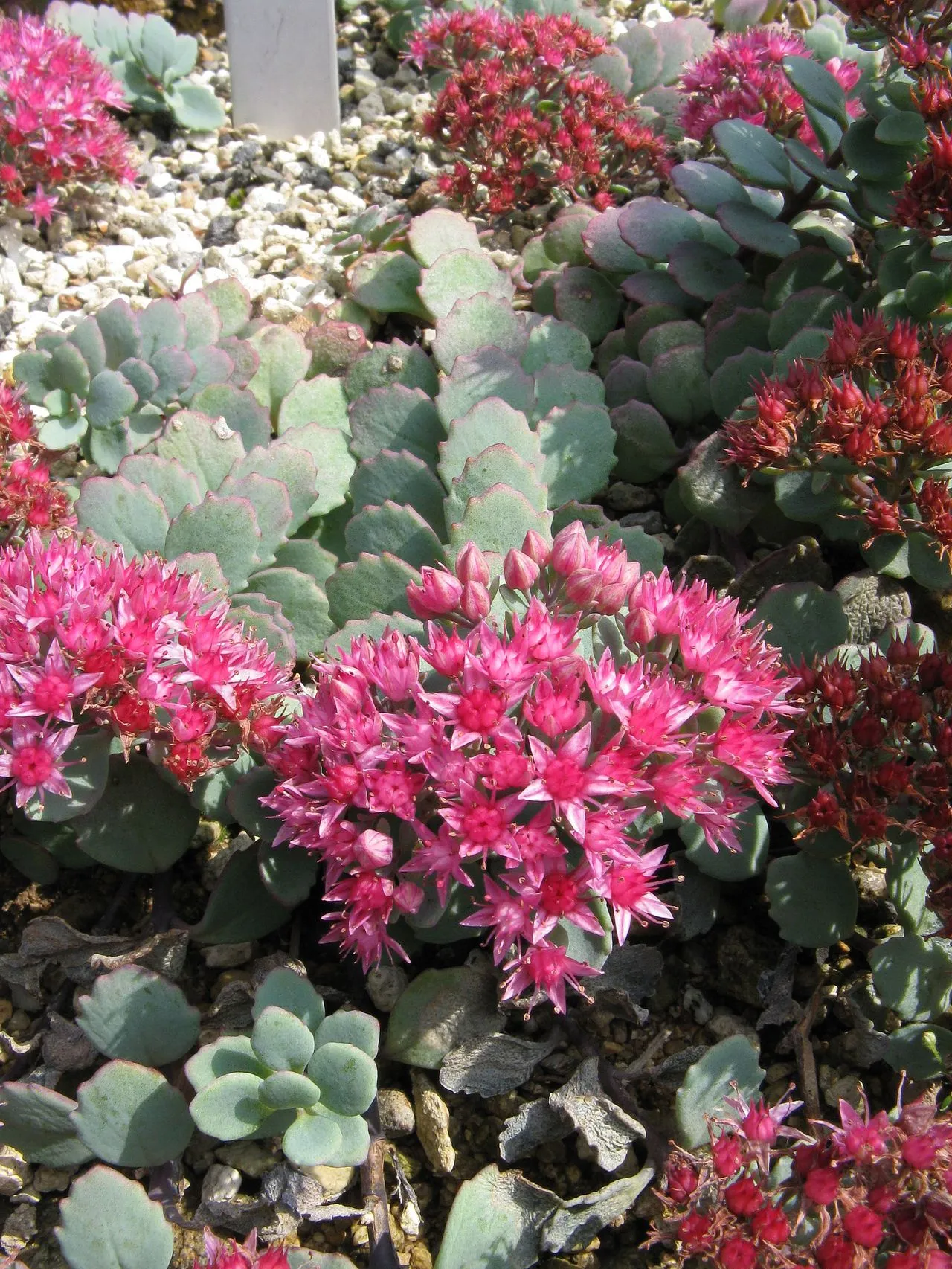
- Leaves obovate to near-orbicular, 1 to 2 cm long, distinctly blue-grey with a fine red margin, arranged opposite or in whorls of three.
- Leaf shape and blue colour separate H. cauticola from H. sieboldii (leaves more rounded, tighter whorls of three) and from H. ewersii (leaves wider, less glaucous).
- Inflorescence a loose cyme of deep rose-pink five-petalled flowers on short terminal stems in September and October, later than most compact sedums.
'Lidakense' is the commonest cultivar, with stronger blue pigmentation and brighter pink flowers than the type. 'Ruby Glow' is a hybrid with H. ewersii, larger and a shade redder.
Cultivation
A cold-hardy alpine species. Standard treatment for the smaller Hylotelephium group in the pillar guide. Specific to this species:
- USDA zones 4 to 9.
- Full sun for the bluest foliage and tightest habit. Partial shade produces looser greener plants.
- Lean gritty soil. On rich beds it flops open and the blue fades.
- Drought-tolerant once established.
- Suits rock gardens, troughs, raised alpine beds, and the fronts of dry borders. Works well threaded between paving in a gravel garden.
The late flowering window is the strongest argument for this species. At a point when most small sedums are finished for the year, H. cauticola is just opening.
Propagation
Division in early spring as the crown buds break, or stem cuttings of non-flowering shoots in late spring. Cuttings root in a fortnight in gritty compost. Seed is viable but slow and cultivars do not come true; vegetative propagation is preferred.
Notes
The species name cauticola means "cliff-dwelling", a direct reference to its wild habitat on rocky coastal outcrops where soil depth can be under 5 cm. In cultivation it needs the same: crown above the substrate surface, sharp drainage below. A waterlogged winter will rot it out in a season.
Pollinator value is significant in autumn, bringing in hoverflies and late bumblebees when little else is in flower. It pairs well with silver foliage (Artemisia schmidtiana 'Nana', Cerastium tomentosum) and with the larger Sedum telephium cultivars behind it for a staggered late-season bloom.
See also
- Sedum telephium
- SunSparkler Sedum
- Sedum Dazzleberry — a SunSparkler compact hybrid that shares H. cauticola parentage.
Frequently Asked Questions
Is Sedum cauticola the same as Hylotelephium cauticola?
Yes. Hylotelephium cauticola is the current formal name, but the plant is still widely sold as Sedum cauticola in horticulture.
How tall does Sedum cauticola grow?
Plants are semi-herbaceous perennials 10–20 cm tall. They die back partly in winter and re-emerge from a woody crown in spring.
When does Sedum cauticola flower?
It flowers late for a compact sedum, opening deep rose-pink cymes in September and October. That late window is one of its main garden uses.
Where should Sedum cauticola be planted?
Use it in rock gardens, troughs, raised alpine beds, fronts of dry borders, or gravel gardens. Lean gritty soil and full sun keep it compact and blue.