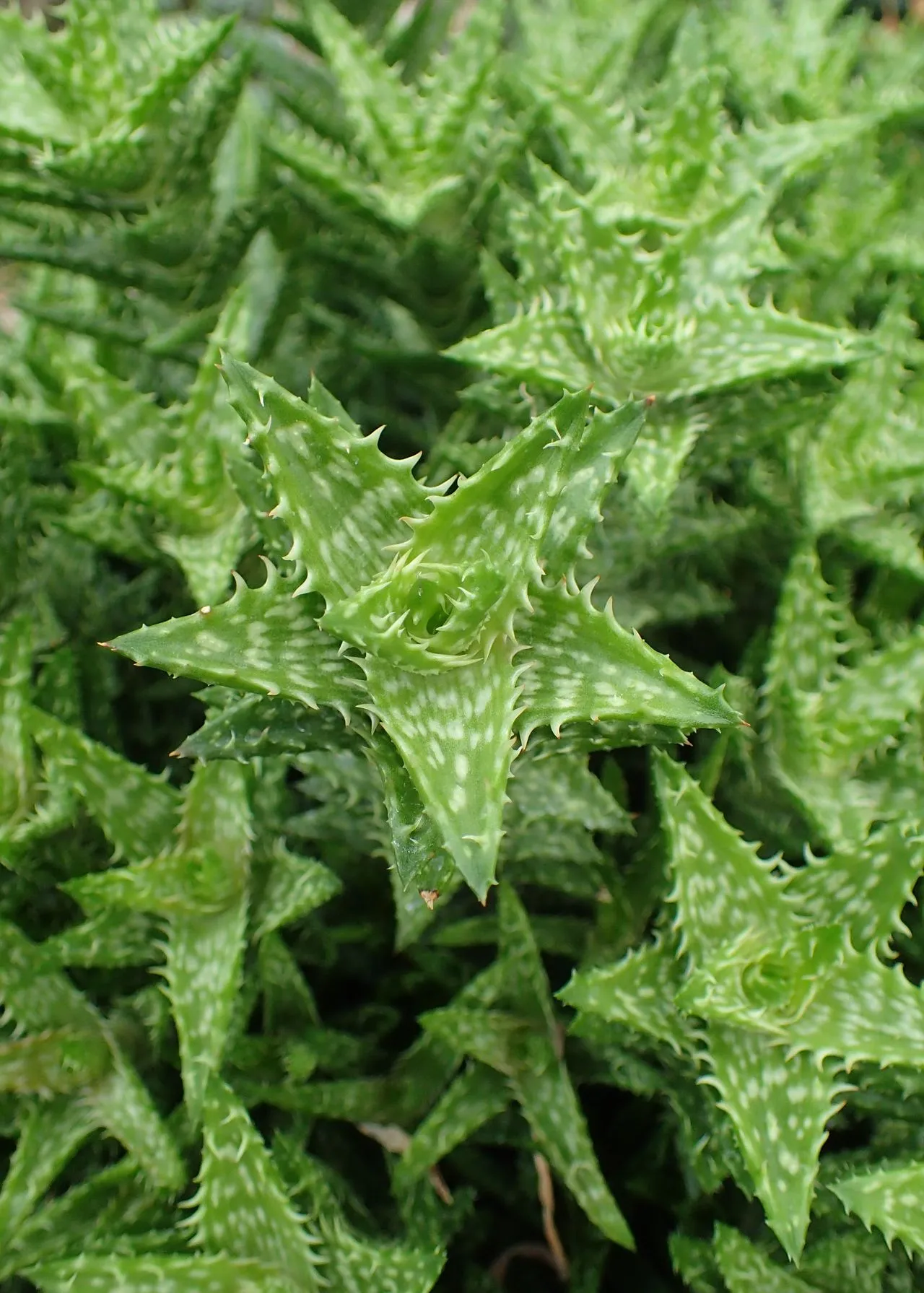
Yellow Aloe vera leaves span a wide diagnostic range, from the normal shedding of a single old basal leaf each month to the early warning of root rot, nutrient lockout, and chronic low light. Brown and yellow often overlap on the same leaf, but the dominant colour and texture steer the diagnosis in different directions. A yellow-green fade across the whole plant signals something systemic — light or nutrients. Uniform yellowing confined to one or two lower leaves can be normal senescence. Yellow combined with soft or translucent tissue signals rot and requires immediate action.
Part of the Complete Aloe Guide.
Over-watering and the first signs of root rot
The most common reason Aloe vera turns yellow is too much water held in the root zone for too long. A. vera stores water in its leaf parenchyma; when roots are waterlogged, they lose the ability to regulate ion uptake, and the plant begins moving excess water into the leaf tissues. The leaves first shift from their normal sage-green to a washed-out yellow-green, then become increasingly translucent and soft as the cells rupture under the pressure of water they cannot export. The process begins in the oldest lower leaves and progresses inward toward the crown over days to weeks.
Diagnostic signs: lower leaves are yellow-green, soft, or translucent; the substrate feels wet more than 7 days after the last watering in a 10 cm pot at 20°C; the pot feels heavier than expected for its size; and there may be a sour or swampy smell from the drainage hole. Do not wait to see how it develops. Unpot the plant and inspect the root zone immediately. Healthy Aloe vera roots are pale tan to cream, firm, and slightly elastic. Rotten roots are black, grey, hollow, slimy, or foul-smelling. Remove all rotten material back to clean tissue with a sterile blade, then dry the plant bare-root in a shaded location with airflow for 5 to 7 days. Repot into dry mineral substrate containing 40 to 60% pumice or coarse grit, and withhold water for at least 7 days after potting. Full root salvage guidance is in Root Rot Diagnosis and Aloe Vera Soft and Mushy.
Under-watering and drought-induced chlorosis
Chronic drought is a less common cause of yellowing than over-watering, but it occurs when a plant has gone 4 weeks or more without a thorough soak, or when peat-heavy nursery substrate has become hydrophobic and water runs down the pot wall without penetrating the root ball at all. Leaves initially wrinkle lengthwise; after prolonged stress, chloroplast function degrades and the outer leaves develop a pale yellow cast before drying from the tip inward. The tissue is crisp or leathery rather than soft.
Probe the substrate 4 to 5 cm deep. A bone-dry root ball that feels as light as polystyrene and does not release moisture when squeezed confirms the diagnosis. Submerge the entire pot in a basin of water for 20 to 30 minutes, then allow it to drain fully. If water beads off the surface of the substrate rather than soaking in, the mix has gone hydrophobic and should be replaced with a mineral-heavy blend that wets evenly and dries within 48 hours in summer. Do not overcompensate with frequent shallow waterings after the soak — a single thorough drenching rehydrates the root zone more effectively than daily sips.
Iron and manganese lockout from hard water
Persistent use of hard tap water gradually raises substrate pH above 7.5. At that point, iron and manganese become insoluble and the roots cannot access them even if present in the substrate. The symptom is interveinal chlorosis of the newest central growth: the leaf blade turns yellow while the veins remain green. Older leaves are usually unaffected because the nutrients already incorporated into those tissues were absorbed when conditions were correct. The new growth records the current chemistry of the root zone.
Switch to rainwater or low-mineral water. As a short-term correction, foliar application of chelated iron at the dilution specified on the product label can green new growth within 2 to 3 weeks. Do not increase nutrient concentration as a short-term fix — adding more fertiliser to a high-pH substrate locks out more nutrients rather than making them available. A white crust on the soil surface or pot rim confirms chronic mineral accumulation; flush several pot volumes of rainwater through the drainage hole before correcting pH further. The wider picture of nutrient imbalance patterns is in Mineral Deficiency Symptoms.
Nitrogen deficiency in over-leached or old substrate
Aloe vera has relatively modest nitrogen requirements, but specimens grown for several years in the same mineral substrate with no fertiliser and frequently watered with very pure water may develop a mild shortfall. Unlike iron lockout, nitrogen deficiency begins in the oldest leaves because nitrogen is a mobile nutrient that the plant redistributes from old tissue to new. The outer leaves turn uniformly pale yellow from tip toward base, while the newest central leaves remain comparatively green.
A half-strength balanced fertiliser — approximately 5-5-5 or equivalent — applied once monthly during active spring and summer growth is sufficient for a container plant. Do not apply fertiliser to a plant that is currently waterlogged, root-damaged, or showing soft yellow tissue from rot. Drainage and root recovery always take priority over nutrition.
Inadequate light and whole-plant yellowing
Low light does not usually cause acute yellowing but produces a slow shift of the entire plant from deep sage-green to a washed-out yellow-green over weeks to months. New leaves formed in low light are longer, paler, and narrower than those formed in adequate light. The rosette opens up and the plant may lean toward the nearest light source. No individual leaves die; the whole canopy shifts uniformly. Human vision adapts to room brightness in a way that can be misleading: a table 2 m from a window can receive a fraction of the light available at the glass, far below what A. vera needs for robust growth.
A. vera needs a minimum of 4 to 6 hours of direct sun per day for compact, correctly coloured growth. Indoors, this means a south-facing window at less than 60 cm from the glass, or a high-output LED grow light running for 10 to 14 hours at the manufacturer-recommended succulent distance. Move the plant gradually — direct outdoor sun after indoor cultivation requires a 10 to 14 day acclimation period to avoid sunburn, as described in Aloe Leaves Turning Brown.
Natural leaf senescence
A single lowest leaf turning slow yellow, then papery and brown, is normal for a mature A. vera rosette undergoing normal basal senescence. The process takes 3 to 6 weeks per leaf and is confined to the lowest one or two whorls. The leaf remains firm and dry as it yellows — completely unlike the wet translucence of rot — and the rest of the rosette stays upright and compact. No action is needed other than removing fully dry leaves once they detach with light pressure.
The diagnostic boundary: one or two firm slowly-yellowing basal leaves at any given time is normal ageing; three or more soft translucent leaves progressing inward toward the crown is pathology.
How to identify the cause
| Yellow pattern | Texture | Location | Likely cause |
|---|---|---|---|
| Yellow-translucent lower leaves | Soft, wet | Base first | Over-watering or root rot |
| Wrinkled, then yellow dry tips | Crisp, leathery | Lower to mid leaves | Drought or hydrophobic mix |
| Yellow between veins, green veins | Firm | Newest central leaves | Iron or manganese lockout |
| Pale uniform yellow, whole plant | Firm, may be stretched | All leaves | Insufficient light |
| Pale old leaves, green new leaves | Firm | Oldest outer whorl | Nitrogen deficiency |
| One leaf drying slowly, papery | Dry, firm | Lowest position | Normal senescence |
The substrate check and root inspection together resolve the majority of diagnoses. A wet pot with soft leaves points firmly toward over-watering or rot; a bone-dry pot with wrinkled firm leaves points toward drought.
Risk and severity
Treat soft translucent lower leaves as urgent. Root rot can reach the stem base and the growth point within one to two weeks in a warm wet pot, and a destroyed crown does not regenerate. Interveinal chlorosis with firm leaves is not an emergency but should be corrected within one growing season to prevent cumulative root tip damage. Whole-plant pale yellowing from low light weakens the plant over time and makes it more vulnerable to rot and pest colonisation. Natural senescence of one or two basal leaves carries no risk.
Solutions
If lower leaves are soft and yellow
Stop watering immediately. Unpot the plant the same day. Remove wet substrate, rotten roots, and any collapsed basal leaves. Dry the plant bare-root in shade with good airflow for 5 to 7 days. Repot only firm tissue into dry free-draining mineral substrate. Delay watering for 7 days after potting, then water lightly only if temperatures are above 18°C and the substrate has fully dried.
If the whole plant is pale yellow-green
Improve light in stages. Move to a brighter window or supplement with grow lights for 10 to 14 hours daily. Introduce direct sun over a 10 to 14 day acclimation period to prevent sunburn. New central growth will return to full colour within 4 to 6 weeks of adequate exposure.
If new leaves show interveinal chlorosis
Switch to rainwater or a low-mineral equivalent. Apply chelated iron foliar spray once per week for 3 to 4 weeks. If the substrate pH tests consistently above 7.5, flush several pot volumes of rainwater through the drainage hole. Repot into fresh mineral mix if the substrate has been used for more than 3 years without any pH management.
If only the oldest basal leaves are affected
Remove each leaf only after it detaches with light pressure or has fully dried to papery. Do not cut partially yellowing leaves — a wet cut surface can become an entry point for fungal pathogens. Let the plant complete the senescence cycle at its own pace.
Prevention
Grow Aloe vera in a pot with a drainage hole, a mineral-heavy substrate, and a minimum of 4 to 6 hours of direct daily light. Water only when the top 3 to 4 cm of substrate tests dry, then soak completely and empty the saucer within 30 minutes. Use rainwater or low-mineral water if your tap water is hard. Apply a balanced fertiliser at half strength once monthly in spring and summer only. Inspect the root zone annually at repotting — a healthy white root system prevents the majority of pathological yellow scenarios before they develop into emergencies.
See also
- Aloe Vera Soft and Mushy — the full emergency protocol when yellow progresses to soft translucent tissue.
- Root Rot Diagnosis — detailed root inspection and salvage steps shared across succulent genera.
- Mineral Deficiency Symptoms — identifying interveinal chlorosis and correcting pH-related nutrient lockout.
- Aloe Leaves Turning Brown — how yellowing and browning overlap in sun stress, cold injury, and normal ageing.
Frequently Asked Questions
Can yellow aloe leaves turn green again?
Leaves yellowed from rot or senescence will not re-green. Leaves pale from low light or mild iron deficiency can regain colour as conditions improve, but only the new central growth will show the full benefit.
Why are only the lower aloe leaves yellow?
Lower yellow leaves are either normal senescence — one or two oldest leaves drying per month — or early root rot. Soft and translucent lower leaves confirm rot; firm and slowly papery lower leaves confirm ageing.
Why is my whole Aloe vera turning yellow-green?
Whole-plant pale yellowing is almost always a light problem. Move the plant to a brighter position or supplement with a grow light for 10 to 14 hours daily and the new central growth will return to sage-green within 4 to 6 weeks.
How do I know if yellow aloe leaves are from over-watering or under-watering?
Over-watered leaves are soft and translucent; under-watered leaves are crisp, wrinkled, and leathery. Substrate moisture confirms the diagnosis — wet soil for more than 7 days in a 10 cm pot at 20°C indicates over-watering.