| Question | Short Answer |
|---|---|
| What is the main identification point? | The Identification section separates Aloe cameronii by plant habit, leaf form, marginal teeth or surface markings, flowers, and lookalikes named in the article. |
| How should this aloe be watered? | Follow the Cultivation section rather than a fixed calendar. |
| How is it propagated? | Use the Propagation section. |
| What should buyers watch for? | Check the Notes and lookalike sections. |
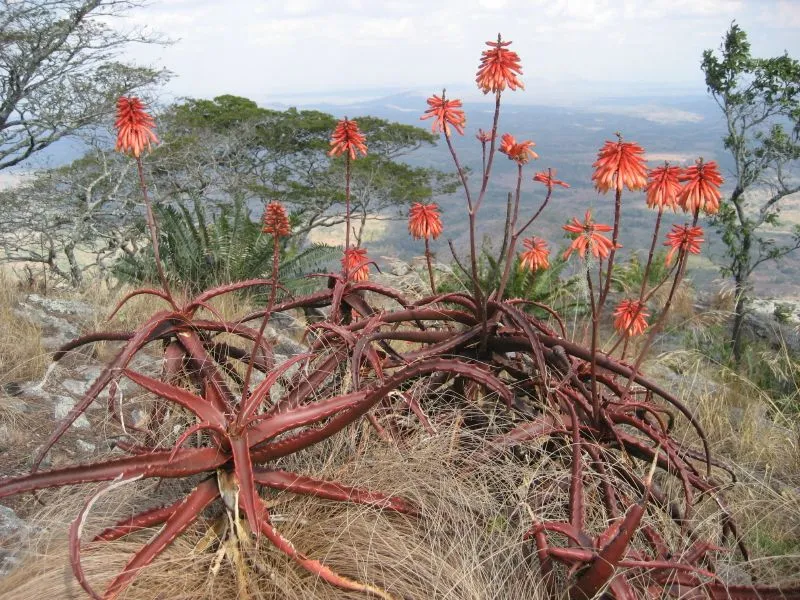
Aloe cameronii Hemsl., described by William Botting Hemsley at Kew in 1903 from material collected in the highlands of what is now Malawi, is a clumping stem-forming aloe of the Zambezian woodland belt and the most reliable "red aloe" in cultivation. It is native to Malawi and adjacent western Mozambique, on rocky outcrops and grass-grown gneiss slopes between roughly 800 and 1,800 m. Mature stems reach 60 to 80 cm tall, branching at the base into loose clumps of half a dozen to twenty rosettes, with narrow, gently recurved leaves 30 to 50 cm long that flush deep copper-red to burgundy under sun stress and dry-season drought. That stress colour is the defining feature of the species and the reason it has held a permanent place in subtropical landscape design.
Habitat is seasonally dry miombo and montane grassland on the Malawi-Mozambique border, with a hot summer wet season from November to March and a long cool dry winter from April to October. Outcrops carry shallow mineral substrate over weathered crystalline rock, and A. cameronii sits on summit and south-facing positions where rooting is restricted, drainage is total, and water stress is constant for the second half of the year. The colour change tracks that ecology: under steady moisture the leaves stay flat green, and as the dry season tightens they narrow, recurve harder, and pigment up across weeks. Intensity peaks in late winter and lasts until the first heavy rains. The species is not assessed as threatened on the IUCN Red List, and like all aloes other than A. vera it sits on CITES Appendix II.
Part of the Complete Aloe Guide.
Identification
A settled A. cameronii is a multi-stemmed clump 60 to 80 cm tall, occasionally taller in old garden plants, with each stem terminating in a loose open rosette 30 to 50 cm across. Stems are slender and lean outward as the clump matures, often resting on neighbouring stems for support, and old leaf bases persist as a dry papery sheath on the lower trunk. The leaves are the diagnostic surface: narrow, lanceolate, 30 to 50 cm long and only 4 to 6 cm wide at the base, with a pronounced gentle recurve so that the upper third of each leaf bends back toward the ground. Margins carry small firm reddish-brown teeth set 5 to 10 mm apart, much less prominent than the white triangular teeth of the broad-leaved Madagascan aloes.
Leaf colour is what people remember. Under shade or steady irrigation the leaves are mid-green with a faint glaucous bloom. Under full sun, restricted water, and cool nights the leaves flush a saturated copper-red, deepening through orange-bronze in early stress to a true burgundy across the leaf face by mid-winter, with the keel and margins running darkest. The colour is cumulative and reversible: a plant moved into a warm wet greenhouse loses its red over three to four weeks and returns to green. A clump held in continuous low-stress conditions never reds up at all, which is why glasshouse specimens look unimpressive next to landscape plantings in the same climate band.
The species flowers in autumn, April to June in the southern hemisphere or September to November in the northern, throwing simple unbranched racemes 30 to 50 cm tall above the rosette. Flowers are tubular, coral-red to red-orange, densely packed in the upper half of the raceme, and hold for two to three weeks. Inflorescences are usually solitary or paired per stem rather than the candelabra-style branched panicles of A. striata or A. ferox.
Three lookalikes recur in cultivation, and the field separators are clean.
A. striata, the South African coral aloe, is solitary rather than clumping, carries broad pink-grey lanceolate leaves with smooth toothless cartilaginous margins (run a finger along the edge), and flowers in winter on a branched candelabra panicle. Toothless margins and broad pink-grey leaves rule out A. cameronii immediately; A. cameronii always has small marginal teeth and narrow recurved leaves.
A. arborescens, the krantz aloe, is a much taller multi-stemmed shrub reaching 2 to 3 m, with green to grey-green leaves that curve upward and outward but do not fully recurve in the way A. cameronii does. Stress colour in A. arborescens is mild: leaves may grey or take on a slight blue cast under drought, but they do not turn copper or burgundy. If a "red aloe" in a garden is in fact taller than your shoulder and never colours up properly, it is almost always A. arborescens.
A. ferox is the bitter aloe of the South African Eastern Cape, a single-stemmed tree aloe to 3 to 5 m with a thick unbranched trunk and a crown of broad thick blue-green leaves up to 1 m long, armed with prominent dark reddish-brown teeth on the margins and often the leaf surfaces. The scale alone settles it: A. ferox leaves are roughly twice as long, twice as broad, and several times thicker than A. cameronii, and the trunk is single rather than clumping.
Cultivation
A. cameronii is a forgiving species in subtropical and Mediterranean climates and the easiest of the showy red-flushing aloes for a temperate-climate grower with a frost-free greenhouse.
Light. Full sun is mandatory for the colour change. A minimum of 6 to 8 hours of direct light, ideally with cool nights below 12 °C through the dry season, drives the copper to burgundy flush. South or south-west exposure under glass works; a continuously shaded plant stays flat green and never reads as a "red aloe", which defeats the point of growing this species.
Water. Treat the species as a summer-rainfall grower with a long dry winter. From late spring through early autumn, water deeply when the top 3 cm of substrate has dried, then drain freely; in a 25 cm pot in warm growing weather that means roughly every 10 to 14 days. From mid-autumn cut watering back sharply and let the rosette go thirsty, since the dry stress is part of what triggers the winter colour. A single light watering every 6 to 8 weeks through winter is enough to keep fine roots alive without arresting the pigment response.
Substrate. A heavily mineral mix of about 70 percent inorganic to 30 percent organic suits the species. A working recipe is 40 percent pumice, 20 percent coarse perlite or lava grit at 3 to 6 mm, 10 percent quartz grit, and 30 percent sifted loam-based compost. A 1 to 2 cm mineral top dressing keeps the leaf bases dry and discourages mealybug.
Temperature. Frost limit is around 0 °C with the substrate fully dry; a brief light frost on a desiccated established plant produces only cosmetic leaf-tip damage. A wet plant at 2 to 3 °C rots within a week, and any sustained subzero exposure kills the rosette. Outside USDA zone 9b or its equivalent it is a glasshouse plant. Above 38 °C in dry conditions the rosette closes inward and growth halts; recovery follows cooler nights and a deep watering.
Container. A sturdy terracotta or glazed stoneware pot 25 to 35 cm wide suits a settled clump, with proportional depth. Repot every 3 to 4 years in early spring as the rootball fills the pot. The cultural baselines of the beginner's guide apply here, with the proviso that this species wants stronger sun and a sharper winter dry rest than most South African aloes on the same bench. Feeding is light: a quarter-strength balanced cactus fertiliser once or twice in the growing season is enough.
Propagation
A. cameronii propagates easily from offsets and from stem cuttings, with both routes giving high take rates in cultivation.
A settled clump produces basal and short-stem offsets readily, often three to six per growing season once the parent has reached 40 cm or more. Lift the clump in early spring as growth resumes, separate offsets with a clean knife where they branch from the parent stem, callus the cut surfaces 5 to 7 days in dry shade, and pot into the same mineral mix as the parent. A 90 percent take rate is normal at 22 to 26 °C with restrained watering for the first three weeks.
Stem cuttings root almost as reliably. Sever a 15 to 20 cm length of leafy stem, strip the lower 3 to 4 cm of leaves, callus 5 to 7 days, then place upright in a pot of pure pumice. Roots emerge in 2 to 3 weeks at 22 to 26 °C with no watering until rooting is confirmed, then a light first water and a transition to the standard mix. This is the fastest route to a flowering-sized landscape plant and is how nurseries bulk up stock.
Seed germinates at 22 to 26 °C on a sterile mineral surface in 2 to 4 weeks at a 60 to 75 percent rate, but A. cameronii hybridises freely with A. chabaudii and other Zambezian aloes in mixed plantings, and open-pollinated seed rarely comes true. Seedlings reach flowering size only after 4 to 5 years.
Notes
Stress colour management. The copper-to-burgundy flush is the commercial appeal of this species, and it is entirely cultural. A landscape plant held lean through the dry season delivers the full colour shift every winter; a generously watered or shaded plant stays green and disappoints. Growers who buy A. cameronii expecting permanent red leaves are misreading what the species offers.
Pests. Mealybug occasionally hides between leaf bases of crowded clumps, especially under glass with poor airflow; an open multi-stem habit makes inspection straightforward and a quarterly hand-lens check is enough. Aloe mite, which deforms growing points into cauliflower-like masses, is reported on this species occasionally; any affected stem should be cut out and destroyed away from the collection.
Landscape use. In USDA 9b/10a equivalent climates A. cameronii is one of the strongest landscape aloes for mixed succulent beds. Autumn coral flowers and winter copper foliage give a cool-season peak that is rare among the aloes stocked in trade.
See also
- The Complete Aloe Guide: genus-level cultivation principles and where the Zambezian clumping aloes fit alongside their South African and Madagascan relatives.
- Beginner's Guide to Succulents: light, water, and substrate fundamentals to settle before reading species-specific notes.
- Aloe striata — the South African coral aloe compared in the identification section.
Quick answer: how to keep Aloe cameronii red
The red color comes from bright light and mild stress, not from constant drought. Give the plant more sun in stages, keep the root zone airy, and water deeply only after the mix has dried. If the plant turns green indoors, it is usually asking for more light, not more fertilizer.
Use a potting mix that dries before cold nights
Aloe cameronii hates the combination of wet roots and cool weather. A gritty cactus mix such as Bonsai Jack Succulent and Cactus Soil Gritty Mix is useful when your regular potting soil stays damp for days. If you blend your own mix, aim for mineral drainage rather than a peat-heavy houseplant soil.
As an Amazon Associate, we earn from qualifying purchases, at no extra cost to you.
Frequently Asked Questions
What is the main identification point?
The Identification section separates Aloe cameronii by plant habit, leaf form, marginal teeth or surface markings, flowers, and lookalikes named in the article.
How should this aloe be watered?
Follow the Cultivation section rather than a fixed calendar. The article gives drying depth, seasonal growth rhythm, and the wet-cold risk for this plant.
How is it propagated?
Use the Propagation section. The article states whether offsets, stem cuttings, or seed are practical, and notes that single-leaf cuttings do not work for aloes.
What should buyers watch for?
Check the Notes and lookalike sections. The article flags trade confusion, hybrid material, or conservation sourcing where those issues apply.
Why is my Aloe cameronii turning green?
It is usually getting softer light than it wants, or it is growing in rich, moist conditions that reduce stress color. Increase light gradually, use a faster draining mix, and keep watering tied to dry soil rather than a fixed weekly schedule.