| Question | Short Answer |
|---|---|
| What is the main identification point? | The Identification section separates Aloe striata by plant habit, leaf form, marginal teeth or surface markings, flowers, and lookalikes named in the article. |
| How should this aloe be watered? | Follow the Cultivation section rather than a fixed calendar. |
| How is it propagated? | Use the Propagation section. |
| What should buyers watch for? | Check the Notes and lookalike sections. |
Aloe striata Haw., the coral aloe, was described by the English botanist Adrian Hardy Haworth in 1804 from cultivated material that had reached European glasshouses from the Cape. It is native to the Eastern, Western, and Northern Cape provinces of South Africa, with a smaller distribution in southern Namibia, on rocky shale and clay slopes between roughly 100 and 1,400 m. The defining mark, easy to feel and impossible to mistake once you know it, is the leaf margin: a smooth, thickened pink to red rim with no marginal teeth at all, a near-unique condition in mainstream Aloe.
Habitat is open and exposed: shale outcrops, dry slopes, low scrub, and sometimes the gravelly margins of seasonal drainage lines. Rainfall is irregular and largely in the cooler half of the year across most of the range, with a strong winter-rainfall signal toward the western Cape and a more aseasonal pattern eastward. The IUCN Red List treats the species as Least Concern, and CITES Appendix II controls international trade in the genus rather than reflecting an immediate population threat for this taxon. Where the range overlaps with Aloe ferox or Aloe africana, natural hybrids occur and complicate field identification.
Part of the Complete Aloe Guide.
Identification
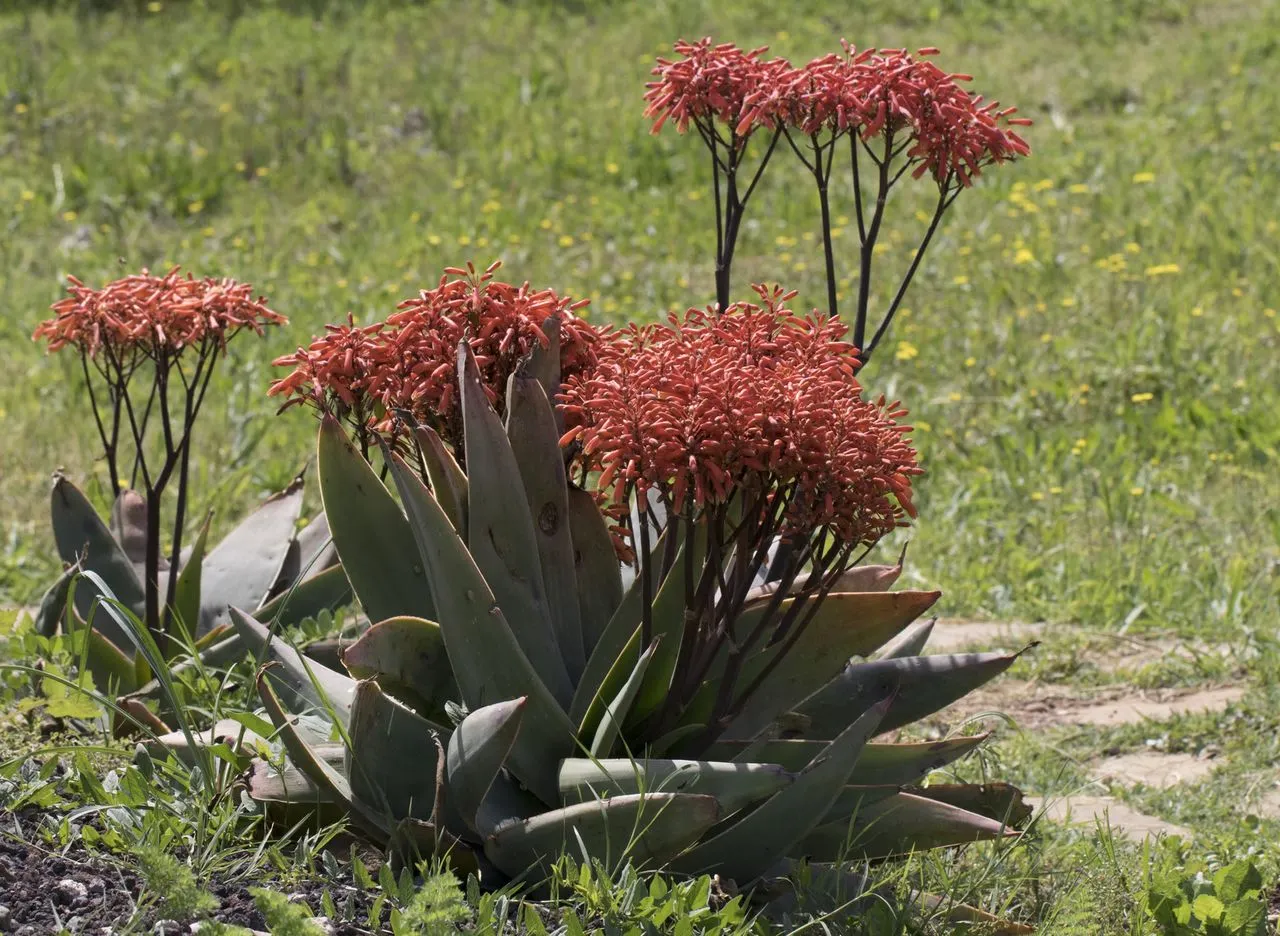
A. striata is stemless or short-stemmed and almost always solitary, slowly building one wide low rosette rather than a clump of offsets. The mature rosette typically measures 60 to 90 cm across, occasionally larger in old, well-sited garden plants. Leaves are broad, thick, and lanceolate, pale blue-green to slightly pinkish-grey under strong light, with faint longitudinal pale stripes running the length of the leaf surface. Those stripes are the source of the specific epithet, striata, and they are easier to see in raking light than under noon sun.
The diagnostic feature is the leaf margin. Run a finger along the edge of a healthy leaf and you find a smooth pink-red cartilaginous rim, not the row of triangular teeth that defines almost every other commonly cultivated aloe. This single character separates A. striata from most of the genus at a touch, and it is the reason the species is often recommended for gardens with children or pets. The plant still has a sharp dry terminal point, so it is not weapons-free, but the long lateral edges that catch shins and arms in most aloes are absent.
Lookalike confusion is common in the trade. Aloe maculata (the older, still-widespread name A. saponaria refers to the same plant) carries conspicuous H-shaped pale spots scattered on the leaf surface and unambiguous teeth on the margins. If you see spots and teeth, the plant is not A. striata. Aloe ferox grows much taller, with a single thick stem to several metres, and its leaves are armed with prominent dark reddish-brown teeth on both the margins and often the lower surface. Aloe arborescens is shrubby and many-stemmed, forms thickets, and again has clearly toothed margins. None of these three has the smooth pink rim of A. striata.
Flowering occurs in winter, June to August in the Eastern Cape, shifting later as you move into cooler positions or higher elevations. The inflorescence is a stout, repeatedly branched candelabra-style panicle, often 60 to 90 cm above the rosette, carrying short dense racemes of tubular coral-red to orange-red flowers. The flower colour gives the common name "coral aloe" and is the most reliable seasonal cue when the rosette itself looks ambiguous.
Cultivation
Light. Give full sun in the open garden once acclimated. Leaves take on a stronger pink-grey tone in bright light and revert to a flatter blue-green under shade. In a greenhouse, do not screen heavily; A. striata is not a forest understorey aloe and softens visibly under low light. Indoors, only a south-facing window or a grow light supplying at least 6 to 8 hours of bright direct light produces correct, hardened growth. Stretched plants from poorly lit shelves recover slowly even after a move outside.
Water. Treat it as a winter-grower in winter-rainfall climates and a more flexible plant in summer-rainfall regions. In a 20 to 25 cm terracotta pot with a mineral mix, water deeply when the top 4 to 5 cm of substrate has fully dried, then allow free drainage. During cool active growth from autumn into spring, that may mean every 10 to 14 days. In hot dry summers above 30°C, intervals stretch toward 3 to 4 weeks, and a quietly dormant rosette tolerates extended drought without damage. Wet roots in cool still air are far riskier than a long dry spell.
Substrate. A mineral-dominant mix of about 70 percent inorganic to 30 percent organic suits this species. A practical recipe is 40 percent pumice, 20 percent coarse perlite or lava grit, 10 percent quartz or granite grit at 3 to 6 mm, and 30 percent sifted loam-based compost. Drainage matters more than fertility. A. striata responds to a lean mix with slow, hardened growth and good leaf colour, while a peat-rich potting compost produces soft, pale leaves that mark and rot more easily.
Temperature. Frost tolerance is moderate. An established, bone-dry plant takes brief exposure to about -3°C, with reports of survival at -5°C in free-draining ground in California and inland Mediterranean gardens. Wet cold is a different problem; -1°C with damp roots causes more damage than -4°C with a dry root ball. Above 35°C, the rosette tightens and water demand rises slightly, but the species handles long hot summers without distress as long as night temperatures fall.
Container. Use a wide, shallow terracotta pot for collection plants, since the rosette is broad and the root system is not deep. A young plant fits a 14 to 18 cm pot; a mature rosette wants 25 to 35 cm of width and good drainage holes rather than depth. In open ground, plant on a slight mound or raised bed in heavier soils, since the species resents long winter waterlogging more than it resents lean conditions. The cultural basics here are those outlined in the beginner's guide; A. striata simply rewards stricter drainage than the genus average.
Feeding is light. A quarter-strength balanced cactus fertiliser once in late spring is enough for a potted plant in fresh substrate. In open ground, a top-dressing of coarse grit and an annual mulch of decomposed compost kept clear of the neck keep the plant moving without forcing it.
Propagation
Seed is the standard route and the only reliable one for this largely solitary species. Fresh seed germinates well at 18 to 24°C, sown thinly on the surface of a sterile mineral mix and covered with 1 to 2 mm of fine grit. Keep evenly moist with bright shade and constant air movement. Germination usually starts within 2 to 4 weeks, and a 60 to 75 percent germination rate from fresh, properly stored seed is realistic in a home setup. Seedlings reach 5 to 8 cm across in their first year under good conditions, and a flowering-sized rosette typically takes 4 to 6 years from sowing.
Hand-pollination is straightforward. The flowers are bird-pollinated in habitat, mainly by sunbirds, and a small brush moved between racemes on warm winter days produces viable seed in cultivation. If you grow A. striata next to A. ferox, A. africana, or A. maculata, expect hybrid seed unless you bag the inflorescence; the species crosses readily within the South African aloe complex, and natural hybrids in the wild are well documented.
Vegetative propagation is unreliable. Offsets are rare in true A. striata; a "coral aloe" producing many basal pups is most likely a hybrid with A. maculata or A. ferox. Cutting the rosette is not a normal method and tends to destroy the plant without producing useful clones. Tissue culture is used by some commercial nurseries, but home growers should stay with seed.
Notes
Hybrids in trade. Garden centres often sell hybrids labelled as A. striata that show partial spotting, intermediate teeth, or aggressive offsetting. If a "coral aloe" has any marginal teeth, however small, or H-shaped spots on the leaves, it is not pure A. striata. It is almost certainly an A. striata x A. maculata or A. striata x A. ferox cross. These hybrids are often vigorous and attractive, but they are not the species and should not be used as parent stock for seed.
Pet and child safety. The toothless margins make A. striata one of the safer aloes to plant where children and pets brush past it. Sap chemistry is similar to other aloes and should not be eaten, but the everyday risk of scratches and cuts that comes with most aloes does not apply on the leaf edges. The dry terminal spine is still sharp; site the rosette away from face height on raised beds.
Pests. Mealybug occasionally hides at the leaf bases of crowded plants. Aloe mite is more often reported on warmer-growing aloes such as A. arborescens, but any cauliflower-like distortion of new growth should be removed and the plant isolated immediately. Sun-grown plants in airy conditions stay largely pest-free.
See also
- The Complete Aloe Guide: genus-level cultivation, taxonomy, and how toothless-margin species fit alongside the toothed majority.
- Beginner's Guide to Succulents: light, water, and substrate fundamentals to settle before reading species-specific notes.
- Aloe cameronii — another landscape aloe with strong seasonal colour, contrasted in the identification section.
Frequently Asked Questions
What is the main identification point?
The Identification section separates Aloe striata by plant habit, leaf form, marginal teeth or surface markings, flowers, and lookalikes named in the article.
How should this aloe be watered?
Follow the Cultivation section rather than a fixed calendar. The article gives drying depth, seasonal growth rhythm, and the wet-cold risk for this plant.
How is it propagated?
Use the Propagation section. The article states whether offsets, stem cuttings, or seed are practical, and notes that single-leaf cuttings do not work for aloes.
What should buyers watch for?
Check the Notes and lookalike sections. The article flags trade confusion, hybrid material, or conservation sourcing where those issues apply.